
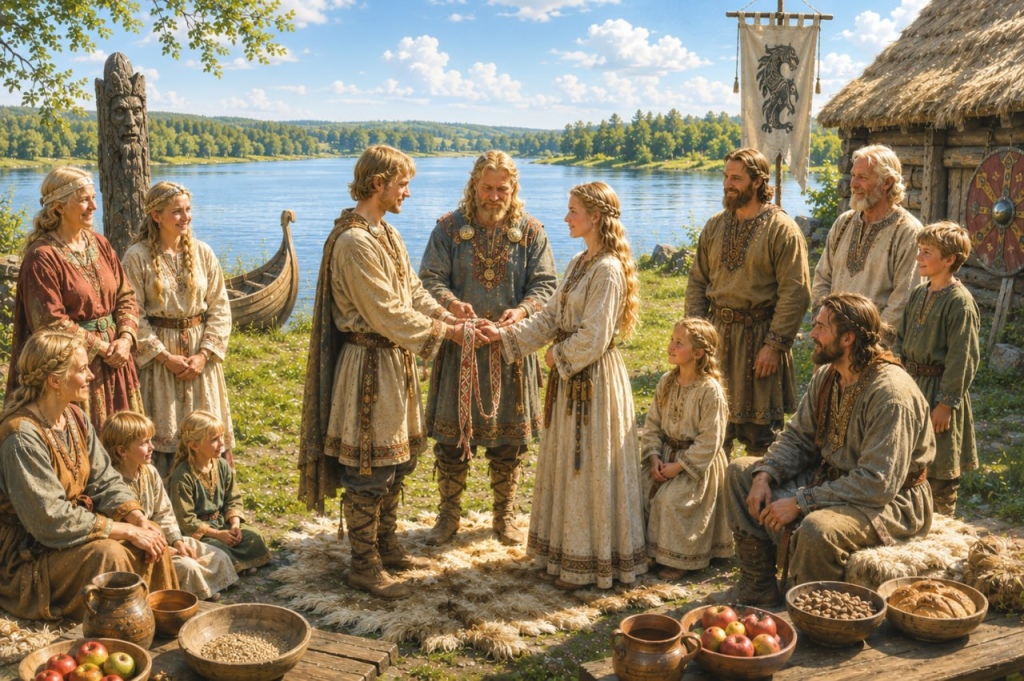
A marriage is more stable when compatibility is established due to shared cultural background and values.
In a tribal context, we Europeans, though not engaging in close-cousin marriages, would have been living in tight-knit clan groups whereby clan members would interact with members of the other allied clans at tribe gatherings and other occasions.
It would have been like a “small town” type of environment where if everyone doesn’t know everyone, you can place people by asking who their kin are.
– Tribalism & Kindred by CE
For myself, I accept the view that the peoples of Germany have never contaminated themselves by intermarriage with foreigners but remain of pure blood, distinct and unlike any other nation.
Their marriage code, however, is strict, and no feature of their morality deserves higher praise. They are almost unique among barbarians in being content with one wife apiece – all of them, that is, except a very few who take more than one wife not to satisfy their desires but because their exalted rank brings them many pressing offers of matrimonial alliances. The dowry is brought by husband to wife, not by wife to husband. Parents and kinsmen attend and approve the gifts – not gifts chosen to please a woman’s fancy or gaily deck a young bride, but oxen, a horse with its bridle, or a shield, spear, and sword. In consideration of such gifts a man gets his wife, and she in her turn brings a present of arms to her husband. This interchange of gifts typifies for them the most sacred bond of union, sanctified by mystic rites under the favour of the presiding deities of wedlock. The woman must not think that she is excluded from aspirations to manly virtues or exempt from the hazards of warfare. That is why she is reminded, in the very ceremonies which bless her marriage at its outset, that she enters her husband’s home to be the partner of his toils and perils, that both in peace and in war she is to share his sufferings and adventures. That is the meaning of the team of oxen, the horse ready for its rider, and the gift of arms. On these terms she must live her life and bear her children. She is receiving something that she must hand over intact and undepreciated to her children, something for her sons’ wives to receive in their turn and pass on to her grandchildren.
By such means is the virtue of their women protected, and they live uncorrupted by the temptations of public shows or the excitements of banquets. Clandestine love letters are unknown to men and women alike. Adultery is extremely rare, considering the size of the population. A guilty wife is summarily punished by her husband. He cuts off her hair, strips her naked, and in the presence of kinsmen turns her out of his house and flogs her all through the village. They have in tact no mercy on a wife who prostitutes her chastity. Neither beauty, youth, nor wealth can find her another husband. No one in Germany finds vice amusing, or calls it ‘up-to-date’ to seduce and be seduced. Even better is the practice of those states in which only virgins may marry, so that a woman who has once been a bride has finished with all such hopes and aspirations. She takes one husband, just as she has one body and one life. Her thoughts must not stray beyond him or her desires survive him. And even that husband she must love not for himself, but as an embodiment of the married state. To restrict the number of children, or to kill any of those born after the heir, is considered wicked. Good morality is more effective in Germany than good laws are elsewhere.
Germania by Cornelius Tacitus
Think we could learn a thing or two from these Germanic barbarians? They were practicing The Old Ways.
7 responses to “Marriage”
A tradition of community support and community morals creates the basis for a successful society.
Without good morals, laws are less than useless.
Your above-described marriage with but a few modifications would sound almost exactly like the Amish Wedding I was honored to be a guest at last year.
Speaking of old ways:
SNIP So, while the tribes themselves were part of a long-term cultural and linguistic development, the earliest clear evidence of Germanic-speaking peoples dates to about 500 BCE, with their homeland in southern Scandinavia and northern Germany.
SNIP Babylon first appears in the Bible as “Babel” in Genesis 11, in the story of the Tower of Babel
SNIP Babylon was established around the 18th century BC, specifically under the reign of the Amorite king Hammurabi, who made it a major city.
So, I suggest that the Bible or at least parts of it was a bit older than the First Establishment of the Germanic tribes. Most of the newer stuff is based upon the foundations of the Old Agreement between God and Man aka Old Testament.
Cornelius Tacitus an interesting historian spoke of the
Crucifixion of Jesus.
https://en.wikipedia.org/wiki/Tacitus_on_Jesus
Old ways if it means GOOD morals isn’t just German, it’s the basis of a successful society.
Thus, my often comment I want Good Neighbors and given good morals other differences can be worked around.
The Old Ways is specific to pre-Christian Germanic folk.
Enjoying a deeper dive into the history of the pre-Christian Germanic folk.
Seems from a casual study as I don’t have GROK to help that most of the information of this culture was from the primary source of Germania written by Cornelius Tacitus. Even the later Medieval texts annotate Tacitus as source. And likewise, more current writing annotates Tacitus and Medieval texts.
Archeology of that era shows no real sign of a written language as skalds and oral tradition was all they had.
Research on this book shows that Cornelius Tacitus never went to the Germanic tribe’s area and all his writing was from reports of travelers who visited that area.
https://en.wikipedia.org/wiki/Germania_%28book%29
SNIP Tacitus himself is thought to have never travelled to Germania, thus his information is second-hand at best.[5] Ronald Syme supposed that Tacitus closely copied the lost Bella Germaniae of Pliny the Elder, since the Germania is in some places outdated.
Seems his depiction of the Noble Barbarian might have been a reaction to the corruption of Rome in his time as Tactitus was born during Nero’s reign and the ongoing series of corrupt Emperors during his life.
If it wasn’t for the adultery punishment mentioned they’d seem far more noble and wise than the “civilized peoples” of Roman times.
BTW if the woman was punished, what happened to the man involved?
Do like the artwork, romantic style. As they didn’t have bathhouses nor chimneys, they are amazingly clean despite soot from fires.
Wonder what the root word of romantic is.
You trust Wikipedia? We weren’t allowed to use it as a source in college in 2009 or when I taught at the military academy 6 years ago.
No, I actually did some research well past Wikipedia.
I was quite sure of your response, so I looked around to various well documented documents.
So perhaps you have better documents and links I should check out, Roth?
Well, sorry. You only mentioned Wiki. What else?
Better documents? The Poetic Edda, Voluspo, Havamol, many Sagas, Germanic Theology, and Tacitus, as mentioned. No links. No AI. Books. One has to read books.
At the end of the day, neither you nor I were there, so you just believe what you will. I’m not going to argue with you. You seem to miss the point of the post. That being that our ancestors had stronger families and clans than we do today, and that we could and should learn from that.
Oddly if you read my first post here, you’d have been able to agree with my saying much the same thing.
SNIP A tradition of community support and community morals creates the basis for a successful society.
Without good morals, laws are less than useless.
Your above-described marriage with but a few modifications would sound almost exactly like the Amish Wedding I was honored to be a guest at last year.
And SNIP Old ways if it means GOOD morals isn’t just German, it’s the basis of a successful society.
Thus, my often comment I want Good Neighbors and given good morals other differences can be worked around.
And Roth I still want to know what happens to the MAN involved with adultery.
I’m sure with your knowledge of the Old Ways you should know.
Your posting was a mirror image of the Wikipedia article I linked.