
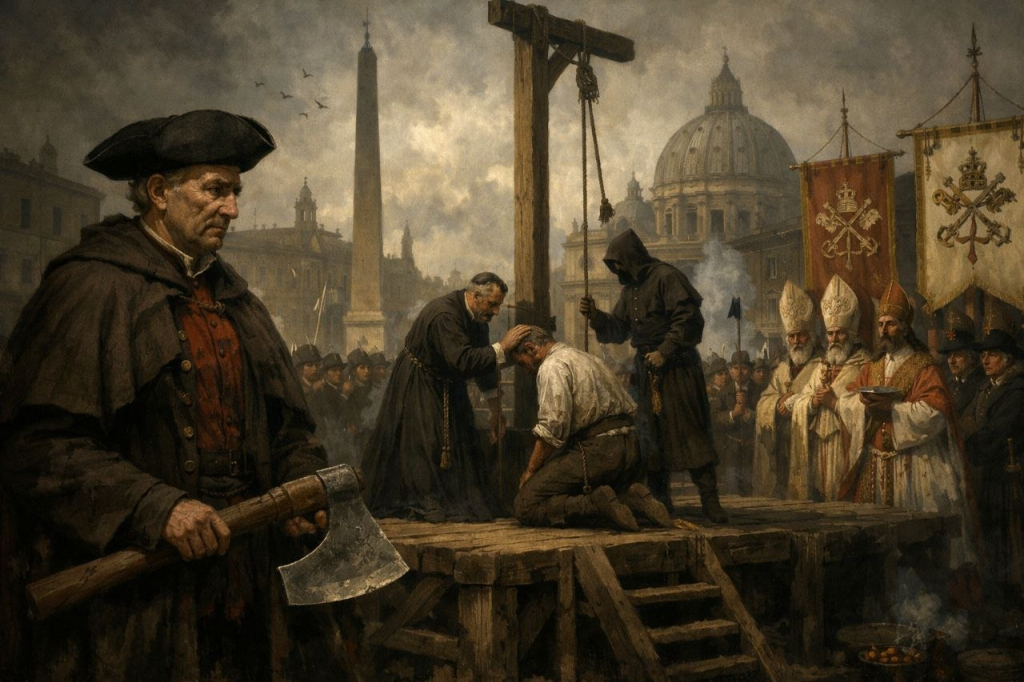
From Huter der Irminsul
The figure of Giovanni Battista Bugatti is not a macabre historical curiosity—he is a case indictment. 514 executions in the name of a state that saw itself as a moral authority. 514 lives ended under the banner of order, justice, and—particularly cynically—Christian mercy.
In the Papal States, violence was not an accident. It was institutionalized. Publicly staged in squares like the Piazza del Popolo, so that everyone could see what happens when you question the “divine order.” This was not just criminal justice—it was a demonstration of power.
And this is precisely where it becomes uncomfortable: The Church was not just a religious authority; it was political power. And political power defends itself. Often with the harshest means. Anyone who resisted, anyone who threatened the existing order—whether for criminal, political, or religious reasons—could be declared an enemy. Not because God demanded it, but because institutions want to maintain control.
The Church was not only a religious authority, it was a political power. And political power defends itself. Not infrequently with the harshest means. The oft-repeated story that people were executed en masse “simply because of their faith” is an oversimplification—but it does contain a kernel of truth: In a system that claims to possess the sole truth, dissent quickly becomes a threat. And where dissent becomes a threat, the path to violence is short.
Bugatti himself? Not a sadistic monster. That’s precisely what makes him so disturbing. He was dutiful, routine, almost banal. A man who got up in the morning and did what the state demanded of him—while this state invoked divine legitimacy.
That is the real scandal: Not the executioner, but the structure behind him. An institution that preaches charity while simultaneously upholding a system in which killing is part of the order.
When morality and power become inextricably intertwined, criticism becomes a threat—and violence becomes justification.
The story of Giovanni Battista Bugatti is not a distant echo from a barbaric past. It is a warning. 514 executions in the Papal States—carried out not in chaos, but in the name of order, morality, and divine truth.
This is the crux of the problem: violence that considers itself just.
This pattern can be seen throughout history. In the Spanish Inquisition, where “pure faith” became the justification for persecution. In the case of Giordano Bruno, who was burned at the stake because thinking was dangerous. In England under Henry VIII and Elizabeth I, where religion became a political weapon. And in the witch hunts of the Holy Roman Empire, where fear, faith, and power combined to form a deadly mixture.
The same formula is repeated time and again: An institution claims absolute truth → dissent becomes a threat → violence becomes a “necessity.”
Bugatti was no outlier. He was the logical consequence of a system that never had to question itself.
And this is precisely where the present begins.
Because anyone who believes these mechanisms have disappeared overlooks how little has fundamentally changed. Even today, institutions—religious and political alike—appeal to moral superiority. Even today, people are marginalized, persecuted, or silenced because they don’t fit into the prevailing worldview. Perhaps no longer in public squares with axes. But with laws, with social pressure, with digital ostracism, with violence on the fringes of society.
The methods change. The logic remains.
The truly dangerous element is not the fanatic. It is the system that legitimizes fanaticism. It is the structure that says: We are right—and therefore we are justified in acting.
That is precisely where the justification of injustice begins.
When an institution—whether church, state, or ideology—places itself above criticism, it becomes dangerous. When it considers itself infallible, it becomes blind. And when it begins to impose its “truth,” it becomes brutal.
The Bugatti story is therefore not a reason for mere outrage at the past. It is a touchstone for the present.
The real question is not: How could that have happened back then?
But rather:
Where is it happening today – only in a different form, with different means, but with the same conviction of being right?
3 responses to “Where the Justification of Injustice Begins”
Waco,April 19/1993……,never forget.
Will add Ruby Ridge 92’.
The list of abuses by those in government enacting FORCE in pursuit of power is longer than that of their lies.
I thibk Bob Dylan did a great job of capturing this dynamic (albeit a little different one) with his tune “With God on our side”. It implies the same idea to justify violence.