
From Huter der Irminsul:
Who defines the meaning of a symbol?
A symbol possesses no inherent morality of its own; it is neither sacred nor demonic. It is human beings who assign it meaning—and that meaning can shift over the course of history.
For this very reason, it is worth looking beneath the surface. Much of what we take for granted today is the result of centuries of evolution, cultural encounters, and religious reinterpretations.
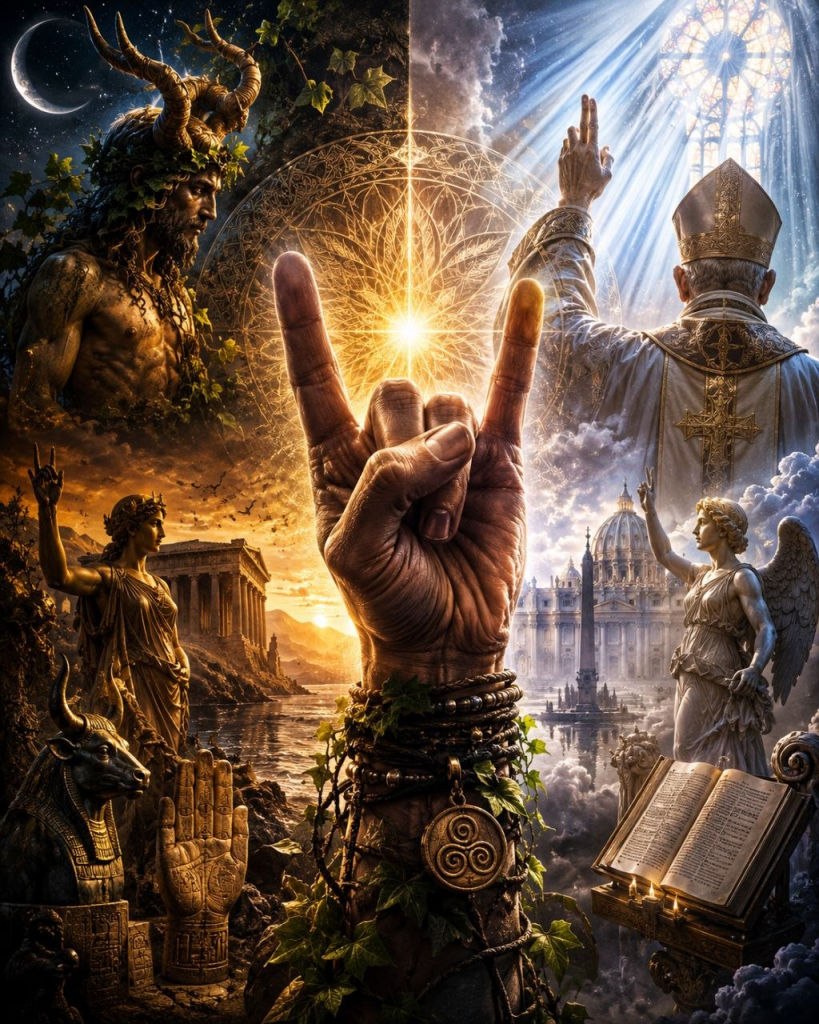
The so-called *mano cornuta*—the “horned hand”—is a striking example of this. Long before it became associated with rock or heavy metal music, it served as a protective sign in parts of the Mediterranean region. It was intended to ward off the “evil eye,” keep negative energies at bay, and shield the bearer from envy and ill will. In many ancient cultures, horns did not symbolize evil but rather vitality, fertility, protection, and the power of nature. Deities such as Pan or Cernunnos embodied this original symbolism.
However, the spread of Christianity altered the understanding of many pre-Christian images. Numerous sacred sites were Christianized, ancient festivals were given new names, and existing symbols were either integrated into the Christian faith or reinterpreted. At the same time, certain signs and deities from earlier religions became increasingly associated with evil. Historians view this as a complex process of cultural and religious transformation; within spiritual traditions, it is often understood as a deliberate reinterpretation of older symbolic worlds.
The papal gesture of blessing, too, did not emerge in a historical vacuum. The raised hand—signifying blessing, authority, or a divine connection—was already known in the great civilizations of Egypt, Mesopotamia, Greece, and Rome. Christianity imbued this gesture with a new theological significance, making it an expression of its own faith.
This historical context demonstrates that symbols rarely emerge entirely anew. They travel through time, being adopted, adapted, and endowed with new meanings. This is no secret; rather, it is a normal part of cultural history.
Yet, even today, we see people hastily labeling the rock ‘n’ roll sign—or the *mano cornuta*—as a “sign of Satan.” Often, this stems not from personal research, but from a specific interpretation passed down through generations. In the process, it is easy to forget that the gesture’s original meaning in many regions was quite the opposite: protection and warding off evil.
Schools and society inevitably convey only a portion of history. No single course of study can fully cover every mythology, symbolic language, or cultural evolution. That is why education does not end with a diploma; often, it truly begins when people start asking questions and comparing different sources.
Spiritual maturity does not mean believing everything. Nor does it mean hastily condemning everything. It begins where curiosity outweighs fear and where understanding matters more than prejudice.
Perhaps this is the greatest lesson of ancient symbols: not every sign is what it seems. Sometimes its history has been forgotten. Sometimes it has been deliberately retold. And sometimes, a look into the past reveals that what is perceived as dark was once understood as light, protection, and blessing.
Those who truly seek the truth should neither believe blindly nor demonize hastily. They should have the courage to explore origins, consider diverse perspectives, and form their own judgments. For insight arises not from a fear of symbols, but from the desire to understand their history.
“Truth fears no questions. Only dogmas demand blind faith.”
A symbol is not merely what others have made of it over the centuries—it is also what its history reveals. Those who seek its origins often discover that protection turned into demonization, and remembrance into oblivion.
Perhaps true spirituality lies not in believing everything or rejecting everything. Perhaps it lies in having the courage to see, feel, and realize things for oneself. For wisdom begins where fear ends—and where the heart is ready to look beyond the veils of history.
5 responses to “Symbols”
Words and customs once acceptable have also changed with time.
Once a Faggot was a stick of firewood.
A fag was slang for a cigarette.
Both today seem to have quite different meanings and social responses around the BBQ grill.
Fancy words from a well-spoken person could attempt to teach from the history of their Greek forefathers that love for little boys was a warrior’s thing and thus “good”.
It did come from back in the old times so must have current value, yes?
Hebrews 13:9
Do not be carried away by all kinds of strange teachings, for it is good for the heart to be strengthened by grace and not by foods of no value to those devoted to them.
Many of of our old symbols have been corrupted to erase our understanding of the past and today are considered verboten. The fylfot, the wolfsangel and ēþel to name a few, the rainbow is still permissive however it’s symbolism has certainly changed.
The evilness of the devilhorns is not in question, just who might have shown those supposed innocenti of old times (i.e. practicers of witchcraft and worse). Perhaps to round things out we should find some hand signs the mayans used on the blood alter to see if we can co-opt them, as well, if not considered as cultural appropriation.
“In many ancient cultures, horns did not symbolize evil but rather vitality, fertility, protection, and the power of nature. Deities such as P̲a̲n̲ or C̲e̲r̲n̲u̲n̲n̲o̲s̲ embodied this original symbolism.”
Referring to pagan idols as “deities” shows the allegiance is not to our CREATOR, who warned against associating with familiar spirits, demons, necromancers, and those eager to throw shade on the everlasting truth.
Now who needs to put in more research, the author or the poster?
With all due respect, I think you missed the point of the post. You’re entitled to your beliefs, but can you disprove “it served as a protective sign in parts of the Mediterranean region. It was intended to ward off the “evil eye,” keep negative energies at bay, and shield the bearer from envy and ill will. In many ancient cultures, horns did not symbolize evil but rather vitality, fertility, protection, and the power of nature. Deities such as Pan or Cernunnos embodied this original symbolism.”?
Read this again, “A symbol possesses no inherent morality of its own; it is neither sacred nor demonic. It is human beings who assign it meaning—and that meaning can shift over the course of history.”
… and, “Those who truly seek the truth should neither believe blindly nor demonize hastily. They should have the courage to explore origins, consider diverse perspectives, and form their own judgments.”
I am so glad things such as this don’t occupy space in my world. I work a 40-hour week to pay my mortgage and farm my land to grow my food. The meaning of ancient hand gestures and their modern equivalent seem pretty petty and insignificant in the grand scheme of things. I’ve finished my morning coffee; it’s time to go pull some weeds.