
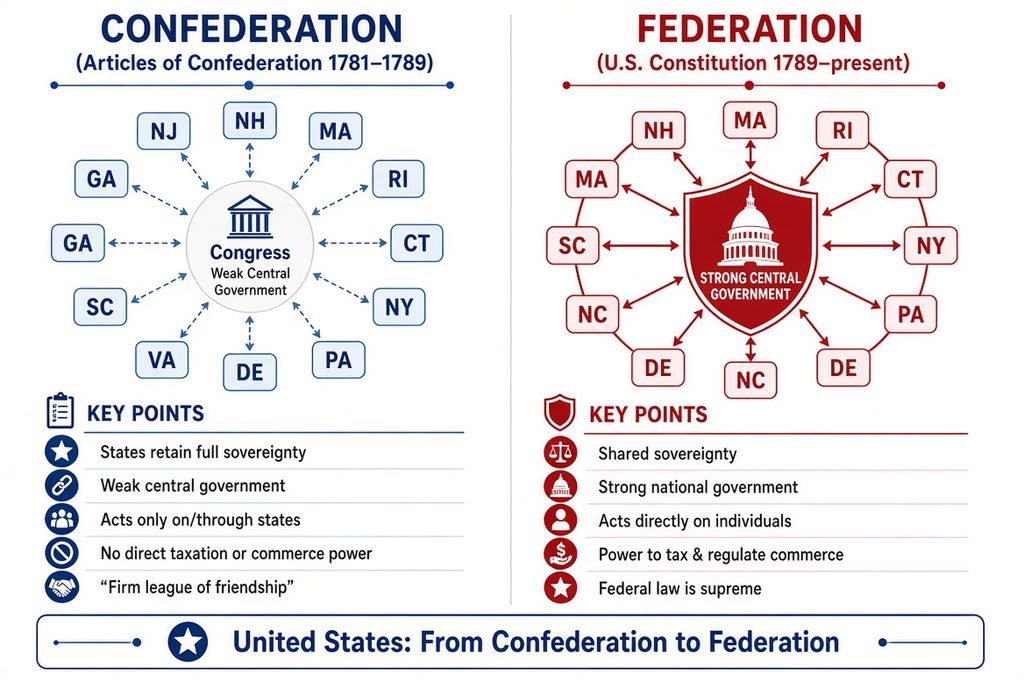
I asked Grok “What lessons were learned from the Articles of Confederation and Perpetual Union that were incorporated into the Constitution”?
Grok:
The Articles of Confederation and Perpetual Union (ratified 1781) created a deliberately weak central government—a “firm league of friendship” among sovereign states—reflecting postwar fears of concentrated power. Experience under this system exposed critical flaws that nearly paralyzed the young nation economically, diplomatically, and in terms of internal order (most dramatically illustrated by Shays’ Rebellion in 1786–87). The Framers of the 1787 Constitution deliberately corrected these defects while retaining a federal structure that still protected state authority in many areas.
…
In short, the Constitution replaced a confederation of sovereign states with a compound federal republic possessing sufficient energy and authority to govern a continental nation, while still dispersing power through separation of powers, checks and balances, federalism, and a written bill of rights (added shortly afterward). The experience under the Articles demonstrated that excessive fear of central authority could be as dangerous to liberty and prosperity as excessive centralization itself.
~~~~~~~~~~~~~~~~~~~~~
I then asked it for the differences between a confederation vs a federation:
The distinction between the two terms was sharpened in American political language precisely because of the shift from the Articles (confederation) to the Constitution (federation). The same contrast later appeared during the Civil War, when the seceding Southern states formed the Confederate States of America in deliberate opposition to the Federal Union.
In short: a confederation prioritizes state autonomy with a loose central bond; a federation creates a stronger national government while still preserving meaningful state powers under a constitutional framework.
~~~~~~~~~~~~~~~~~~~~~
Your thought exercise: Did the founding fathers abandon their distrust of the government when writing the proposed Constitution or did they limit the power of the new Federal government as a solution to the problems of the AOC?
This will be discussed at the PATCON. What went wrong with the limitation of the Constitution over time. In other words, how did the box get opened and the State’s power become eroded?
6 responses to “Lessons Learned”
The demise of freedom began with the creation of the Constitution. Those who think that a Constitutional Convention needs to happen to “fix” what’s wrong ignore the truth that the same kinds of folks who created the central power structure under the Constitution will likely do EVEN WORSE if another is held. Complaints about the Articles are promoted by those who value central power and what it can do FOR THEM, rather than what freedom and decentralized power does for everyone.
The mistake was in not limiting the authority of the convention to just tweaking the AoC. The Anti Federalists were right. The current constitution, even before the tyrant Lincoln destroyed the Republic, was the result of a coup.
I believe you are absolutely correct. The anti-Federalist were correct.
[…] https://appalachianrenegade.com/2026/08/21/lessons-learned/ (RTWT) […]
Grok chalks both up to generating governental errors. And it’s true they both have them.
But the the errors in the Articles of Confederation resulted in inefficiency.
Whereas the errors in the implementation of the Federation resulted in tyranny.
Just kicking the dirt and saying there’s problems with both glosses that undesirable reality over.
Lincoln the Tyrant was effectively unbound once the Southern, seceding States withdrew their representatives from the governmental structures.
On his watch, the already wounded and compromised republican governance structure was then fully done down with the aid of many foreign mercenaries, chiefly Irish, and also Germans. Many of these Germans were refugees from the losing revolutions of 1848, and they were revolutionary leftists at heart, friendly to centralized state power despite their “professed” love for Liberty. Their idea of Liberty was not one of empowerment of individuals, or of the constituent States of the republic, but rather their enforced acceptance of only policies and laws meted out by a centralized “federal state”, and not at all the envisioned freedom of the individual “States” to set their own courses in any and all powers that were not explicitly enumerated as belonging to the federal government by the Constitution, something that was clearly to be seen in the Ninth and Tenth Amendments.
After the depredations of Lincoln, and those subsequently introduced by the Radical Republicans during “Reconstruction”, the “Republic” of the Constitution was a dead letter, and thence still further to be aggressed against in later legislation, and particularly by Amendments, the consent to which held hostage the former Confederate States to be admitted to their residual “rights” as States under the new, mutilated regime. After that, it was merely a mopping up operation for the centralizing federalists to vitiate the Ninth and Tenth Amendments, and to stamp out any calls for their continued relevance.