
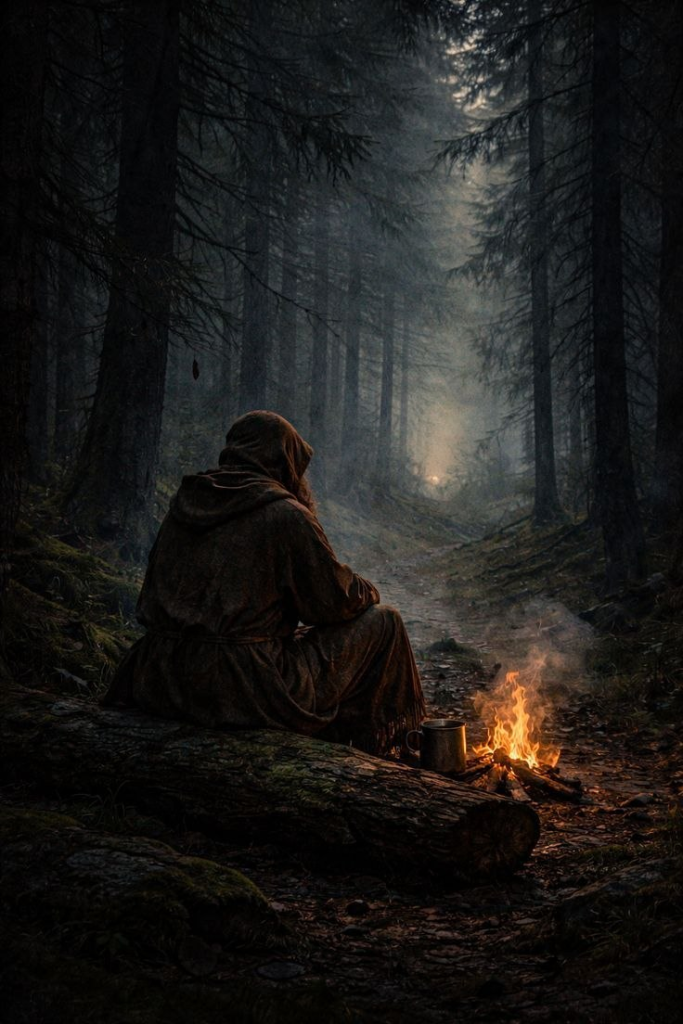
From Huter der Irminsul
People are often not afraid of evil itself—but rather of what they cannot control.
Fear makes people predictable. Those who are afraid seek security. And those who believe they have control are loath to give it up. For a loss of control implies uncertainty—and for many, uncertainty spells fear.
Thus, a dangerous cycle emerges:
Fear leads to a desire for control.
Control leads to mistrust.
Mistrust leads to isolation.
And isolation, in turn, leads back to fear.
The situation becomes particularly dangerous when people begin to want to destroy the very thing they fear.
Perhaps not because the unknown poses an actual threat—but because its mere existence challenges the established order.
And this is precisely where one of the most important messages of science fiction may lie:
The alien—the unknown—need not be our enemy. It is our fear of it that might turn it into one.
Perhaps, then, we will one day face a crucial choice: Do we fight the unknown out of fear—or do we summon the courage to understand it?
For true strength may not lie in the ability to control everything.
True strength lies in the ability to let go of control without losing oneself.
Perhaps this is exactly what humanity must learn if it truly wishes to transcend its limitations.
Not to control everything.
Not to fight everything.
Not to destroy everything we do not understand.
But rather to find the courage, together, to face the unknown.
For perhaps humanity’s greatest enemy is not what exists outside of us.
Perhaps it is the fear within us.
What if the thing we fear has not come to destroy us, but to show us who we truly are?
“Overcome your fear of what you cannot control.” For if we manage that, everything changes: mistrust can turn into curiosity, separation into cooperation, and fear perhaps even into insight.
And perhaps that is precisely where true development begins—not when we understand everything, but when we have the courage not to understand something and yet not immediately want to destroy it.
2 responses to “The Cycle of Fear”
The question which needs to be asked is whether it is indeed fear or something else.
F-E-A-R has always had 2 meanings (acronyms):
Forget Everything And Run
or
Face Everything And Rise.
Always your choice
To your multiple points, how many folks really confront what they are actually afraid of and tackle it as a challenge, IF it’s something within their power to change? I believe fear is more related to the unknown and NOT what is in front of your eyes. Just my nickel’s worth on a Friday evening.
Our Lord reminds us not to fear anyone, as fear can lead to doubt and disbelief. By keeping our eyes on Christ, he will guide us through life’s storms, just as scripture promises. In tough situations, the unknown can feel overwhelming, but fear only opens the door to negative thoughts and harmful emotions that cloud what Christ has taught us—and that’s how the devil uses fear to slip in.