
Roth Note: I ran across this today and found it interesting. I have not independently verified the content.
Did you know that the Vatican was named after “Vatika,” the goddess of the underworld?
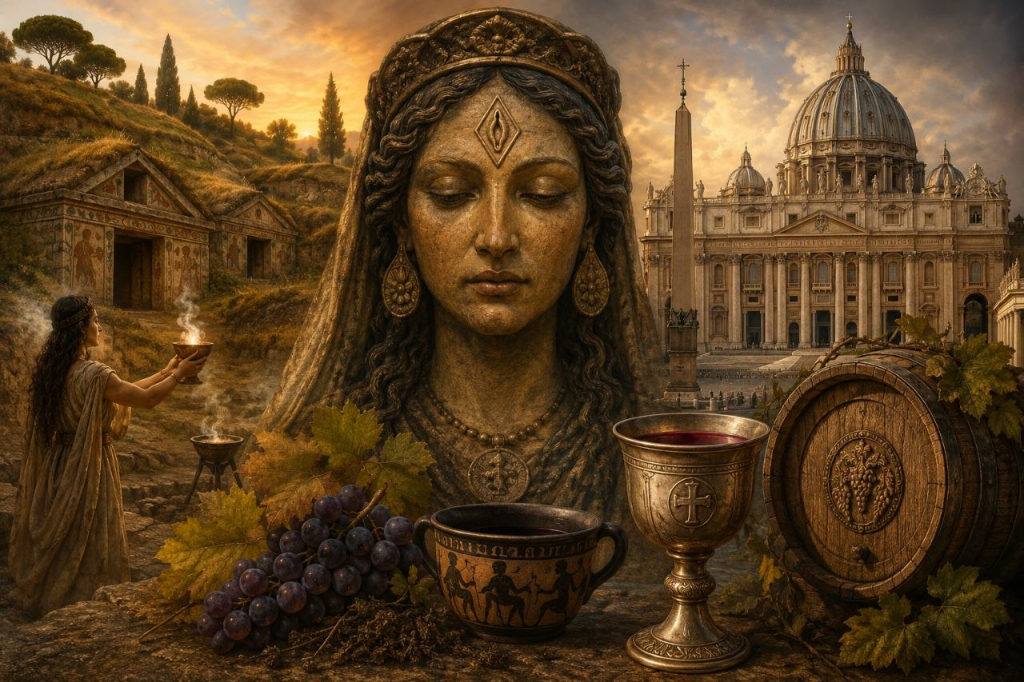
Vatica is the archaic Etruscan name of a goddess associated with death and the underworld. She is likely a specific manifestation of the Etruscan goddess of death and the underworld, Vanth. While Vanth’s domain extended across a vast area of the Etruscan realm, Vatica’s sphere was presumably the large burial ground on the hillside of the very area where the Vatican stands today. It is assumed that she was the spiritual guardian of the tombs located there.
In fact, the name “Vatican” is a true mystery. It has no connection to the Bible, the Greek language, or Latin. Like many other Christian traditions and customs, the name we associate with the center of the Catholic Church most likely has “pagan” origins, tracing back to the Etruscan language and, perhaps, to a goddess. The Etruscans did not bury their dead within their city walls. Instead, they built cemeteries outside their settlements—such as the large burial ground on the hillside outside an ancient city in the region that would later become Rome. This necropolis, and all those buried there, may well have been under the special protection of the goddess Vatika.
The Vatican and the Vagina
Vaticanus—the term for the burial hill and, by extension, the name of the goddess of death and the underworld—evolved over time into Vaginatus. This brings us to the vagina—not an unusual association for a goddess of death, given that many cultures and spiritual traditions held the view that, upon death, humans return to the womb of the Great Mother, the entrance to which is, of course, the vagina. The Altes Museum in Berlin houses a ceramic mask of an Etruscan goddess—possibly Vatica. This finely crafted ceramic piece may have served as a door ornament or a tomb decoration. A striking feature is the diamond-shaped symbol on her forehead, which is interpreted as a vulva. Intriguingly, the term “tika” also refers to the various auspicious marks Hindus often wear on their foreheads, directly over the third eye. Especially among women, these marks often take the shape of the paisley pattern—itself a symbol of the vulva. Such tikas are believed, among other things, to foster powerful visions; they are also associated with prophetic dreams, including those experienced during near-death episodes. It is also interesting to note that some Hindu monasteries are known as Vatika.
A Bitter Grape Variety and Prophetic Visions
Vatika also lent her name to a bitter grape variety that grew on the Vatican Hill. Farmers used it to produce a cheap wine; when consumed alongside an herb of the same name, it induced hallucinations. It is quite possible that the underworld goddess’s oracular priestesses on this hill experienced “prophetic visions” under the influence of these substances. In any case, it was this specific quality that led to the word’s adoption into Latin. The Latin verb vaticinor means “I predict” or “I prophesy.” Since the Church Fathers preferred to keep the original Etruscan linguistic root—which points to a goddess—under wraps, reference is instead made to a later transformation of the word, claiming that the name “Vatican” derives from vaticiniis ferendis (meaning “making predictions”). One can only speculate as to whether the Pope or his staff derive inspiration from the influence of Vatican wine. It is interesting to note, however, that the English word “vat” refers to a large tub or barrel used for storing liquids (such as wine). This raises the question of whether the chalice containing the sacramental wine in St. Peter’s Basilica is filled with hallucinogenic Vatika wine.
Centuries after serving as a necropolis, this hill in Rome became the site of a circus whose main attraction was the stoning of people.
According to legend, Saint Peter was executed there—crucified upside down—and buried not far away. Emperor Constantine established a shrine on the site when it was already known as Vatican Hill. Some centuries later, the Papal Palace was built there; thus, the Vatican—a word of Etruscan origin associated with a pagan goddess—gives its name to the heart of the Church.
©Artedea.net
10 responses to “Vatica – Etruscan Goddess of Death and the Underworld”
“a word of Etruscan origin associated with a pagan goddess—gives its name to the heart of the Church.”
The “heart of the Church” you reference is that of the western Church.
There was a schism that came to a head in AD 1054. The western Church split from the Eastern Church and went its own way.
The western Church DOES NOT speak for the eastern Church.
Good clarification.
The Roman Catholic Church is Roman paganism, not Christianity. And yes it’s epicenter is aptly named.
So now we are anti Catholics?
Asking for myself not a friend.
Does make me wonder how this sort of articles is supposed to build unity between patriots on this site.
Bad enough you have to be white to be in the “club “.
Really odd article.
Good point. This whole ongoing series has the foul odor of divide and conquer. I walked away from Mother Church after Vatican II. I still consider myself a baptized and confirmed Catholic even though I do not attend Mass. And the documentation of the Catholic Charities (along with the Lutherans and others) who facilitated the Biden Invasion has closed up my wallet, except for the support of local pro-life groups.
However, I refuse to channel Odin, Thor, Druids, May Poles, nature worship or some of the other essays which have been allowed to be presented on this site. Paganism is not my thing. And, according to the Good Book, all accounts will be settled in HIS own time.
I don’t really care if one follows The Old Ways, is a Christian Protestant, or a Christian Catholic so long as they put the Folk first and America second. One’s religious preference should be secondary to protecting our people, our country, and defeating evil. Before anyone’s head explodes, I understand that some put their religion above all else. Fine for them, but doesn’t help protect the Folk or restore America.
As for evil, there are those who claim to be Pagans, Catholics, and Protestants who do evil. Plenty of blame to go around. There are also plenty of all those persuasions that want to protect the white race, America as it was founded, and fight evil. The latter group, I hope, is the totality of the audience here.
And as for this post, refer to the Roth Note. I don’t use AI. If something is important to me I’ll dive into old books, archival information, etc. I just found this topic interesting, as I mentioned.
Grok:
That claim is a modern myth without support from ancient sources or scholarly consensus.
The Vatican (as in Vatican City and the papal complex) takes its name from the Mons Vaticanus (Vatican Hill) on the west bank of the Tiber in Rome, or more broadly from the Ager Vaticanus (the surrounding territory). This name predates Christianity; the area later became associated with St. Peter’s martyrdom and the basilica built there.
I wonder after reading the comments above, how many folks read your Grok “It’s a modern myth” and say:
Oh, MY Bad it’s not just Roman Paganism. Just a modern myth.
“You can sway a thousand men by appealing to their prejudices quicker than you can convince one man by logic.” — Robert A. Heinlein
Grok being “logic”.
Since we are doing old stuff:
Virgil’s Aeneid (Book IV, line 174), where he wrote Fama, malum qua non aliud velocius ullum — “Rumour, than whom no other evil thing is faster”
The base set for the more common saying:
“A Lie Goes Around the World Before the Truth Gets Its Boots On”
I still see zero team or community building in Roth’s article. Maybe I too stupid to know the subtle reasons.
FWIW ChatGPT had essentially the same answer.
God / Family / Country
Gemini:
There is no single universally “correct” expression, as the sequence depends entirely on personal, religious, or organizational values. However, “God, Family, Country” (in that specific hierarchical order) is widely used by traditional, conservative, and faith-based groups to emphasize spiritual and domestic priorities over nationalism