From Huter der Irminsul
Roth Note: Primitive people thinking they can dance and make it rain? There’s always more to the story …
Since the dawn of human history, humanity has turned its gaze toward the heavens. In the clouds, people saw far more than fleeting phenomena—they were bearers of hope, life, and renewal. Rain signified fertility, harvest, and survival. When it failed to fall, not only the earth suffered, but often the community as well. From this deep connection to the rhythms of nature, rituals emerged intended to link humanity with heaven and earth. One of the most striking of these is the rain dance.
In the shamanic worldview, nature is not a lifeless space but a living whole. Mountains, rivers, forests, animals, and winds possess their own spirits and are interconnected. Humans are not masters of this world, but part of its great cycle. Shamans were regarded as intermediaries between the visible and invisible realms. Through drumming, chanting, dancing, or trance, they sought—according to tradition—to align themselves with the forces of nature; not to dominate them, but to live in harmony with them.
It was against this backdrop that the rain dance acquired its profound significance.
It was never merely a plea for rain; it was an expression of trust, gratitude, and connection. With every movement, people reminded themselves that all life is interdependent and that giving and receiving are part of the same cycle.
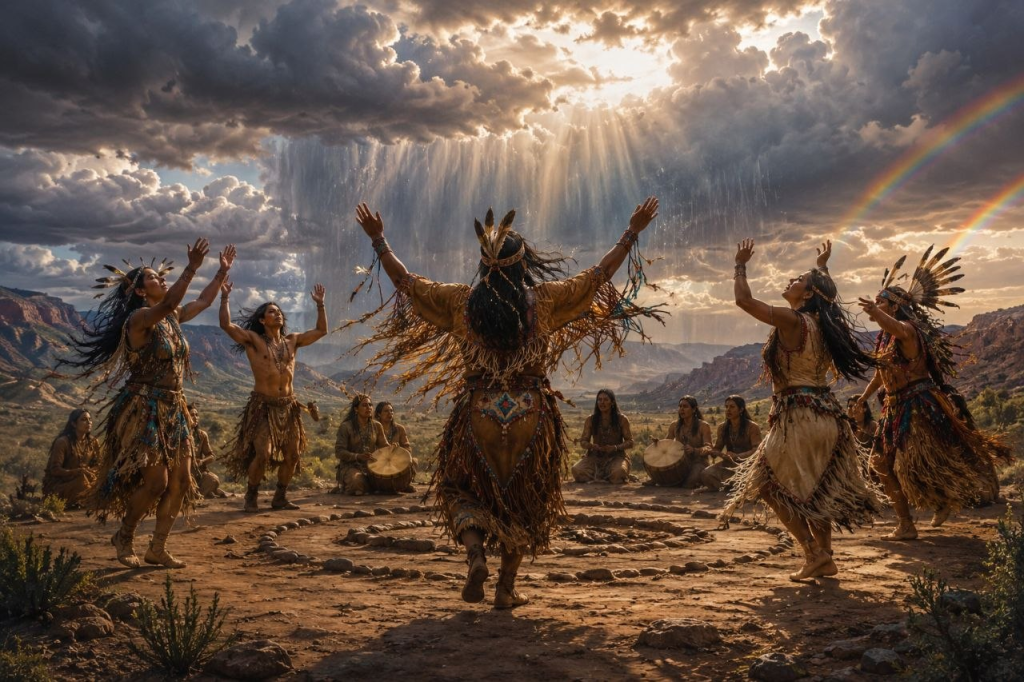
The dance itself was rich in symbolism. Stamping feet connected the dancers to the earth, whose parched soil thirsted for water. Raised arms opened toward the sky as a gesture of receptivity. The circle formation—common in many places—represented the eternal cycle of becoming and passing away, of drought and rain, of death and new life.
The drum often provided the heartbeat of the ritual. Its steady rhythm evoked the pulse of life and helped leave the cares of daily existence behind. Chants told stories of ancestors, the forces of nature, and a longing for harmony. Every step, every sound, and every voice formed part of a shared prayer—not merely for rain, but for balance between humanity and the natural world.
In many mythologies, rain was regarded as a heavenly blessing. Gods of thunder, mighty serpents, dragons, or feathered beings presided over the clouds and waters. Water became a symbol of purification, fertility, and renewal. When the rain fell, it bridged heaven and earth, infusing all life with new vitality.
This symbolism extends far beyond the weather itself. In many spiritual interpretations, the rain falling outside mirrors an inner transformation. Just as parched earth craves water, the soul yearns for hope, compassion, and renewed vitality. Thus, the rain dance becomes a meditation in motion—a dance that touches not only the heavens but, above all, one’s own heart.
The four elements also converge in this ritual. The earth sustains humanity. The air grants the breath of life. The sun’s fire provides warmth and vital energy. Water completes the cycle, fostering new growth. In the rain dance, these forces merge into an image of the interconnectedness of all life.
Rain rituals are documented across numerous regions of the world—from the indigenous cultures of North and South America to Africa, Australia, and Asia. Each community developed its own unique ceremonies, songs, and symbols. According to current scientific understanding, there is no conclusive evidence that such rituals influence the weather. Their true power lay in their spiritual and social significance: they fostered communal bonds, inspired hope, and helped people navigate difficult times together.
Perhaps therein lies the timeless message of the rain dance.
It reminds us that all transformation begins within. To dance is to set in motion not only the body but also memories, feelings, and hopes. The first rain does not always fall from the sky; sometimes, it falls within the heart. There, it fosters trust, dispels inner dryness, and inspires the courage for a fresh start.
Thus, the rain dance remains far more than a mere historical ceremony. It is a powerful symbol of the profound connection between humanity, nature, and the cosmos. It reminds us that we are part of a living whole and that new life can emerge from patience, mindfulness, and a sense of connection—just as the first rain touches the earth after a long drought.
2 responses to “Rain Dance – The Dance Between Heaven and Earth”
Well, I have not read anything about the results of the rain dance. I have read about the horrible results of the Ghost Dance. And a modern equivalent of the Ghost Dance is taking place in this corrupt, syphilitic-thinking, delusional country as I type this. It is the Ghost Dance of the MAGA BOTS, oblivious to the demonic power and takeover of America by Israel, the Muslims, and the DSA. America’s chastisement will be horrific. Plan accordingly. Bleib ubrig.
A timeless message. Take a look inside – “all transformation begins within.”