
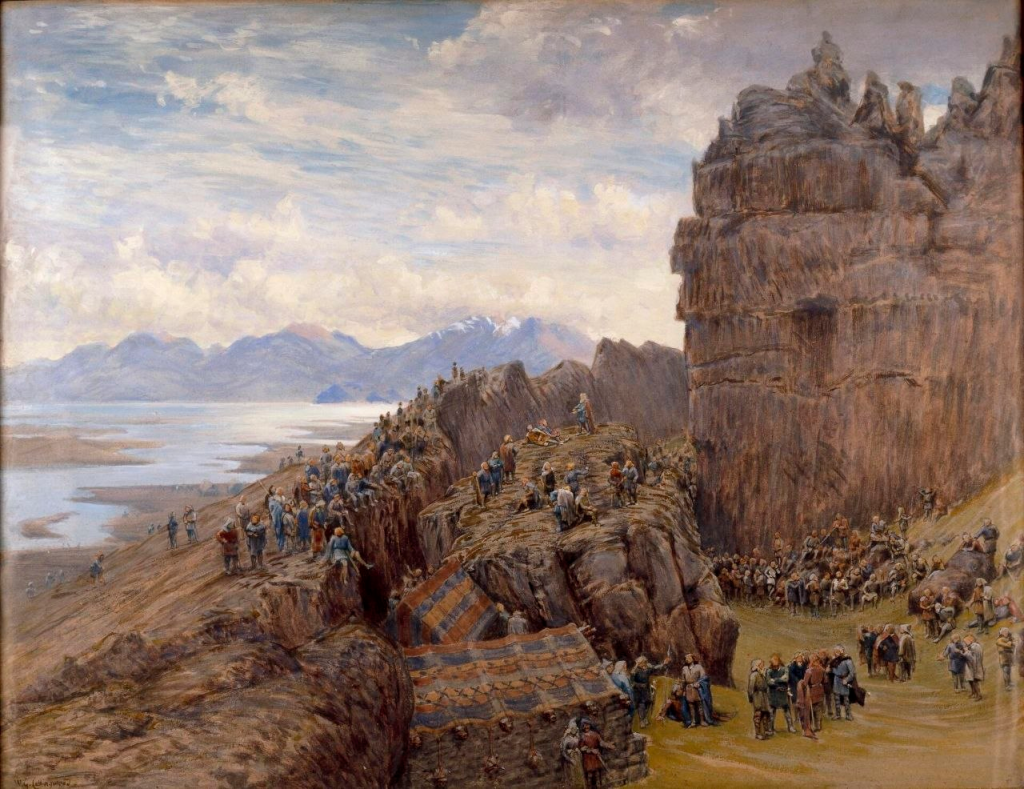
The Alþing at Þingvellir
Artist: William Gershom Collingwood (1854–1932)
Among the Germanic peoples, law was one of the foundations of society. It protected the community, settled disputes, and defined the responsibilities expected of every free person. Keeping your word, honoring your oaths, supporting your kin, and living according to the customs of the community were not simply personal virtues. They were part of what it meant to live within the law.
Some crimes were punished by one of the harshest penalties in the Germanic world: outlawry. The Icelandic law code Grágás describes the sentence in plain terms. A person declared a full outlaw (skóggangr) lost the protection of the law and was required to leave Iceland. Anyone who remained after the time allowed could be killed without paying compensation. Grettis saga shows what that sentence looked like in practice. After being declared an outlaw, Grettir Ásmundarson spent years living in isolation, hunted, and cut off from the legal protections every free person once possessed.
The same respect for the law even appears in the legendary traditions. In Gesta Danorum, Saxo Grammaticus recounts that Odin was driven from Ásgarð after violating Rindr, and Ullr ruled in his place until Odin’s return. Saxo wrote centuries after the conversion and interpreted older traditions through a Christian lens, but his account may preserve an earlier heathen tradition. Whether historical or legendary, the story reflects how seriously the Germanic peoples regarded the law and the consequences for violating it.
Outlawry was one of the harshest punishments in the Germanic world because it stripped a person of the rights and protections they once enjoyed as a member of the community. The surviving law codes and sagas show that law, honor, and accountability were inseparable in Germanic society. Those traditions helped hold their communities together, and they are still worth remembering today.
Roth Note: Worth returning to … there … fixed it.
2 responses to “FORGOTTEN CUSTOMS OF THE GERMANIC PEOPLES: OUTLAWRY”
They were once a great people, but now they’ve declined into what some view as a third-world state, with heavy migration and governments seemingly allowing the ongoing decline of their populations. Once-great nations of past empires, like the Roman Empire, now rest in the dustbin of history, and just as they fell, so too may the United States. Corruption, perceived evil, and wickedness have taken hold, making collapse seem imminent, while the people appear so detached from reality that cognitive dissonance has become the norm.
Seek the Lord while you still can because the door is closing in on the world as well as salvation and grace.
There is only One true Law, the Law of God – Torah.
Phil1350 said it correctly, “Seek the Lord while you still can because the door is closing in on the world as well as salvation and grace.”