
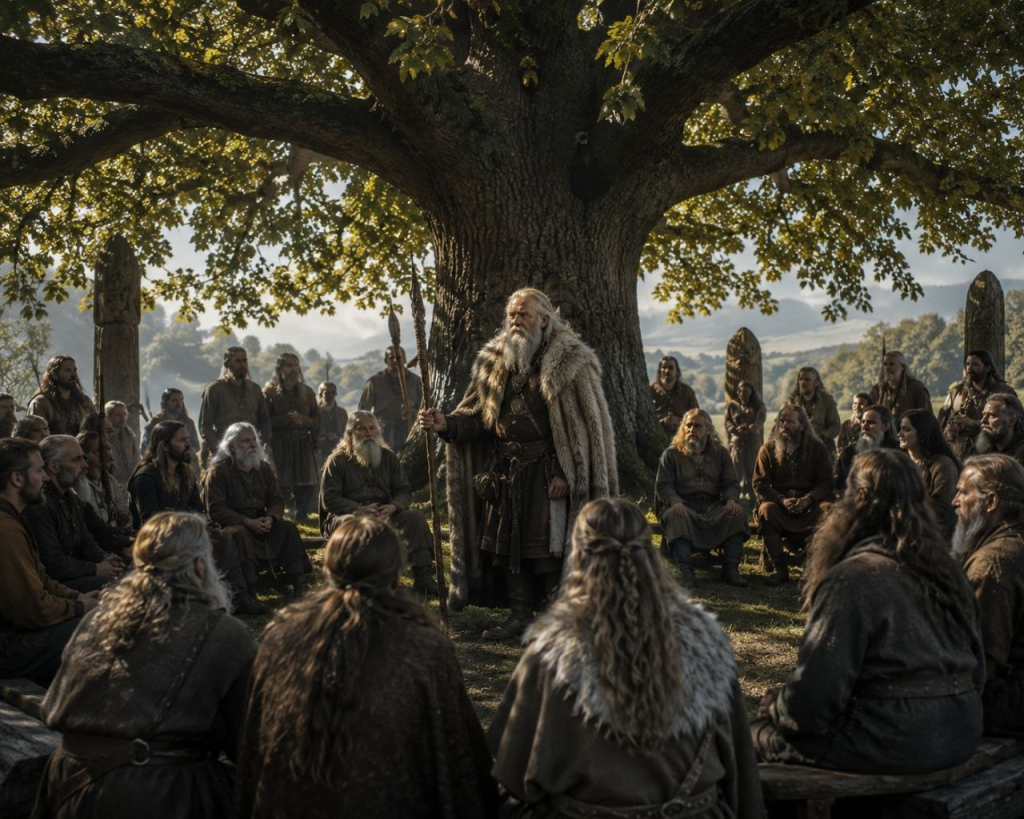
The image we hold of the Germanic tribes today is incomplete. Much of what has been handed down comes from the records of Roman or, later, Christian authors. While their accounts are valuable, they invariably reflect an outsider’s perspective. A great deal of the Germanic peoples’ actual worldview, their stories, and their oral traditions has been lost over the centuries.
Nevertheless, the sources paint a consistent picture: the community stood above the individual.
The tribal elder—often respected for his age, wisdom, and proven judgment—did not rule as an absolute monarch. Rather, he was a guardian of memory, an advisor, and a mediator. His words carried weight because they were grounded in experience, yet his voice did not supersede the will of the kin group.
Important decisions were made collectively. At assemblies, free men and women—practices varied by tribe and era—gathered to deliberate on matters of war and peace, alliances, disputes, and the well-being of the community. There, they spoke, listened to one another, and strove to reach a decision. It was not the power of a single individual that was to determine the fate of all, but the shared will of the community.
Underlying this concept was a profound mythological idea: the human being was not an isolated entity, but a thread in the great tapestry of the kin group. Every action affected the fate of all. Honor, therefore, was not merely personal renown but the standing of the entire lineage. Those who acted justly strengthened the community. Those who committed treason, murder, robbery, or perjury did not merely harm individuals; they disrupted the order that bound ancestors, the living, and future generations together.
For this reason, a chieftain alone did not adjudicate serious transgressions. The community deliberated on what form of restitution or punishment corresponded to the wrong that had been committed. Depending on the deed, this might entail compensation, penance, banishment, or—in the case of particularly grave crimes—even death. The goal was not mere retribution, but the restoration of peace within the community. Order had to be renewed so that the trust binding the kin-group could endure.
In the Germanic worldview, law was not a cold statute but a living covenant among humans, ancestors, and gods. To honor this covenant was to honor the powers that watched over the world; to break it was to set oneself against the very fabric of life.
Perhaps therein lies the greatest lesson of these ancient traditions: a community is strong when wisdom is heeded, responsibility is shared, and decisions are borne collectively. No individual is greater than the people; no power stands higher than the duty owed to the community.
The voices of the ancients may have faded, yet their vision lives on: a kin-group consists not only of the living but also of the ancestors, the children, and those yet to be born. Whoever acts for the community acts for the past, the present, and the future alike. In this sense, the *Thing*—the assembly of the people—was more than a place of law. It was a sacred space where the order of the world was reaffirmed time and again through collective judgment.
Roth Note: How can we have such a community in America today? Is it even possible any longer?
4 responses to “The Judgment of the Kin – On Counsel, Honor, and Community Among the Ancient Germanic Peoples”
Did the Germanic Tribes lack men with overweening ambition?
You know those folks like Julius Caesar who like so many well-known men of history took his army across the river against the Roman Republics laws and took control of the Republic, turning it into an Empire?
Folks like Genghis Khan?
These folks didn’t allow the opinions of the “family-clan” and so on limit their ambitions.
The Greeks had a word for hotheaded power grabbers that used oratory and the crowds’ passions to gain power.
Demagogue.
Historian Reinhard Luthin defined demagogue as “a politician skilled in oratory, flattery and invective; evasive in discussing vital issues; promising everything to everybody; appealing to the passions rather than the reason of the public; and arousing racial, religious, and class prejudices—a man whose lust for power without recourse to principle leads him to seek to become a master of the masses.
Perhaps the Germanic tribes were more wise and civilized than the mere Greeks or Romans.
This is the reason Amish communities would split up when they grew to a certain size. This model works with a small number of people, maybe a couple hundred. When towns in the US grow over 100,000 all of the societal ills that beset large cities start to happen. And this applies to a
“greater metropolitan area” as well where there are contiguous suburbs.
It would greatly benefit us to revive small farming and manufacturing communities. And enact a very picky immigration system where you must have a needed skill and learn the common tongue.
Check your Bill Buppert file and you will learn the Irish and Scots self-ruled via tribalism (clan centered) for a more than a 1000 years.
[…] posted an interesting article concerning Germanic tribes and how laws were dispensed. One of points described the shared will of […]