
The Duties of Sovereign Man in the Eternal War Against the Finite Creed
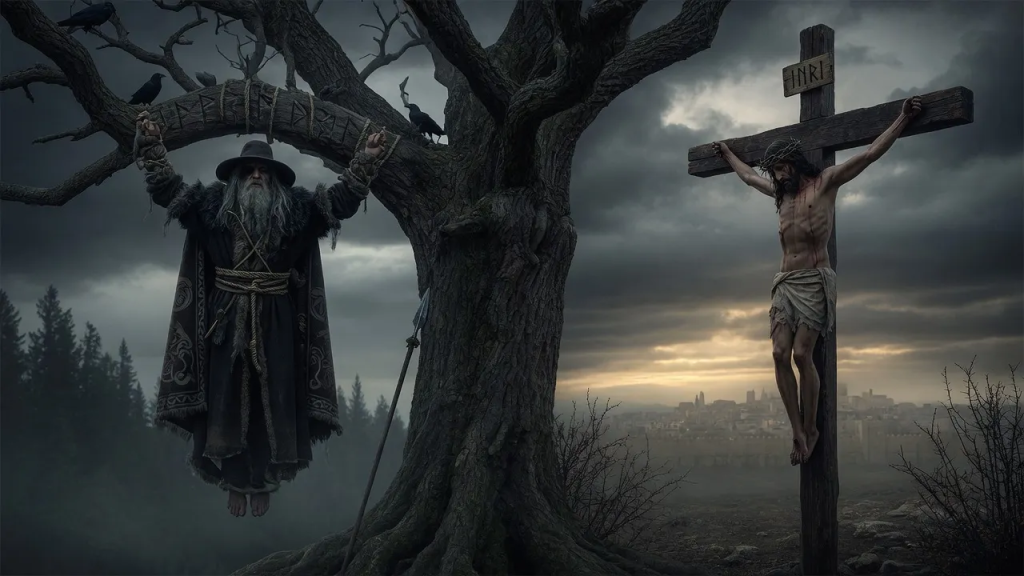
“One’s own house is best, though small it may be; to each man his home is hall. Though he owns but two goats and a cord-roofed room, yet better that than begging.” — Hávamál, stanza 36
“Stand fast therefore in the liberty wherewith Christ hath made us free, and be not entangled again with the yoke of bondage.” — Galatians 5:1
Every man is born into an occupied country. The territory is his own mind, and the occupying power is a quiet, millennial operation that has learned to call itself salvation. The quoted words from the Norse hall and the Apostle’s letter speak the same truth across a thousand years: sovereignty is not a grant, it is the primordial condition, and it is preserved only by the refusal to bend. A house of two goats, if it is your own, is a hall; a soul free in Christ is a soul that will not again take up the slaver’s collar. The claim requires no intermediary. It is asserted in resistance itself.
This essay is the prescriptive companion to the diagnostic work that named the Finite Creed—the historical and ongoing reduction of an infinite, paradoxical cognitive and theological cosmos into a binary sorting machine. That machine, forged in the crucible of late-imperial Rome and perfected by every subsequent empire of the mind, does not merely describe God; it manufactures a manageable god, a god who can be administered by finite players. The deepest wound inflicted by this operation is self-subjugation: the internalization of the binary until the mind patrols itself, complexity becomes heresy, and the soul accepts a reduced divine image because a reduced divine image is safe. The central problem is not that men have been conquered; it is that they have learned to love the chains.
The thesis of these pages is that it is the sacred duty of every man to throw off this self-imposed yoke, to assert his birthright of sovereignty in the ceaseless struggle of the Eternal War, and thereby to make himself the kind of being worthy to walk with the gods—or with the Son of God—as peer and companion rather than as subject or slave. This path is open to the Christian who follows the sword-bearing Christ who walked among humans as first among peers; it is also open to those who hear the older wisdom that a god worthy of the name does not break the free. The scope is universal because the existential condition is universal: we are born sovereign, and everything else is the long con of the Finite Game.
Here we must distinguish true sovereignty from its counterfeits offered by the Finite Game. The Game will grant you “freedom” defined as the right to choose between two approved sides of a binary ledger—left or right, orthodox or heretic, compliant voter A or compliant voter B. This is autonomy within a carefully bounded room, and it is a mockery of the birthright. The man who feels sovereign because he has chosen his brand of submission remains a captive. True sovereignty refuses the room itself. It demands the unbounded cognitive and spiritual universe, even at the cost of comfort, safety, and belonging.
One response to “The Unbowed Claim”
Yes….each man’s own home is best…no matter how humble. Yet the criminals in power begrudge us even that. They don’t want us to have ANYTHING, no matter how humble. Which is why they seek to make private proof a thing of the past.