
For millennia, people relied on copper.
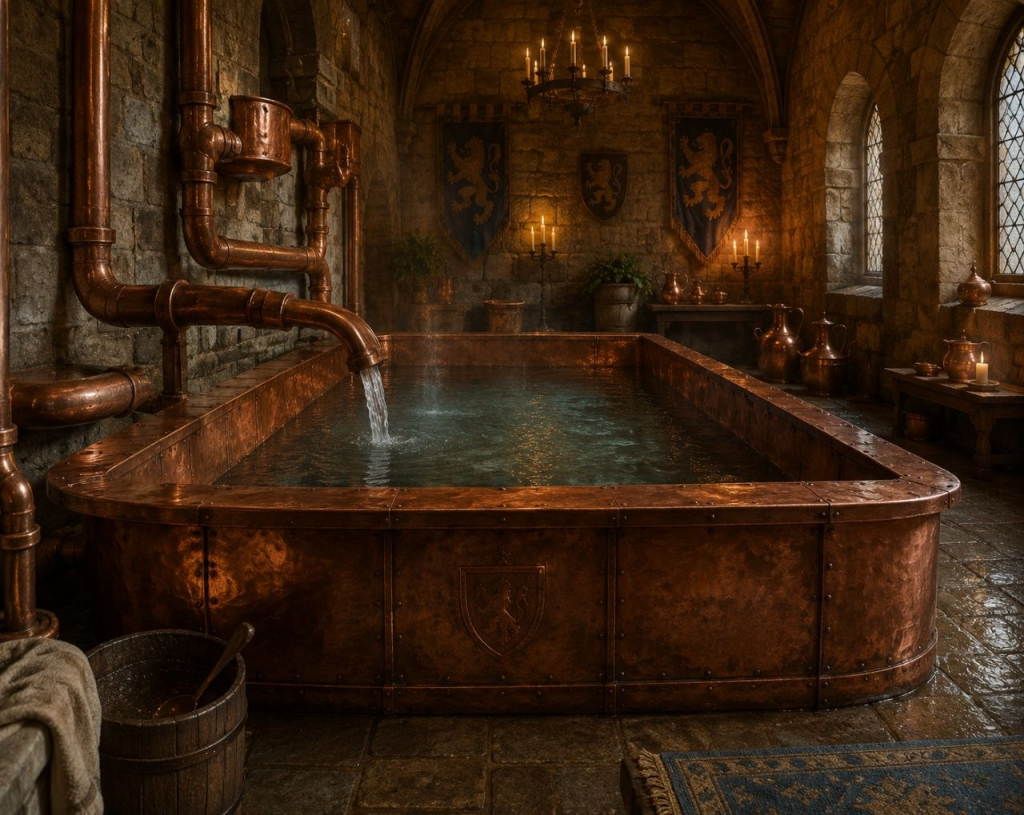
Our ancestors used it for water pipes, tanks, and supply systems. Not because it was cheap, but because it worked. Copper was durable, resilient, and possessed properties that we now try to replicate with great technological effort.
Then came the modern world.
Gradually, copper disappeared from our infrastructure. It was replaced by plastics, synthetic materials, and an ever-increasing use of chemicals. What was once supported by intelligent material selection is now often replaced by industrial processing.
This is particularly evident in swimming pools.
Copper pipes and copper-containing systems used to be widespread. Today, chlorine dominates. Millions of people regularly swim in water that has to be treated with chemicals to remain hygienic. At the same time, many are familiar with the side effects: burning eyes, irritated skin, respiratory problems, and the pungent odor that has long since been accepted as normal. But why do we accept something as progress when it produces side effects that previous generations didn’t experience in this form?
Of course, chlorine kills germs. But it also reacts with sweat, urine, and other substances in the water. This creates compounds that have been the subject of health debate for years. People who regularly use or work in swimming pools, in particular, repeatedly report problems with their skin and respiratory system.
The real question, however, is broader. Why have natural materials with special properties been systematically displaced?
Was it truly people’s health that drove this development?
Or was it primarily lower costs, easier installation, and higher profits?
Increasingly, the impression arises that many proven solutions of the past disappear as soon as they become less economically attractive than industrial alternatives. This applies to building materials, food, agriculture—and possibly also to our water systems.
Progress should mean creating better solutions.
Yet sometimes it seems as if we replace natural and proven systems with more technically complex processes, only to then combat the new problems with even more products and chemicals.
Perhaps we should therefore ask ourselves an uncomfortable question:
Did we really replace copper because it was inferior?
Or did we replace it because a world full of plastics, additives, and chemical processing became more economically attractive?
The past wasn’t perfect. But perhaps in some areas it was closer to nature—and therefore closer to what is ultimately good for humanity.
From Huter der Irminsul
3 responses to “THEY TOOK OUR COPPER – AND GAVE US CHEMICALS”
“We” replaced copper purely out of economic consideration; we’re too cheap to use it in all the applications mentioned or alluded to in the article. Simple as that. From a more practical standpoint, there is the issue of the total amount of a copper available on the worldwide commodities market. This is necessarily constrained both by the amount of it that can realistically be mined and produced, as well as the demand for it in applications where no suitable substitute has been found. Obviously, most of the copper now goes into electronic and electrical devices.
We have ditched the penny (which was already long since stripped of most of its copper content, save for a very thin plating) and now water lines in most new homes and buildings are installed in one of the various plastic piping systems (pvc, cpvc, PEX), again due to cost. Of course, plastics require oil to produce, and the longer term trend may well make that unaffordable, which could conceivably force a return to copper for domestic potable water piping.
And yes, copper is naturally beneficial in drinking water distribution for it’s natural anti-microbial properties. the abandonment on copper for that purpose in newer construction has lead to the reemergence of legionella outbreaks, among other problems.
Copper housing products were replaced for simple economic reasons, material cost, labor cost to install, tools required, and I’m only guessing on this last one the ‘skill’ and availability of skilled labor to install copper. (I am not saying anything against plumbers, roofers, and metal workers)
Copper was replaced with materials that came out of oil wells. Greater profit and refinery byproducts could then be disposed of. The oil lobby had more money to bribe Congress and the bureaucracy to deem these materials safe.