
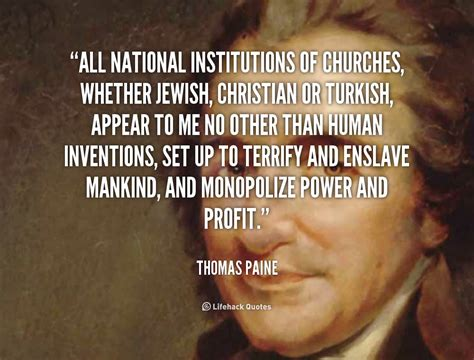
From Grok:
Paine wrote this in his 1794–1795 book The Age of Reason (Part I), a famous deist critique of organized religion.
In the full context:
“I do not believe in the creed professed by the Jewish church, by the Roman church, by the Greek church, by the Turkish church, by the Protestant church, nor by any church that I know of. My own mind is my own church.
All national institutions of churches, whether Jewish, Christian or Turkish, appear to me no other than human inventions, set up to terrify and enslave mankind, and monopolize power and profit.”
Later in the same chapter, Paine explicitly links “the Turks” to “Mahomet” (Muhammad) and “the Koran” (Quran), treating it as the third major revealed religion alongside Judaism and Christianity.
Why “Turkish” instead of “Muslim” or “Islamic”?
In 18th-century Europe, it was extremely common to use “Turkish” (or “the Turk”) as shorthand for Muslim or Islamic. The powerful Ottoman Empire — ruled by ethnic Turks — was the dominant Muslim power that Europeans interacted with (through trade, war, and diplomacy). So “Turkish church” or “Turkish” simply meant the religion of the Turks = Islam. Paine was not referring to the modern country of Turkey (which didn’t exist yet as a nation-state) or to the Turkish language, but to the Islamic faith as one of the world’s major institutional religions of his era.
Paine’s point was universal: he rejected all organized “national” religions (Jewish, Christian, and Muslim/“Turkish”) as man-made tools of control, regardless of which one. He was advocating for deism — belief in one God revealed through nature and reason, not through any specific church or scripture.
This usage was standard in English writing at the time (you’ll see it in many Enlightenment-era authors). It has nothing to do with ethnicity or the modern Turkish state.
4 responses to “For Your Consideration:”
When facts become hate speech, truth becomes an arrestable offense.
Charlie Kirk’s life was serving the living God and was destroyed by Gov.com.
Pity he’s not around to discuss deist vs Jesus.
The fear of death (and what is beyond) has been EXPLOITED by governments and organized religions for eons. That provides significant power on its own, but when these folks are given preferential treatment (tax breaks, etc) we give them even more power. Those who have brought the truth of reality and the divine are not the ones who have exploited fear for their political and financial benefit. The key is for everyone to know the difference.
[…] highlighted the words of Thomas Paine in a recent post, “churches are human inventions, set up to terrify and enslave mankind, and monopolize power […]