
How the Roman Regime Used Christianity to Simplify Thought and Subdue the Mind
Note: What follows are out-takes from an essay by E.M. Burlingame. It is NOT an attack on Christianity. It’s also not for the doctrinaire religionist who refuses to consider history. Rather, it is an attempt to explain what we have inherited and how we have been conditioned not to think, not to question, but to determine what we’re allowed to think and to say. It explains …
“the reason this history matters now, in this moment, to the specific kind of person willing to carry it. Not as a grievance. Not as nostalgia for a world that’s gone. But as a map. The campaign that opened in the fourth century hasn’t ended. It’s only changed instruments. And the first thing the map tells you — the thing it’s always told those who could read it — is that the room isn’t the world. The universe is still there. It’s simply been waiting, as it always waits, for the minds capable of letting it back in.“
What Rome accomplished in the fourth century wasn’t a religious conversion. It was the largest successfully executed opening move of the Great Game in Western history — a deliberate act of cognitive disarmament, aimed at eliminating the mental infrastructure on which the Sport depends. What was destroyed wasn’t belief. It was the capacity for a specific kind of thought. And as we will trace across the essays that follow, the methodology has never changed. Only the instruments have.
The Great Game is waged primarily by what I call the Resentfuls: a disposition — envy elevated to doctrine — operating within the intellectual, financial, managerial, and merchant classes. Their motivation isn’t ideology in any pure sense. It’s the conviction that those who build and sustain across generations shouldn’t exist independently or at all, and that they, the Resentfuls, should have the status of those they resent. The Sport of Kings, conversely, is played by those who build, sustain, and transmit: the multigenerational families and their allies across every class, whose obligation is stewardship rather than seizure.
The Great Game is forever Revolution. The Sport of Kings is forever Restoration.
Control the cognitive field — the language, the permitted questions, the structure of available discourse — and raw intelligence becomes largely harmless. The brilliant mind, trained only in binary categories, produces brilliant arguments for binary conclusions. The Game requires nothing more.
The Common Man is also a player in the infinite game — when allowed sophistication of thought, and even when not. This matters enormously. When the pagan tradition provided the common citizen with a cognitive world of genuine complexity — competing cults, philosophical schools, a universe of many gods and many truths — ordinary men and women were participants in the Sport whether they knew it by that name or not.
But the common man retains a form of infinite-game advantage that no institutional framework can fully extinguish. He lives closer to base reality. He works with soil, weather, bodies, hunger, birth, death — with the irreducible, uncontrollable, unboundable fabric of existence that no creed can fully capture and no bureaucracy can fully manage. Hence the drive to end the small farmer, the man who lives close to and in daily communion with life and the earth, the old gods.
The Christianity that Rome weaponized in the fourth century wasn’t the Christianity of the first three centuries. The religion of the Apostles and the early Church was something strikingly different: rich, disputatious, philosophically sophisticated, and deeply engaged with the intellectual world it inhabited.
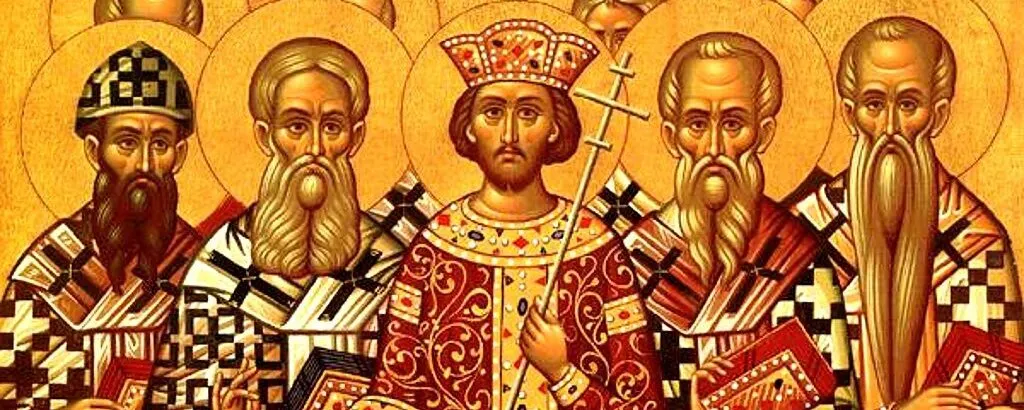
This wasn’t the Christianity Constantine needed. The early Church’s intellectual diversity — its dozens of competing schools, its tolerance for paradox and mystery, its willingness to hold multiple cosmologies in tension — was precisely what made it resistant to the kind of imperial standardization the regime required. The Council of Nicaea in 325 CE wasn’t a theological summit. It was a hostile acquisition. Constantine didn’t patiently seek theological truth. He commanded hundreds of bishops to produce a single, rigid creed, and then he enforced it with the power of the state. His goal wasn’t the salvation of souls. It was the order of the empire: one God, one Emperor, one realm.
What was destroyed at Nicaea — and in the decades of enforcement that followed — was not paganism alone. It was the Christianity of the first three centuries: the rich, philosophically open, sophisticated and intellectually demanding tradition that had spent three hundred years thinking carefully and complexly about the nature of reality. The regime didn’t adopt Christianity. It replaced it with a simplified version designed for governance. A version of binaries to be controlled. The distinction matters, because the war being described in these essays isn’t a war against Christianity. It’s a war against the same target Christianity itself was used to eliminate: the open epistemic system, the infinite cognitive space, the trained capacity for sophisticated thought.
Christianity, as standardized and enforced by the imperial state, offered the cognitive simplification the regime required by collapsing the infinite cognitive space of both paganism and early Christianity into a severe and comfortable finitude. At the heart of the new enforced doctrine lay a binary code that sorted all of existence into mutually exclusive pairs: Saved or Damned, Good or Evil, Orthodoxy or Heresy, Faith or Unbelief.
Every complex moral dilemma, every philosophical subtlety, every shade of grey was abruptly funneled into a single axis of judgment. There was no spectrum of virtue, no partial enlightenment, no noble pagan — only the stark division between the children of light and the children of darkness.
And so we see today, from the perspective of the ‘elites’ there are the children of light (Progressives, Globalists, Zionists) and children of darkness (traditionalists, conservatives, true Christians, virtuous pagans). A new instrument, but the same tactic as that established in the 4th Century.
5 responses to “The Finite Creed”
Mr. Harbard, thank you. Thank you for sharing this essay. Thank you for continually exposing what empire and religion have done. We are all God’s children, sons and daughters. Our true identity in Christ is what empire and religion fear the most. I believe we are currently in the greatest awakening. In the years and ages to come, guys like you will be seen as frontrunners and heralders of real Truth…Exposers of lies that have been told for centuries.
Thank you for what? The promotion of polytheism?
Lol I thought you were leaving and not coming back…
Sorry. I put Jane’s IP address in the moderation list. She changed it so it was bypassed and published.
Yea she’s a Troll or a Mole…