From Wikipedia: Truth is conformity to reality or fact. It contrasts with falsity or misrepresentation that fails to align with the world. Truth is typically treated as a property of truthbearers, such as sentences, propositions, or beliefs that describe things as they are.
It’s been said that we each have our own truth. However, that conflicts with the definition of truth. It would be better said that we each have our own opinions or beliefs of what the truth is, and how do we arrive at that? It would seem that one’s place of birth (environment), one’s experiences, the degree of study or lack of study, influence of one’s peers and family, prejudices and biases, and other trusted sources of information all converge to produce those opinions and beliefs. One could say we’re born into many of our beliefs.
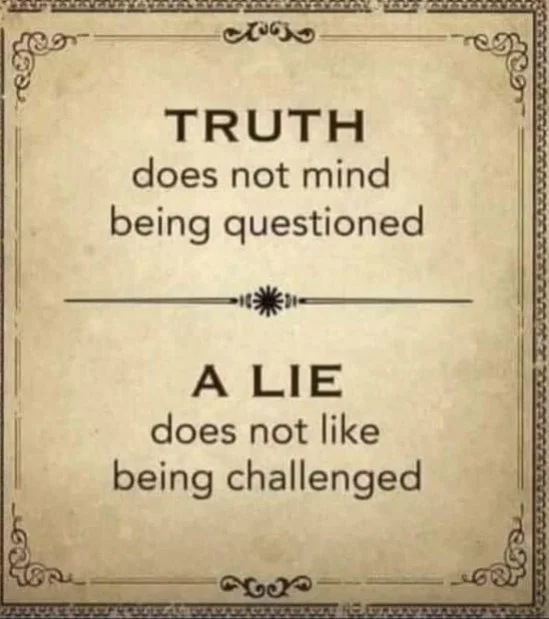
The problem arises when one refuses to acknowledge that their opinions and beliefs might be erroneous. When one refuses to consider conflicting information and evidence with an open mind, such a one will inevitably respond to such conflicting evidence and information, the challenge to their opinions and beliefs, in anger and with ad hominem attacks on the messenger rather than offering evidence and data to the contrary; reasonable and amicable debate. Such a one would be demonstrating their ignorance. Anyone who doubts this need only read the comments section of any social media platform, substack, or podcast.
From Merriam Webster: Ignorance is the state or fact of being ignorant : lack of knowledge, education, or awareness.
I will freely admit to being ignorant. I know little of advanced physics, brain surgery, complicated math, so when I declare someone to be ignorant, it’s not a pejorative. It’s simply recognizing that they lack knowledge, education, or awareness of the matter in question. On the other hand, I know a great deal about geo-politics, history, and religion. I’ve gained knowledge and education and I am continuously aware of developments of additional evidence, data, and information in those fields. While imperfect, my beliefs and understandings are based on extensive study. I’m a skeptic. I question truth claims and don’t allow my pride or prejudice to keep me from changing my mind based on additional data, evidence, and verifiable information.
From Wikipedia: Critical thinking is the process of analyzing available facts, evidence, observations, and arguments to reach sound conclusions or informed choices. It involves recognizing underlying assumptions, providing justifications for ideas and actions, evaluating these justifications through comparisons with varying perspectives, and assessing their rationality and potential consequences. The goal of critical thinking is to form a judgment through the application of rational, skeptical, and unbiased analyses and evaluations.
People who fail to think critically are typically locked into beliefs and opinions that are untrue or only partially true. Never-the-less, they will adamantly defend those opinions and beliefs with angry attacks against anyone who doubts them rather than consider that it’s possible they could be in error.
I’ll raise my hand and admit I’ve been guilty of this in the past. We all have. But show me new evidence, new data, a better argument … I’ll change my mind. Will you?
3 responses to “Truth?”
I would say most arguments come about from those areas that are in the gray area not the black or white ones like politics, religion, geography, and demographics…
I get where you are coming from and a valid question.
But, as a old retired .mil guy who has many decades as both OPFOR and threat analyst.
Is what most people believe today REALLY the truth or the results of a Disinformation/Misinformation or even a concerted information overload program? For the people on the right as a example. Fox news since Rupert Murdoch retired and his sons (assisted by their hard left wives) took over, has become the CNN of the right for spouting bull BS. As for the utopians on the left since the left’s news organizations have failed enmass, they go straight to full on commies and that failed systems various types for truth and skip what used to be news sources in between the left and the masses and no one seems to notice or say anything about that major shift.
The various multiple information campaigns I have been seeing seem to be destroying centers/purveyors of truth and substituting another source of “New Truth” for the masses based on what side you are on or your original belief system. Major military and intel agencies world wide have used these tactics for decades. Once you destroy a source of truth and substitute another controlled one, you now control the narrative and the belief structure.
And since most of the US and west are populated by mid functioning morons who are blissfully ignorant and unaware about whats happening around them , this is a truly scary time in history.
I wonder what history a few hundreds years in the future, if we don’t destroy the planet on our way down, will say about us?
I’m guessing they will say the same thing as what we say about the collapse of the Roman Empire and the reasons why it happened and be just as wrong are we are about what happened to Rome.
Pretty much agree. But I think instead of calling them mid-functioning morons, they’ve been literally bred to be tax cattle by the Rockefellers/Rothschilds. The focus on jobs/money and stupid political distractions along with entertainment, whether hollyweird or sportsball, keeps them from being able to see how they are being led to the slaughterhouse. AI/CBDC/digital ID, climate hysteria, lgbt/abortion/euthanasia/vaccines, chemtrails, poisonous medicines/foods, etc. Worse are the ones who attack you when you try to warn them about the situation, call you a conspiracy theorist. MOO.