
On the Patience of a People Who Have Never Been Finally Defeated
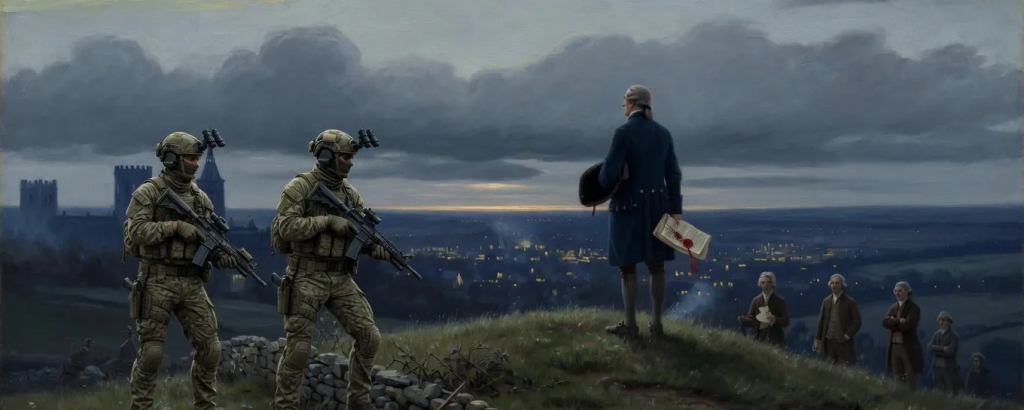
Here is the first thing to understand about the Saxon: he does not hate quickly, and he does not hate easily. But when he has been brought to the place where strength diminishes and he still advances—that is not the heat of a moment. That is something that was decided long before the battle began. Something cold. Something final.
The historians of other traditions have often mistaken Saxon patience for Saxon weakness. This is an error that has been made repeatedly, by peoples who did not live long enough to understand what they had provoked. We Saxons have outlived every empire that has ever been. Such only the empire we built remains.
The common law followed the flag. Wherever the English settled—in Virginia, in Massachusetts, in New South Wales, in New Zealand, in Canada, in Natal, in the Punjab—they brought with them the assumption that law was not the will of the ruler but the evolved inheritance of the community, and that no man, however powerful, stood above it. This was not an imperial imposition. It was an export of the thing the English valued most: the principle that power is bounded, that the individual has rights that the state cannot extinguish, and that those rights are defended not by the goodwill of rulers but by the structure of law itself.
The empire was, at its best, the globalization of this principle. Its worst chapters—and they were real, and they were many—were the moments when the principle was violated by its own carriers. The slave trade. The famines. The Amritsar massacre. The Highland Clearances. These were not expressions of the Saxon character at its most characteristic; they were betrayals of it, recognized as betrayals at the time by the men within the tradition who opposed them—Wilberforce, Burke, Bright, the Clapham Sect, the anti-Corn Law campaigners. The empire’s capacity to reform itself again and again from within was itself an expression of the tradition: the tradition that holds that a wrong, once recognized, must be named and corrected, regardless of the cost to the powerful.
Read Burlingame’s entire essay … It’s quite good.
One response to “The Slow Hate of the Saxon”
Until White Men Tribe Up nothing of consequence will ever be done…It’s only when the Saxon builds his armies that the empire will take notice and only then will change or war take place… Everything else is just bluff and bluster from an atomized and individualistic selfish population that is more concerned about making money and selfish pleasures than survival of them and their progeny…That’s the sad truth of the matter and I don’t see it changing until there is pain and death on the table because no one can look in the mirror and self reflect…