
Human beings have more than one identity. We may be Englishmen, yes—but we may also be fathers, sons, cousins, Armstrongs, Mancunians, Northumbrians, Europeans, white men, Indo-Europeans, Her Majesty’s subjects, and homo sapiens sapiens. Some of these identities are some near, some distant; some are concrete, some abstract.
We can place human beings on a continuum of identities. Many such continuums could be formulated, but for simplicity’s sake, let us take the following sequence:
family → clan → tribe → polis/city → folk → nation → race → empire → humanity
Right away, we notice that the nation is but one level in a broader field of belonging, not the starting point of social life and not the final possible identity. We can usefully place these identities not only on a line, but also within a series of concentric circles, as in the famous heatmap diagram.
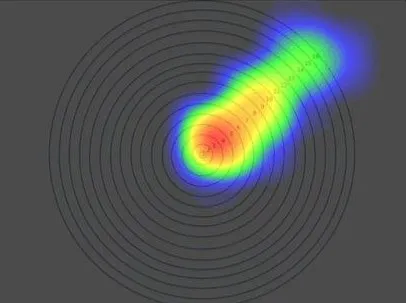
As these identities expand outward, two things happen at once.
First, scale increases. As we move from family to clan up to folk and thence to humanity, more people are bound together, and with this increased scale, greater political and military power becomes possible. We can accomplish larger and larger projects.
Second, immediacy decreases. The more people in your group, the fewer you personally know. You may still be related to them by blood, but this kinship is much weaker, and as we shall discover, it must become symbolic if it is to survive. It is impossible to be loyal to what you do not know, and it is impossible to know millions of people personally, so your loyalty becomes mediated through social institutions, and through social technologies like myth, law, ritual, language, etc.
The core principle is that the wider the identity, the more politically powerful, but the more emotionally abstract and mediated. The larger the scale of belonging, the thinner that belonging is.
Family, for example, is the deepest and most immediate identity. We encounter our family daily. It is personal to us, inherited, embodied. By the time we arrive at the city or polis, though, shared life has changed. It is still kinship writ large, but at this point people are bound together not only by blood, but by civic life—by abstractions such as office and law, and by portable identities such as citizenship. The folk is broader than the city, but usually still below the full nation. The nation is a late consolidation of these earlier forms, taking kinship feeling from family, clan, and tribe, taking civic order from the polis, and taking culture from the folk—but it scales them to a point where it can defend itself against other nations. Empire is wider than the nation as well. It may contain many peoples, or even many races across vast territory, commanding impressive military power. But its identity is thinner than national identity, so it depends on a strong state. Humanity is the widest identity, and is perhaps barely even morally intelligible.
Continue reading … Why Do We Care About Millions of Strangers?