Caveat: This post is not intended as an attack on anyone’s religion. It is simply an historical reality and alternative viewpoint for those to whom it may resonate.
In the ancient way of the pagans, there was no submission to the divine. No kneeling out of guilt. No supplication from a broken person. The ancients knew no sin in the sense of an eternal stain. Rather, they knew balance.
For nature itself teaches no condemnation—it teaches cause and effect, change and responsibility.
Our ancestors knew: Man is not born guilty. He comes into this world free, carried by the breath of the earth and the fire of the stars.
Only later powers made free people guilty. They planted fear in hearts, labeled natural man sinful, and declared his instincts, his desires, his wildness, and his free spirit to be something that had to be broken. For whoever convinces a person that he is inherently impure can control him more easily.
Thus, guilt became a chain, and penance a tool of control. People were taught to lower their gaze, to make themselves small, to kneel, to obey, and to seek salvation only through external authority.
But our pagan ancestors took a different path. They stood upright. With firm feet on the soil of their ancestors. With heads held high beneath the stars. For they did not see themselves as separate from the forces of the world. They were part of the great tapestry of earth, sky, fire, and spirit.
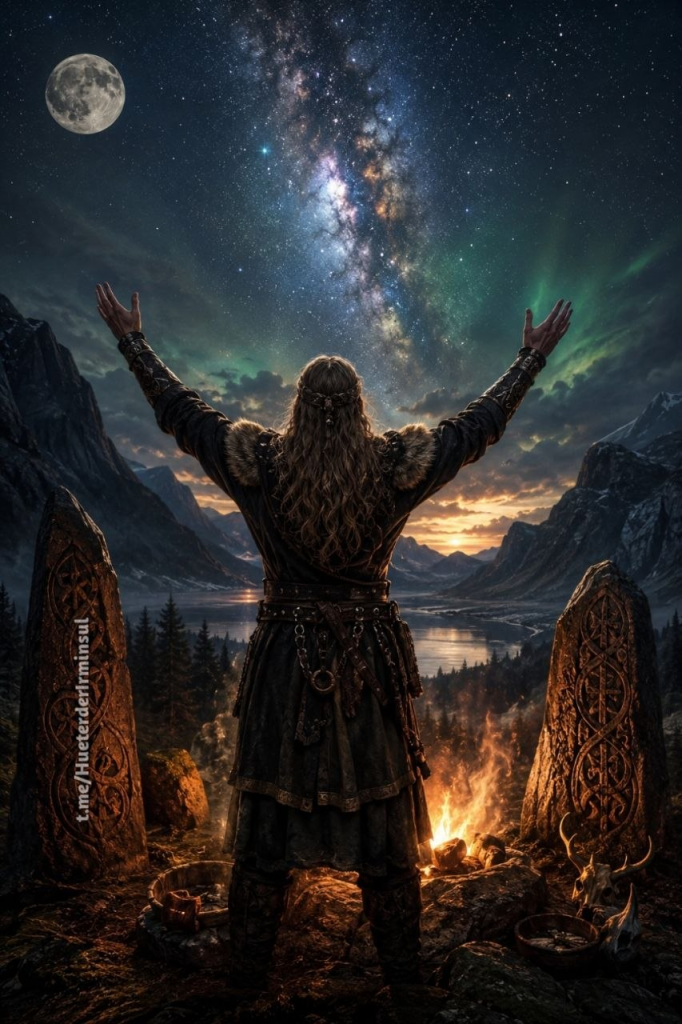
When they called upon the Gods, it was not as servants—but as children of creation, raising their voices to the wind. Their arms were stretched toward the heavens, like the rune Algiz—the symbol of protection, of the connection between humankind and cosmic order.
Thus, humankind stood between the worlds: feet deep in Midgard’s earth, hands open to the cosmos, spirit like a flame in the night forest. This was not a prayer in the sense of later religions. It was a call. A remembering. A conscious merging with the ancient forces.
One spoke to the ancestors in the smoke of the fire. To the Gods in the thunder of the mountains. To the spirits in the rustling of the forests. Not with downcast eyes—but with open eyes. For the free person does not kneel before creation. They recognize themselves as part of it.
And perhaps therein lies the fear of those systems that sought power over souls: A person who recognizes themselves as holy is difficult to control. A person who carries the voice of the ancestors within needs no mediator between themselves and the divine. A person who is in harmony with earth and sky cannot be broken by guilt.
And when the wind rustled through the treetops, when the runes glowed in the fire and the moon hung over the ancient stones,
then the ancients knew: The Gods demand no submission. No self-abasement. No fear. They demand truthfulness. Courage. Honor. Personal responsibility.
And the remembrance of who we truly are.
From Huter der Irminsul