
I’m shocked! Shocked, I say!
The Bogus Blockade Claim of the US Department of War
Now, after more than two weeks, Pete Hegseth has been saying the US blockade is working and getting stronger, describing it as “ironclad,” “tightening by the hour,” and even “going global.” He said the Navy had turned back 34 ships, that transit through the Strait of Hormuz is now “much more limited,” and that the blockade will last “as long as it takes.”
He also framed the blockade as coercive leverage on Iran, saying it is meant to cut off shipping pressure until Tehran abandons its nuclear ambitions. In the same remarks, he warned the U.S. would “shoot to destroy” any Iranian boats laying mines or otherwise threatening commercial shipping.
In order to understand Hegseth’s perfidy, you need to understand the US Navy doctrine for handling a blockade.
Standard Procedure for Seizure and Control
- Interception and Warnings: US forces (Navy warships, often with Marine or Coast Guard support) issue radio warnings, visual signals, or warning shots to order the vessel to stop. Non-compliance can lead to disabling fire (e.g., targeting engines) to halt the ship without sinking it.
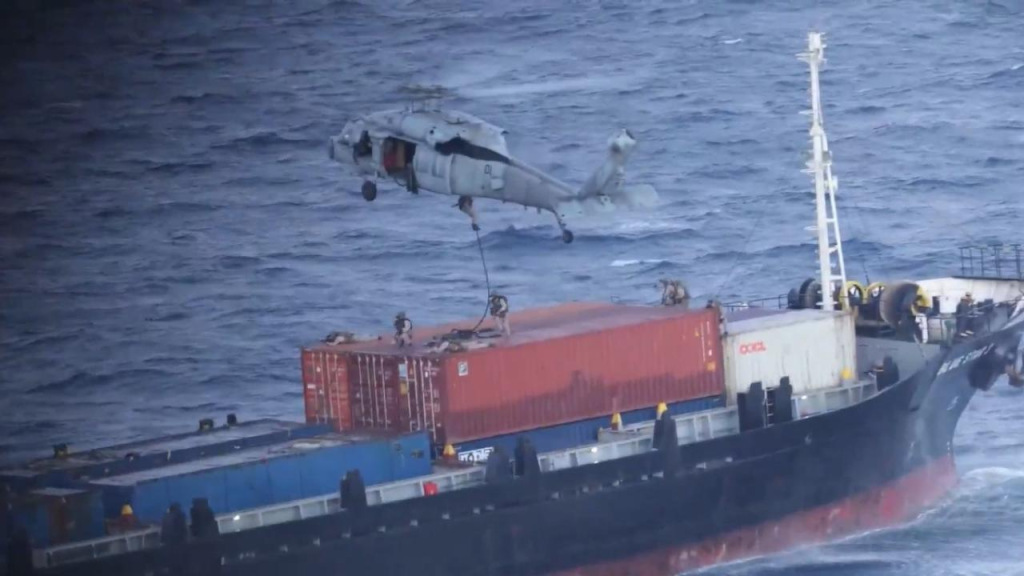
- Boarding (VBSS): A specialized boarding party—typically from the Navy, Marines (e.g., 31st MEU), or Coast Guard—approaches via small boats, helicopters, or fast-roping. The team secures the bridge, engine room, and key areas to establish control. Teams train for both compliant and non-compliant (opposed) boardings, using tactics for close-quarters battle, searches, and restraint of crew.
- Taking Control:
- The boarding party assumes operational command of the vessel.
- In a formal wartime blockade or armed conflict context, a prize crew (detachment of US personnel) may be placed aboard to sail the seized ship to a friendly port for adjudication. The original crew can be detained, removed, or (for neutrals) sometimes allowed limited continued presence under guard.
- The ship and cargo become subject to inspection for contraband, sanctions violations, or blockade breach. Under prize law (revivable in armed conflict), a prize court may condemn the vessel/cargo as lawful prize.
- Post-Seizure: Here is the key point: the vessel is typically escorted to a US or allied port for further inspection, potential forfeiture, or release if the capture is deemed unlawful. Crew handling follows LOAC (e.g., humane treatment; possible internment for belligerents).
The current US deployment means that the US Navy could do VBSS (Visit, board, search, seizure) operations on 11 vessels… Tops! But that would mean that US destroyers, which have the mission of protecting the US carriers from air attacks, would have to be pulled off of their primary mission leaving the carriers to fend for themselves. If we assume that all 11 US ships carried out successful VBSS operations since 15 April, that means between 89% and 96% of all Iranian ships out of the Strait of Hormuz have evaded the blockade. Hegseth is lying.
Of course he’s lying. When is the last time the US government actually told us the truth about anything?

Leave a Reply to Tousling Qatarlson Cancel reply