
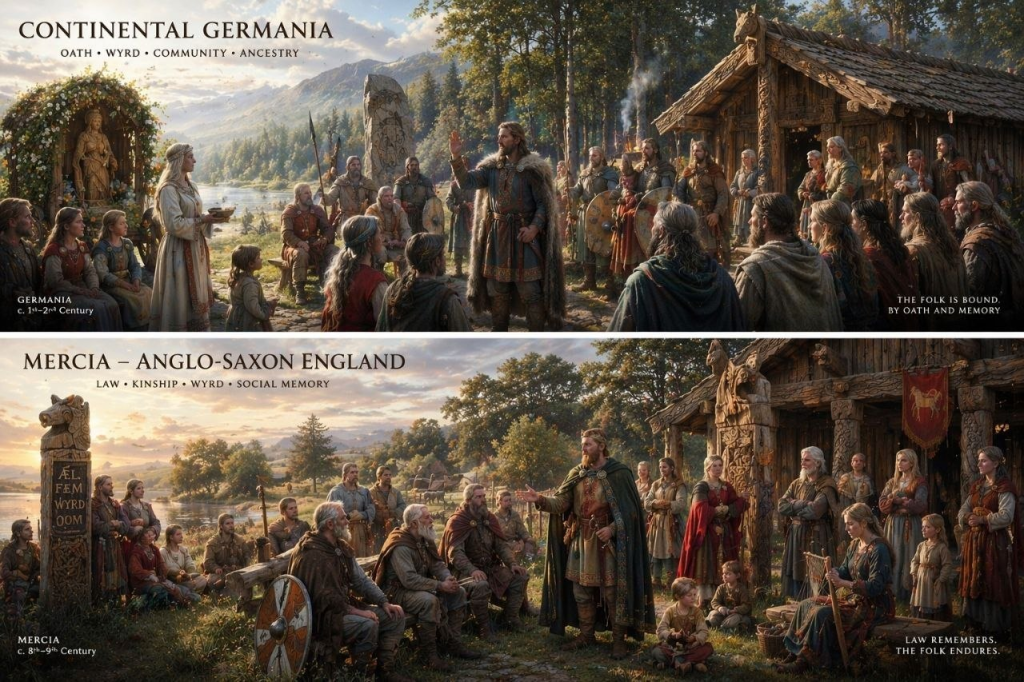
The identity of the Anglo-Saxon peoples is not an isolated development, but a continuation of the older Germanic world carried across the sea into Britain. When the Angles, Saxons, and related tribes migrated, they brought with them more than language or custom—they carried a living system rooted in kinship, honor, and ancestral memory.
This system, described in part by Tacitus in Germania, reflects a society bound together not by distant institutions, but by oath, shared lineage, and duty to the folk. It is best understood as Folkish (in the sense of community-rooted and place-based)—a structure where identity is inseparable from land, people, and inherited obligation.
Oath as the Foundation of Order:
Among both the continental Germanic tribes and the Anglo-Saxons, the oath was sacred. An oath bound individuals in ways deeper than law alone. It defined loyalty between warrior and lord, trust within the kin-group, and obligation to the wider community. To break such an oath was not simply dishonorable—it threatened the cohesion of the folk itself. This tradition carried into Anglo-Saxon England through the comitatus system, where warriors were bound to their leaders in mutual loyalty. In regions such as Mercia, authority rested not on abstract rule, but on networks of sworn allegiance—echoing the earlier tribal systems found along the Danube frontier.
Law as Living Memory:
Germanic law began not as written code, but as living memory—spoken, remembered, and upheld by the community. Over time, Anglo-Saxon rulers formalized these traditions into written law, such as the codes issued by King Æthelberht of Kent. Yet the essence remained unchanged. Law was not imposed from above; it emerged from the shared understanding of the folk. Its principles were consistent across both continental and insular worlds:
– Justice through compensation (wergild).
– Restoration rather than destruction.
– Recognition of kinship, status, and intent.
– Law preserved harmony. It did not exist to sever the community, but to hold it together.
Protection of the Household:
The household stood at the center of both Germanic and Anglo-Saxon life. Women and children were essential to the continuity of the folk, and their protection was reinforced through both custom and law. Tacitus noted the respect given to women among the Germanic tribes, and this respect is reflected in Anglo-Saxon legal codes, which imposed penalties for harm against them. The stability of the household ensured the stability of the wider community. To harm it was to weaken the entire social structure.
Mercia and the Danube – Continuity Across Lands:
The kingdom of Mercia offers a clear example of continuity with earlier Germanic societies. Like the tribes along the Danube frontier, Mercia functioned as a borderland culture, shaped by interaction with neighboring powers while maintaining internal cohesion. It balanced local authority with broader leadership, and relied on warrior elites bound by oath and kinship. Under rulers such as King Offa of Mercia, Mercia achieved strength without abandoning its decentralized roots. This reflects the same adaptive resilience seen among continental Germanic tribes facing Roman influence.
Sacred Landscape and Folk Tradition:
Religion among Germanic peoples was inseparable from land and community. Tacitus describes the worship of Nerthus, whose rites emphasized fertility, peace, and the sacred nature of the earth. This reflects a worldview in which the land itself was alive with meaning.
In Britain, similar patterns continued. Figures such as Nodens illustrate how traditions adapted while retaining their core structure: sacred spaces tied to nature, communal participation, and reverence for ancestral connection. This was a Folkish spiritual tradition, rooted not in institutions, but in place, people, and continuity.
h/t RFU


Leave a Reply to Lineman Cancel reply