
From Huter der Irminsul
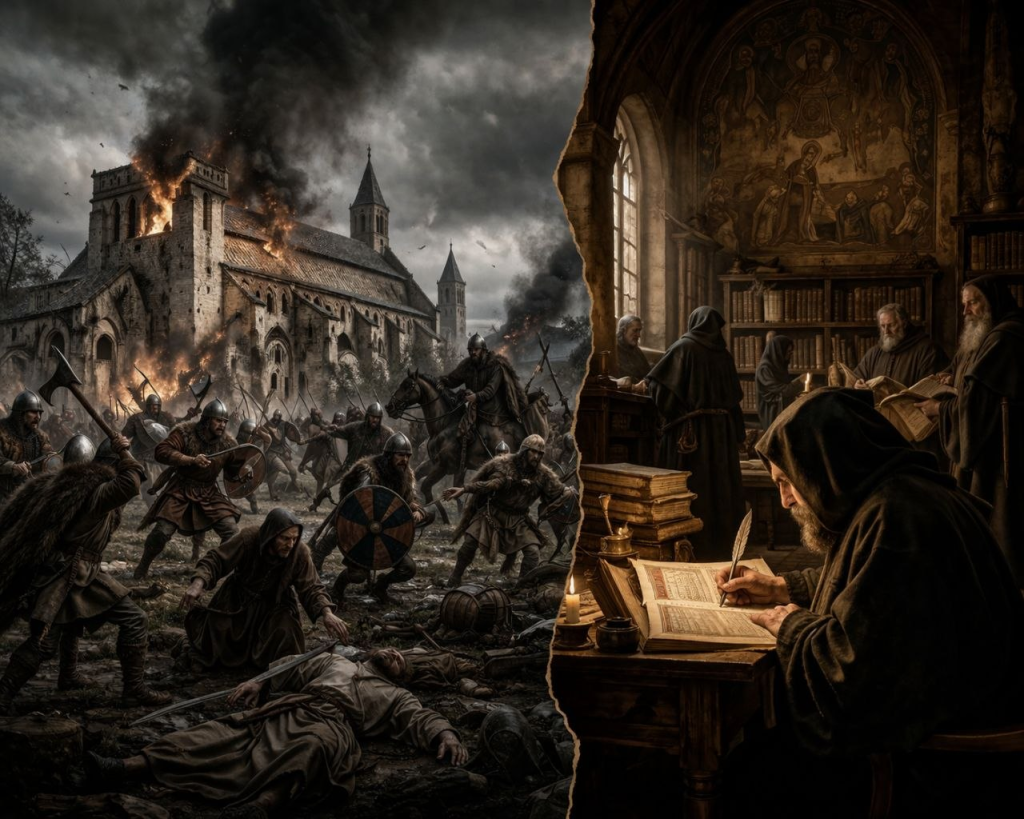
The convenient narrative goes like this: From the outside came the “barbarians,” the “heathens,” the enemies—and invaded Christian Europe. But this story is, above all, a perspective of those who wrote it down.
The uncomfortable reality looks different. While chroniclers lamented external aggressors, Christian princes had long been waging their own wars. They raided each other, plundered their own lands, and didn’t even spare churches and monasteries. The violence wasn’t an alien element—it was inherent to the system.
And who wrote about it? Precisely those monasteries that were affected. Their texts are not neutral reports, but interpretations. Raids were dramatized, atrocities embellished, events imbued with religious significance. Complex power struggles were reduced to a simple story: here the “Christian victim,” there the “heathen perpetrator.”
The result? A distorted view of history that continues to have an impact today. External enemies were stylized as symbols of evil, while internal violence was downplayed or pushed out of focus. Not because it didn’t exist—but because it was harder to fit into a morally clear narrative.
This doesn’t mean that attacks were fabricated from the outside. But their portrayal was selective, exaggerated, and ideologically biased. Anyone who truly wants to understand this period cannot be satisfied with the ready-made stories—but must ask: Who is telling what story here, and why?
Because the greatest deception in history is often not the lie itself, but the convenient oversimplification.
Take a moment and consider what is here written. Then, ask yourself, can this be applied to the state of geopolitical actions by the United States since, say, the end of the American Revolution? About the War Between the States? About the World Wars? About the wars in Asia and the Middle East? And perhaps especially, at the current moment? Think about it …
One response to “The Convenient Narrative”
The adage, “beauty is in the eye of the beholder” reflects upon one’s perspective driven by emotion. History’s past may be reflected as such, to a degree, with altered terminology. Given the complexities established of larger “advanced” societies, narratives have woven further into manipulation in the pursuit of greater greed to “humanities” produced abundance. Suppose this has always been true, but advanced from distant history.