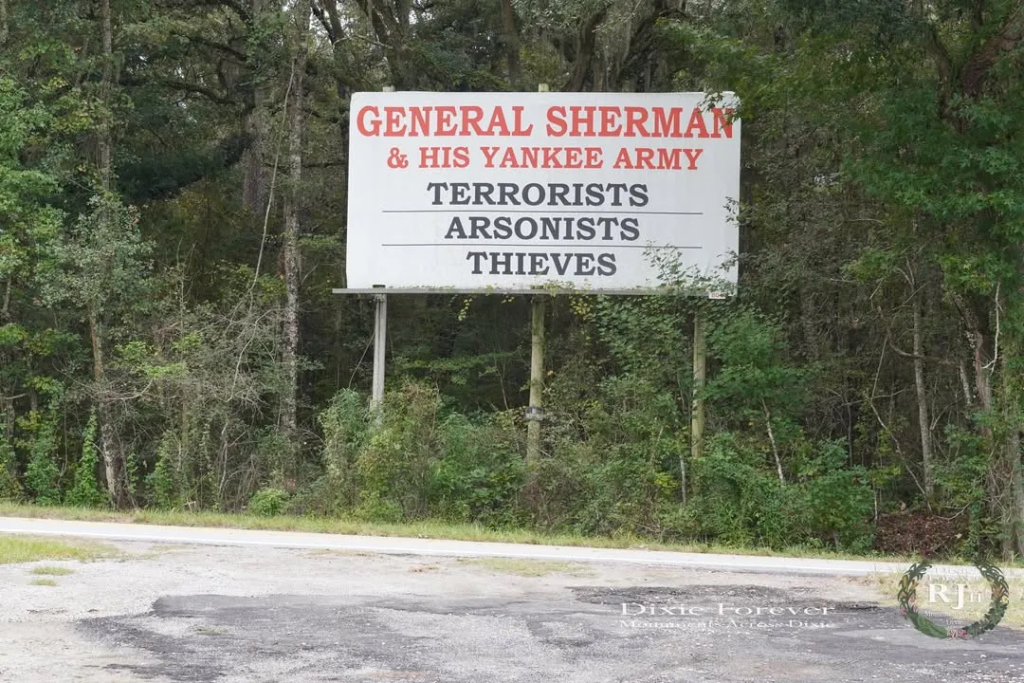
Know Your Real Southern History: General Sherman, The Butcher of the South

General William Tecumseh Sherman is hailed as a hero only by those with dark, vile, and twisted souls—individuals who revel in the wanton destruction of innocent lives and the trampling of sacred rights.

Admiring Sherman says everything about a person’s character—nothing honorable, just a love for despotism over liberty. Deo Vindice; the South remembers the true villains of history.

Continue reading …

h/t WRSA

Note: The Union has not changed much since then. War on civilians has been a rarely admitted standard feature. Dresden, Hamburg, Hiroshima, Nagasaki as examples. How many in Vietnam and Iraq? Gaza? Oh. Right. The Union only funds that one. No direct involvement.

0 0 votes
Article Rating

17 responses to “Know Your Real Southern History: General Sherman, The Butcher of the South”

  1. Let’s not forget Sheridan’s valley campaigns as other examples of Yankee war crimes

  2. Mightymanoftruth Avatar
    Mightymanoftruth

    Roth;
    Good post… William T. Sherman was a blood thirsty bastard, along the same lines as George A. Custer.
    I can come to no other conclusion than that they were both controlled/possessed by evil spirits.
    A quick note on Custer. He was LAST IN HIS CLASS at West Point, (class of 1861). He only rose to the level of being a flag officer because many of the officers above him made the right choice and fought for the Independence of the Southern States; and because of his willingness to butcher and massacre Native American women and children. He got what he deserved at Little Big Horn.
    HELL IS TOO GOOD FOR EITHER ONE OF THEM!

  3. I never studied Southern history but have lived in NC for 20 years. I visited the NC General Assembly library when I first came here to learn about the Civil War. I was amazed by the street signs around Raleigh which offered a small tidbits of NC history. I was shocked when Nicki Haley banned the Confederate flag. I was terribly shocked when bastards took NC statues down and pored paint and broke them. Cooper was a bastard as far as I am concerned when all this was happening. So was WRAL. Let the sun shine in. Thank you for some history I needed to read today. There is so much to learn and digest. I would never live up North again.

    1. For history: The Real Lincoln by Thomas DiLorenzo.

      1. Sarge in South Carolina Avatar
        Sarge in South Carolina

        A great book!!!

        1. Indeed it is! Seek out the Abbeville Insitute for others.

      2. Thanks! Will find this.

      3. Sarge in South Carolina Avatar
        Sarge in South Carolina

        Another great book is Walter Brian Cisco’s well-researched and documented, War Crimes Against Southern Civilians.

        1. My brother is reading Real Lincoln right now. I will mention war Crimes Against Southern Civilians to him and get it myself.

  4. Tragically Roth ignores other facts about Gen. Sherman. Simply, it was Gen. Sherman who championed the idea of compensation for native American tribes after they were displaced for their historical tribal lands. Which reminds me that it was the Cherokee people who were forced to relocate to Oklahoma so white settlers could take over their lands.
    I once commented to a Civil War historian about what Gen. Sherman’s army did on the March to the Sea. He responded that it was nothing compared to what the army did once it turned north and went through South Carolina. When I asked why South Carolina got harsher treatment he replied, “Because that is where the rebellion started.”

    1. I see what you did here. Let’s address the points:

      1. From Grok when I asked if Sherman advocated for Indian civil rights:

      No, General William Tecumseh Sherman did not advocate for Indian (Native American) rights after the Civil War. He played a central role in the U.S. Army’s campaigns during the Indian Wars (roughly 1860s–1880s), prioritizing westward expansion, railroad construction, settler protection, and the subjugation of resistant tribes over any notion of indigenous rights or sovereignty.⁠History

      Sherman’s Post-Civil War Role and Views
      After the Civil War, Sherman rose to Commanding General of the U.S. Army (1869–1883) under President Ulysses S. Grant. His primary tasks included securing the transcontinental railroads (Union Pacific and Kansas Pacific), protecting settlers and miners, and dealing with Plains tribes (such as the Sioux, Cheyenne, and others) who opposed encroachment on their lands. He applied scorched-earth tactics similar to his March to the Sea: targeting resources like the buffalo herds that sustained nomadic tribes, rather than just direct combat.

      2. You then switched to a different topic concerning the Cherokee relocation. The last general in the Civil War to surrender was Standing Watie who commanded Cherokee and other Indian tribes for the South. After the war, the “Union” did not recognize black slaves owned by Indians. They remained slaves until 1901:

      From Grok:
      the Black Freedmen (descendants of those enslaved by members of the Five Civilized Tribes) did not receive U.S. citizenship in 1865–1866. The 1866 Reconstruction Treaties only granted them tribal citizenship within their respective nations (Cherokee, Muscogee/Creek, Seminole, Choctaw, and Chickasaw), along with rights equivalent to “native citizens” (including land allotments and voting in tribal affairs). They remained outside full U.S. citizenship at that time because the tribes were sovereign entities in Indian Territory, and the 14th Amendment (1868) did not extend birthright citizenship to them in the same way it did for others.

      The Freedmen (along with other citizens of the Five Tribes) received U.S. citizenship in 1901 through federal legislation specifically addressing the Five Civilized Tribes—often referred to in historical and legal contexts as the 1901 Five Tribes Citizenship Act (or related provisions in the allotment acts of March 1901, such as 31 Stat. 1447). This occurred as part of the Dawes Commission process (1893–1906), which created the Dawes Rolls to enroll tribal members (including Freedmen categories) in preparation for land allotment, dissolution of tribal governments, and eventual Oklahoma statehood in 1907.

      3. Sherman was evil personified. You should read the atrocities as his “army” went through Smithfield, NC. No state in which he passed was spared from his wrath.

      So you made a comment with no citations, then you switched to another topic and then closed with another unfounded statement. And people wonder how we got here.

    2. And Yet;

      Declaration by the People of the Cherokee Nation of the Causes
      Which Have Impelled Them to Unite Their Fortunes With Those of the
      Confederate States of America

      http://www.unitednativeamerica.com/cherokee.html

      Remember, Sherman and the rest were making total war against their own countrymen, by their own insistence, since they regarded it as some kind of insurrection for sovereign states to freely leave the Union and form their own independent nation. The whole concept was the basis of the Declaration of Independence and consent of the governed which birthed the United States in the first place.

    1. I would still get Dilorenzo’s book.

      1. Getting Lorenzo book.

  5. DWEEZIL THE WEASEL Avatar
    DWEEZIL THE WEASEL

    Another group of facts about “Honest Abe” revolves around his pen pal, Karl Marx. I am not making this up. Read RED REPUBLICANS AND LINCOLN’S MARXISTS. And while you are exposing that Genocidal Terrorist Sherman, look up his partner in crime, Phillip Sheridan. He is attributed to have said “The only good Indian is a dead Indian.” American history has been sanitized by leftists such as Howard Zinn, Ken Burns, and their useful idiots in (((Hollywood))).

    1. Dweezel, thanks so much for suggesting these books. I am going to get them.

Leave a Reply to Ricky Bobby Cancel reply

Your email address will not be published. Required fields are marked *

17
0
Would love your thoughts, please comment.x