I woke up and as I had my morning coffee, I realized that everything is about to change. No matter how I vote, no matter what I say, something evil has invaded our nation, and our lives are never going to be the same.
I have been confused by the hostility of family and friends. I look at people I have known all my life–so hate-filled that they agree with opinions they would never express as their own. I think that I may well have entered the Twilight Zone. You can’t justify this insanity. We have become a nation that has lost its collective mind!
If a man pretends to be a woman, you are required to pretend with him. Somehow it’s un-American for the census to count how many Americans are in America. Russians influencing our elections are bad, but illegals voting in our elections are good.
It was cool for Joe Biden to “blackmail” the President of Ukraine, but it’s an impeachable offense if Donald Trump inquires about it.
People who have never owned slaves should pay slavery reparations to people who have never been slaves.
People who have never been to college should pay the debts of college students who took out huge loans for their degrees.
Immigrants with tuberculosis and polio are welcome, but you’d better be able to prove your dog is vaccinated.
Irish doctors and German engineers who want to immigrate to the US must go through a rigorous vetting process, but any illiterate gang-bangers who jump the southern fence are welcome.
$5 billion for border security is too expensive, but $1.5 trillion for “free” health care is not.
If you cheat to get into college you go to prison, but if you cheat to get into the country you go to college for free.
People who say there is no such thing as gender are demanding a female President.
We see other countries going Socialist and collapsing, but it seems like a great plan to us.
Some people are held responsible for things that happened before they were born, and other people are not held responsible for what they are doing right now.
Criminals are caught-and-released to hurt more people, but stopping them is bad because it’s a violation of THEIR rights.
And pointing out all this hypocrisy somehow makes us “racists”?! Nothing makes sense anymore, no values, no morals, no civility and people are dying of a Chinese virus, but it racist to refer to it as Chinese even though it began in China. We are clearly living in an upside down world where right is wrong and wrong is right, where moral is immoral and immoral is moral, where good is evil and evil is good, where killing murderers is wrong, but killing innocent babies is right.
Wake up America, the great unsinkable ship Titanic America has hit an iceberg, is taking on water, and is sinking fast. The choice is yours to make. What will it be? Time is short, make your choice wisely!
The first Qatari LNG shipment in three weeks has successfully passed through the Strait of Hormuz along an Iranian-designated route with Tehran’s authorization, Fars news agency reported.
Three weeks ago, following a US violation of a memorandum of understanding, Tehran mandated that all maritime traffic through the Strait require Iranian approval.
Fars said that the Qatari tanker presented clear identification data and adhered to the Iranian-designated route, allowing it to sail smoothly through the waterway.
—
The U.S. though, despite being an ‘ally’ of Qatar and Pakistan, did not like the precedence …
The U.S. has blocked a Qatari LNG tanker from continuing to Pakistan simply because it used the Iran-designated safe corridor, and not the US-backed one.
In response to repeated inquiries, we would like to reiterate that due to continued aggressive actions of U.S. forces in the region, passage through the #Strait_of_Hormuz is not feasible. Once stability is restored, all requests will be reviewed and permits issued progressively.
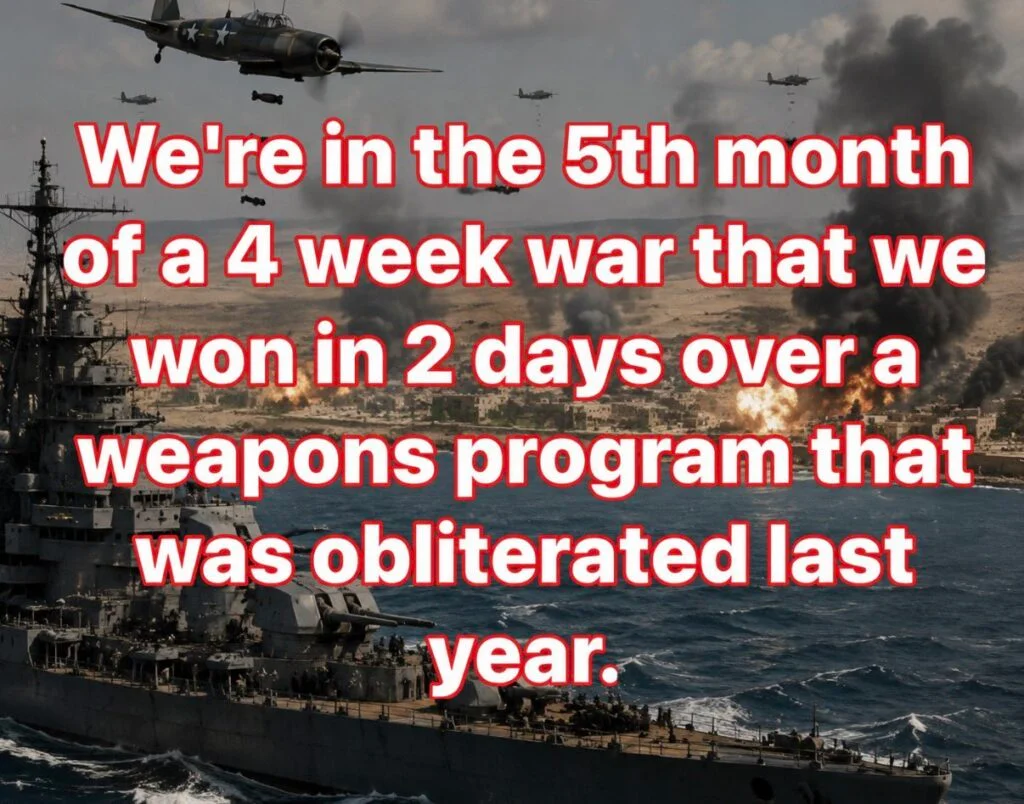
Trump orders major strikes on Iran, likely to start this weekend.
US adds sanctions, Bessent says Tehran can’t pay troops, as Iran faces growing pressure.
Most Americans say the Iran war isn’t worth fighting: AP poll.
Iran claims drone strike on US base in Kuwait – after no new US strikes overnight.
Oil rises as fears of wider conflict grow and lack of talks.
But this Friday’s somewhat ‘quiet’ state of things could likely dramatically shift at any moment, as has been the pattern this summer. The aforementioned Tehran-based analyst Dareini describes a serious change and overhaul in Iranian leaders’ strategic thinking, which has gone from defensive to proactive, with an understanding of the need to inflict pain on the US side in a preemptive way.
“Iranians are tired from suffering from limited US attacks,” Dareini said, charging that the US uses its declared pauses as a “deception tactic” merely in preparation for future attacks and operations.
“There has been a profound change in Iran’s strategic thinking,” he added. “The era of restraint is over. Iran has decided that, if needed, it has to take preemptive military action against the US.”
Waiting for y’all to discover Republican leaders in DC have also scheduled an October recess.
There are only 8 full work days and 8 half-days before the midterm elections. It looks like we’re intent on squandering a majority, until you understand Uniparty IS always the majority. https://t.co/EsZugVtUDCpic.twitter.com/1NQ99iqHCB
Elizabeth Lane on the secret NATO propaganda network pushing the West toward world war.
0:00 Where Are All the Bots Coming From? 9:41 What Was the Institute of Statecraft? 13:15 The Russian Agent Lie 15:11 Who Are "They"? 25:07 Who Is Peter Pomerantsev? 30:21 Where Does the… pic.twitter.com/krrxctHC6O
A year ago, I went looking for something like a Great Replacement Tracker — a site that aggregated all the demographic data for the West and could tell me how bad things really were. To my surprise, I couldn't find one. So six… pic.twitter.com/mC0medeC72
As most of you who have been here for the last seven years, David and I (and I believe Wes as well) were ABSOLUTELY CERTAIN this was not a bat virus from a wet market, and we were EQUALLY CERTAIN this was not an accidental release. We said so. Over and over.
IT WAS INTENTIONALLY RELEASED BY THE CHINESE MILITARY. WE ALL SAID THIS.
China has made a science of the study of Acceptable Losses. Most sources believe that Mao killed 65 million of his own people in the 20th century. THAT is what they consider Acceptable Losses. We would call it Democide.
Do not be deluded into thinking that China is done with this behavior. You would be far safer assuming that they are just beginning.
Spend 3 1/2 minutes. Watch the above video. Remember what happened. Remember that Anthony Fauci first publicly predicted a surprise infectious disease outbreak during the Trump administration in a January 10, 2017, keynote speech at Georgetown University on pandemic preparedness. Remember the lies we were told by the media, the demoncrats, and the Chinese.
THEY TRIED TO MURDER US ALL.
It’s not the flu, bro. It wasn’t a natural virus from a pangolin or a bat. It wasn’t an accident. It was a DELIBERATE, INTENTIONAL attack on all of us, our families, our nation, our world.
Sure, hate Israel all you want. Blame them for everything. Whatever. They’re evil. Got it. No argument there. But Israel is just a gnat compared to the monster that the CCP is. They intend to kill us all.
Spain has deployed just 60 troops to its North African exclave of Ceuta after thousands of migrants overwhelmed security forces and stormed across the border from Morocco, with up to 30,000 more people reportedly swarming the frontier. The Spanish Interior Ministry said the military contingent consisted of three platoons of 20 soldiers each, sent to reinforce the Guardia Civil after officers admitted that the border had “totally collapsed.” Madrid also dispatched specialized police units, bringing their total number to around 200, as well as 30 additional Guardia Civil officers.
The small military deployment came after Ceuta’s regional government pleaded with Madrid to take “decisive” action, close the border and declare a national emergency, warning that local police, hospitals and migrant reception facilities had been overwhelmed.
Prime Minister Pedro Sanchez’s government rejected the emergency request, arguing that migration does not qualify under legislation covering natural disasters, major accidents and other national catastrophes.
Of course it doesn’t. It’s war. Migrants and refugees should be met with military force at the border, or they will wage war on the native population. This is a larger invasion than the original one from North Africa that led to 700 years of Muslim occupation.
UPDATE: the invading force is up to 49,000 strong and they’re pillaging the towns.
Terrifying footage showed scores of people seemingly breaking into homes across the city late at night. One clip appeared to show a man on top of a ladder, hitting a first-floor window with an object. After migrants flooded into the city, many local shops chose to close early. Enrique Serrano, who runs a women’s clothing store in central Ceuta, told Reuters business owners were organising self-defence because they believed police resources would be insufficient.
UPDATE: Finland has joined Italy and Denmark in calling for Spain to be removed from the Schengen agreement.
“We can’t afford to be tired. Coloured men are not peaceful. They will take their sword, if we lay it. They once feared the white man, now they despise him.” — Oswald Spengler
The Fourth Turning Global War has entered its terminal phase, and the metrics suggest we are only beginning to comprehend the depth of the strategic trap into which American policy has walked.
The strategic position has deteriorated in ways that resist quantitative measurement. The American military, designed for power projection against insurgent forces and regional adversaries, has proven vulnerable to the asymmetric warfare tactics of a mid-tier nation with sophisticated missile technology and defensive geography. The Patriot missile systems, costing $2 million per intercept, face Iranian ballistic missiles and drones costing $10,000 to $50,000 per unit—a cost-exchange ratio that renders sustained defense economically unsustainable. The revelation that Russian and Chinese intelligence services are providing real-time targeting data to Iranian forces, confirmed by satellite intercepts and acknowledged in congressional testimony, transforms a regional conflict into a proxy war with great-power adversaries testing American vulnerabilities at minimal direct risk to themselves.
The European powers face civilizational exhaustion: demographic collapse, energy deindustrialization, and the progressive loss of productive capacity to Asian competitors. Their enthusiasm for expanded NATO commitments and confrontation with Russia serves not strategic interest but distraction—the displacement of internal contradictions onto external enemies. The recent declarations by French, German, and British leadership regarding “readiness for war with Russia” represent either dangerous delusion or deliberate provocation, given the demonstrated inability of European militaries to sustain ammunition expenditure for more than weeks without American resupply.
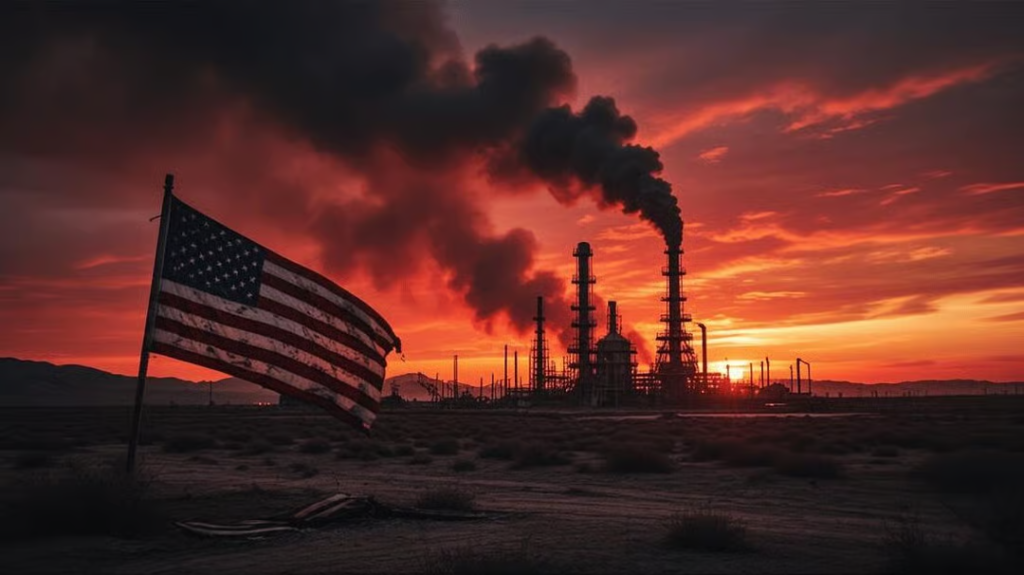
The visual landscape of collapse often precedes its statistical confirmation. The imagery from the Gulf region—satellite photographs of burning tanker traffic, thermal imaging of refinery complexes offline, atmospheric data showing particulate concentrations affecting regional agriculture—prefigures economic consequences that will arrive with lagging but inexorable certainty. The SPR drainage that has suppressed gasoline prices temporarily cannot continue beyond 2027 at current extraction rates. The Hormuz closure has already disrupted grain shipments to import-dependent nations, with wheat futures decoupling from traditional pricing models and phosphate export restrictions from Morocco and China threatening global food security.
Current trajectory analysis suggests the following developments with high probability:
By Q4 2026, the Strategic Petroleum Reserve will approach technical minimums, removing the administration’s capacity to suppress oil prices through market intervention. Energy costs will spike to levels that trigger cascading defaults in the transportation and logistics sectors, with trucking bankruptcies producing food distribution failures in major metropolitan areas. The Federal Reserve, caught between inflation acceleration and financial system fragility, will face the impossible choice of defending the currency or preventing sovereign debt crisis—likely attempting both and achieving neither through yield curve control that destroys market function.
The 2026 midterm elections, should they proceed on schedule, will occur against a backdrop of 6-7% inflation, 7% mortgage rates, and visible military failure in the Gulf. The political response—likely involving expanded emergency powers and the suspension of procedural norms—will accelerate the legitimacy crisis already visible in polling showing majority belief that “the system is rigged” regardless of partisan affiliation.
By mid-2027, absent Hormuz reopening, the global food system will face structural breakdown. Import-dependent nations in North Africa, the Middle East, and South Asia will experience mass migration events that make 2015 appear trivial. European border controls, already overwhelmed, will collapse entirely, producing the demographic and security crises that nationalist movements have predicted—and that mainstream institutions have dismissed as xenophobia.
The American military, exhausted by Gulf deployment and unable to replenish losses at industrial capacity, will face strategic overextension should conflict expand to include Taiwan or Korean scenarios. The revelation of actual casualty figures—currently suppressed through classification and media complicity—will produce domestic political crisis when inevitably disclosed.
The dollar’s reserve status will not collapse catastrophically but will erode incrementally, as BRICS+ nations complete bilateral currency arrangements and commodity producers demand payment in gold or yuan. This process, already underway, will accelerate as American debt monetization becomes impossible to ignore, producing the stagflation scenario that destroyed the 1970s consensus but at an order of magnitude greater severity.
We are not approaching crisis. We are within it. The Fourth Turning Global War is not a future possibility but a present reality, consuming the institutional capital accumulated over eighty years of American hegemony at a rate that precludes recovery. The debt cannot be repaid. The empire cannot be sustained. The social contract cannot be restored. These are not defeatist assertions but empirical observations, supported by Treasury data, CBO projections, and the visible degradation of infrastructure, education, and public health that surrounds anyone willing to look.
The winter is here. The long night has begun. And the saeculum, indifferent to human preference, continues its relentless turn.
Roth Note: Time to ‘lock-n-load’ and hunker down. Time is short. Top off preps now. Do not go quietly …
On a hopeful note from the article: The individual response to systemic crisis cannot reverse systemic trends but can prepare for systemic outcomes. The reconstruction of local capacity—food production, energy generation, security provision, currency exchange—represents the only available hedge against institutional failure. The Amish model, long dismissed as anachronism, reveals itself as adaptive strategy: technological selectivity, communal self-sufficiency, religious cohesion, and geographic dispersion providing the resilience that centralized systems cannot maintain under stress.










I was going to say.. I don’t dispute David’s points, however. Minimum wage does not equal middle-class. Burger flippers don’t…