
Cybele Mayes-Osterman, a reporter at the USA Today, wrote a story on April 16 that buried the lede… The enlisted personnel on board ships deployed to the Iranian war zone are not being adequately fed. Her article — Cookies, deodorant, socks. Iran war puts military packages in limbo — carried a misleading title, most likely the decision of editors eager to give cover for the failure of military and civilian leaders to ensure the sailors and Marines on board ships puttering offshore of Iran are being properly fed.
Her article starts with testimony from family members about the terrible food:
Dan F. was alarmed when his daughter, a Marine aboard the USS Tripoli, a warship deployed to fight the Iran war, sent him a photo of a meal served on the ship. A lunch tray, two-thirds empty, carried one small scoop of shredded meat and a single folded tortilla.
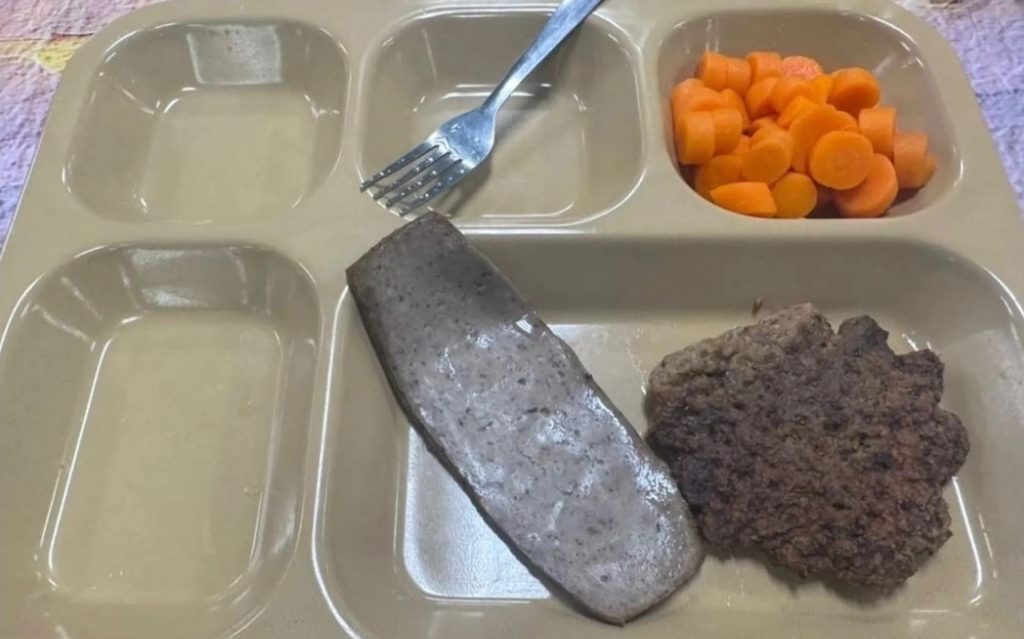
A picture of a mid-April dinner on the USS Abraham Lincoln, shared by a service member with his family, was similarly unappetizing – a small handful of boiled carrots, a dry meat patty and a gray slab of processed meat.
Dan and other military family members worried that their loved ones deployed to the Middle East are going hungry are filling boxes with items they hope could help service members ride out prolonged deployments in the Middle East – homemade fudge, Jolly Ranchers, crossword puzzle books, playing cards, toothpaste, Girl Scout cookies and fresh socks.
The article implies that the problem is lack of mail delivered in a war zone. While mail is not being delivered, that is not the problem. I have been in touch with two angry mothers. One has a son, a sailor who served on the USS Tripoli, who lost 30 pounds during his recent deployment. The other lady, who I met at Robert Barnes’ conference last weekend in Chattanooga, is the mother of a Marine who served on the USS Boxer. The sailor’s mom sent me photos, text messages and emails from her son describing the unpalatable cuisine. She has the receipts.
Roth Note: And they expect these youngsters to be fit to fight?
11 responses to “US Navy and Marine Officers on Board Ships in the Arabian Sea Are Failing to Feed Their Enlisted Personnel Properly”
The FUSA really has devolved into a bad joke. Outrageously stupid stuff like that reported in this article is already common, and will only get worse from here, because the budgets and the logistics and are all FUBAR. The basic competence to run this stuff no longer exists, and – worse still – nobody directly involved gives a damn. Before too long, “our” military is going to take an ass kicking due to straight up lack of readiness and supply.
The damage from that event will be undeniable and unavoidable. And just like that, we will no longer be able to delude ourselves (those who still somehow think it’s Regan’s America, and that “we’ve got this”, present company excluded) that we are a serious, capable world power.
The terminal phase of empire decline is a real bitch that way. The NPC’s are going to be choking to death on the cumulative lifetime supply of black pills they’ve thus far managed to avoid taking, while they’ve continued to ingest an endless diet of mainstream narrative (read: bullshit) for the last couple of decades. Wait until they get a load of unvarnished reality. The reactions should be most entertaining, for those of us who’ve long since figured it out.
Freeze Dried Wholesalers – who claim to fulfill food contracts for the US military – are constantly emailing that they have this or that food (veg/fruit/grains/meat) for sale. In the past they’ve sold midrats and various fast food (name-brand pizza and burgers) as well – all freeze dried. If troops aren’t getting that food, I wonder just where all the 30 year freeze dried steaks and lobster are going?
I have not been over to Sonar21 to read the whole thing yet, but I suspect what we are seeing in this respect is the gradual breakdown of the logistical system under wartime conditions. Iran has been hitting the fleet support facilities within missile range throughout the theatre. These hits are less glamourous than the impacts on combat units/systems and oil infrastructure, but there is a real cost over time to the readiness of the deployed forces when the logistical tail is being consistently targeted.
If you remember some of the convoy attack incidents at the height of the Iraq and Afghan wars, our “combat” units and the USMIL as a whole are extremely reliant on modern creature comforts as a foundation of troop morale. Many of the GWOT convoy ambushes in those wars were conducted against civilian contract truckers being highly paid to deliver toilet paper and other luxuries to the Burger King franchises at forward operating bases. In Iraq the supply routes ran through insurgent controlled regions, and the Afghan supplies were trucked through Pakistan and were interdicted by Pakistani Taliban. These attacks never really affected the US ability to conduct those wars, they were just a costly public embarrassment that highlighted the vulnerability of US logistics due to the emphasis placed on luxuries in the modern military. At Khe Sahn in 1968 the besieged US Marines lived on cold C rations that were air dropped by parachute for 3 months. That is just the norm in a highly kinetic contested warzone. It was always that way in war. In the 19th Century sailing navy you would be gone for 3 years and eat rotten, wormy food the whole time. We are living in the era of the “Ice Cream Soldiers” as Phil Caputo described them in his “A Rumor of War”. That is harmless when you are dominating low end insurgents, but problematic when you decided to take on an innovative modern nation that is a regional power.
The lack of mail getting through is probably related to the rest of the logistical shortages since it is probably routed through the same locations as the rest of the supplies and it is subject to being hit by drone of missile fire. It is also not out of the question that the US Mil would delay mail home from deployed personnel if there are morale problems, since keeping up appearances is the War Department’s top priority.
No bias in this article? I call BS on this. The writer even got their bash Trump comment in. I was at sea much of my time in the Navy. The fleet is well serviced by support ships on a continual basis.
A lot of us SERVED decades ago, sir.
Things have changed a bit since then.
Please do some research and show us some links that show our personnel in that zone are doing so much better than described.
I doubt I could find you exact numbers of support ships available as I would believe that would be classified. I served on an AOE (Fast Combat Support Ship). We carried fuel, munitions, and dry food goods as well as refrigerated/frozen foods. In large quantities. AOE and AO (fleet oilers are deployed with carrier strike groups along with the other combatant ships supporting the carriers mission. We unreped and vert reped supplies to ships in the strike group while underway. Supply ships can resupply at sea from other naval supply ships, thus avoiding what may be designated as risky resupply areas. Yes sometimes there are food and water limitations on board ship due to mechanical issues that may restrict what is going on in the galley. Evaporators down restricting cooking and bathing etc. I’ve had the experience of water rations and C rations etc. Sometimes you just got to suck it up until things straighten out. I believe this article was put forward for propaganda purposes. Ask yourself, “Why does everything have to be a conspiracy.” We don’t know the why in all this.
Sorry Bill S it’s not classified that the US Navy has been steadily decommissioning and or mothballing Naval Resupply ships AND replacing them with Civilian shipping.
The AOE you served on as an example (I could post an entire article from US NAVY sources if you like):
The first class of AOEs was the Sacramento-class, introduced to provide the largest fuel and ammunition capacities of the time, along with multi-product supply stations and helicopter support
These ships were retired in 2005. They were succeeded by the Supply-class, which became the largest combat logistics ships in the U.S. Navy, including:
USNS Supply (AOE-6)
USNS Arctic (AOE-8)
USNS Rainier (AOE-7)
USNS Bridge (AOE-10)
As of the mid-2010s, Rainier and Bridge were placed in reserve, leaving Supply and Arctic as the primary operational AOEs
combattech.net
These ships are now operated by the Military Sealift Command (MSC) with civilian crews, providing cost-effective logistics support while maintaining combat readiness
United States Navy
Since the peak of Operation Praying Mantis in 1988 against Iran, we’ve replaced our Middle eastern supply and refit to BASES (Currently blasted by Iran’s missiles) and Civilian shipping.
It’s not a conspiracy and NOBODY Here even mentioned that idea.
It’s bad management and “COST CUTTING”.
Now it’s the Butchers Bill time.
Consider this. There is a known fuel, raw material, and International trade supply problem stemming from the impacts of the SoH and BaM strait closures. How does the US Navy currently source class 1 and class 6 for forward deployed units in the war zone? Does it procure them from domestic sources in CONUS at US prices and ship them to the other side of the world, or do they utilize local procurement whenever possible? If consumer goods are getting scarce in the Far East and elsewhere and we were peacetime customers in those markets to simplify our logistics for toothpaste and toilet paper, it makes sense that availability disruptions will impact our forces to some degree. We can certainly adapt, but that does not mean that there wont be some class 1 and 6 shortages at the sharp end until the logistical adaptations are up and running.
Regardless of where those supply items are procured, they have to be consolidated somewhere and transferred to the deployed vessels underway. The bases in Bahrain and Oman that provided this fleet support activity in the past have been either destroyed or have been hit multiple times and are still subject to Iranian fires. I suspect the bulk of this activity has been transferred to Diego Garcia. The distance support ships must now travel back and forth to keep the combat ships supplied is now 3 or more times the distance our system was accustomed to. Diego Garcia is also a long way from anything else in the world, so everything being sent there in bulk to be transferred to supply ships is subject to extended travel time too.
Frankly, your personal anecdote about eating well in the peacetime Navy at some distant point in the past is immaterial to current realities, and since Trump makes an ass out of himself on a daily basis, there is no reason for someone to manufacture fake pictures of short rations on food trays to embarrass him.
Well said, and goes to my point upthread, while doing an excellent job of fleshing out the details.
Thanks BRD. I ended up researching a bit to answer my own questions. Turns out that there are only a couple of underway replenishment ships left in the fleet and maybe 4 total. USN has been cutting these as a cost saver for over a decade, and I suspect they were becoming more reliant upon frequent port visits for deployed ships as resupply opportunities instead of the technically complex and potentially dangerous underway replenishment. That being the case, they obviously have not planned for long endurance conflict or heaven forbid, having these few supply ships being targeted or lost. In any event, it is pretty clear that the peacetime norm for them was to sail with perhaps the 30 days of class 1 Hegseth is hiding behind and it was expected that there would be a port visit to replenish before that was consumed. If there is no time or opportunity to pull a combat ship out of action when the weekend regime change war you expected lasts for 6 months, and the regional shoreside supply depots have been flattened with missiles, I can only conclude that the supply system for our forces afloat is much worse than these leaked stories suggest. The replenishment ships can only go so fast, carry so much, and resupply so many ships on each trip. I doubt they can keep up a pace that will keep 1 or 2 CBGs and an ARG fed to the level of peacetime norms, especially if the planned fleet support activity bases were put out of service by the enemy.
It does make you laugh to think about these limitations though when you hear about pundits calling for a land invasion of Iran. We can’t even sustain ourselves sitting offshore just out of their missile range is it is now.
These finer points (as you have outlined) are the sort of thing I try to convey to the few remaining gung-ho MAGA types who remain in my periphery. They somehow believe (because they don’t see these behind the scenes problems, nor typically hear any disclosure of them) that things are hunky dory, and the FUSA .MIL will continue to kick ass and take names like they did, once upon a time.
This is not even the military of the Vietnam era, replete with McNamara’s Morons. What we have now is a hollowed out shell of a military that can put on a good short term show against a non-peer adversary, mostly using high tech weapons that make for impressive TV footage. But once it gets serious, and they are facing a capable enemy of more or less equal capability in a grueling effort over a longer time frame, the illusion breaks down quickly. And all because the ruling class is entirely unserious and incapable themselves, and have allowed it to be so mismanaged.