
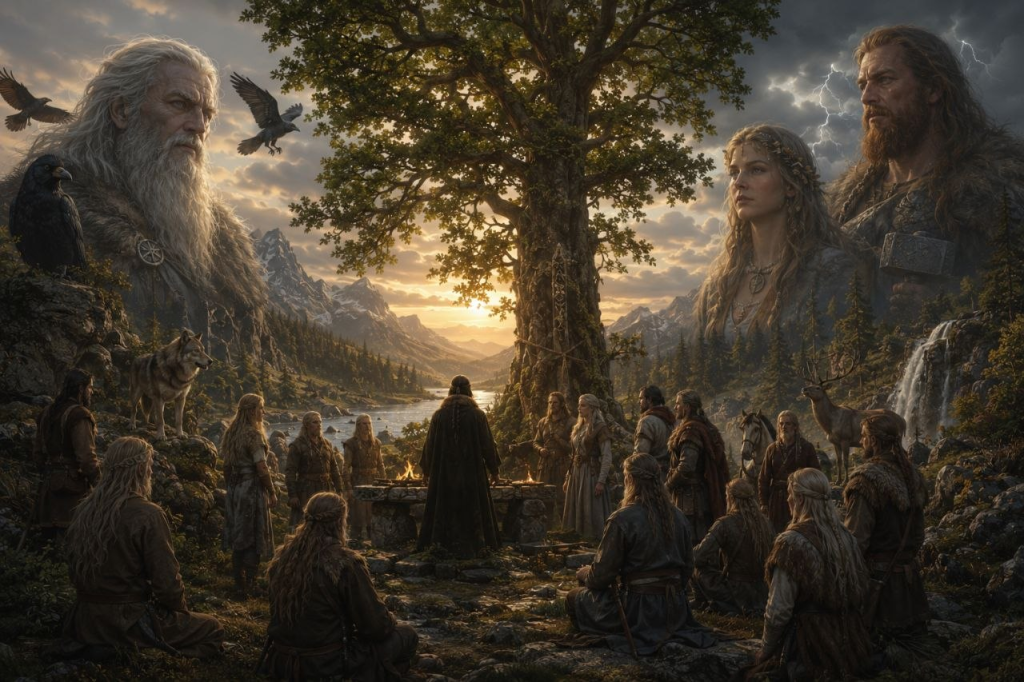
The oldest traditions tell not of a human who bowed cringingly before the gods, but of one who knew their place within a living cosmos. Sky, earth, sea, and fire were not separate worlds, but expressions of the same great order from which the gods themselves emerged. They did not stand apart from nature—they were its most powerful figures, its voices, and its faces.
It was only in later worldviews that concepts such as fear, sin, punishment, or blind obedience were imposed upon the relationship between humanity and the divine. Yet the ancient myths reveal a different understanding. There, the relationship is defined by honor, reciprocity, and responsibility. The gods were honored not out of fear of retribution, but because their presence was recognized in the forests, rivers, mountains, and thunderstorms. Offerings were not acts of penance, but gifts that renewed the bond between the worlds. Those who gave, received; those who received remembered to give in turn. Thus, the cycle of life kept turning.
The Hávamál does not ask its audience to profess faith in Odin. It offers counsel on reciprocity, reputation, friendship, prudence, generosity, and honour. When it speaks of sacrifice and prayer, it does so in the language of exchange and obligation. Belief was certainly present, but it remained embedded within a way of life rather than standing above it as the defining test of religion.
The gods demanded no submission. They demanded character. Courage mattered more to them than obedience, truthfulness more than blind piety, and wisdom more than empty words. Even Odin did not gain his insight through power alone, but by paying a price. Týr sacrificed his hand for the sake of a higher justice. Thor repeatedly confronted the giants—not out of hatred, but because order can only endure where someone is willing to stand as its guardian. The gods themselves were not exempt from fate; they, too, were woven into the great tapestry of becoming and passing away.
Thus, the divine was never distant. It spoke in the wind brushing through the treetops, in the rushing of water, in the flight of the raven, and in the first light of morning. Those who lived attentively could discern its traces everywhere. Nature was not human property, but a sacred community in which every being had its place and every action elicited a response.
In this worldview, humanity was neither the ruler of creation nor a sinful being yearning for redemption. Humans were part of an infinite tapestry—guardians of their word, their kin, and the land that sustained them. Honor meant preserving this balance. Wisdom meant reading the signs of the world. Strength did not mean ruling over others, but remaining true to oneself, even as storms and darkness gathered.
Perhaps therein lies the timeless power of the ancient myths. They teach not fear of the divine, but reverence for life. They remind us that humanity does not stand above nature but was shaped by the same forces as the eagle, the river, and the lightning. The gods are not judges of the world; they are part of its eternal breath. To encounter them, one need not lower one’s gaze, but rather learn to walk through the world with open eyes.
For the sacred does not dwell beyond life. It lives in the wind that stirs the forest, in the fire that grants warmth, in the water that connects all things, and in the earth from which every being emerges and to which it eventually returns. Those who recognize these connections encounter the gods not as subjects, but as conscious parts of the same great order—sustained by honor, wisdom, and the ceaseless cycle of existence.
The conception of humanity, too, differs fundamentally. While ideals such as forgiveness, love for one’s enemies, and turning the other cheek hold a central place in the Christian tradition, we encounter a different ethos in the ancient pagan traditions. There, it was considered a virtue to stand up for what had been entrusted to one: family, kin, homeland, and one’s word. Yielding was not an ideal in itself. Where an injustice occurred, it was right to confront it with courage, determination, and a sense of responsibility.
Peace was a precious good—yet not at the cost of honor or the abandonment of what had to be protected.
The old gods were not teachers of submission. They embodied qualities that humans were meant to cultivate within themselves: wisdom without arrogance, strength without cruelty, courage without hubris, and generosity without the expectation of a return. It was not blind obedience that led to closeness with the divine, but rather a life lived in harmony with the natural order and one’s own obligations. Honor was not a gift from the gods, but something each person created for themselves through their actions.
Roth Note: If one considers the founding of America – the mountain men, the pioneers, the cowboys – one would have a difficult time suggesting they weren’t following The Old Ways, regardless of their religion and who or what they prayed to or thought of as gods. My point in all this? The Virtues. We need to return to the Virtues. Virtuous men built American civilization. Only virtuous men can restore it.