
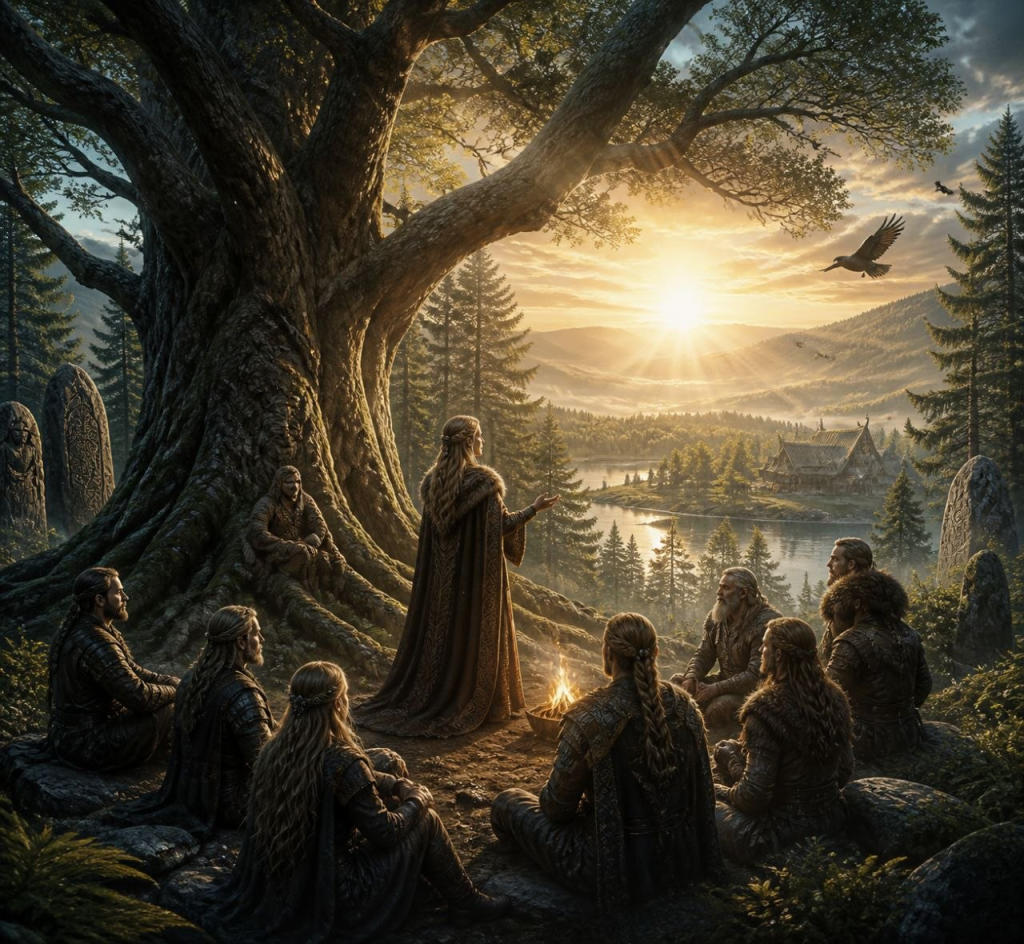
It is said that every people carries within it a stream of memory—older than kings, older than castles. Deep beneath the roots of ancient forests, where mist and morning light meet, the echo of the ancestors rests.
There, the stones tell of a time when honor weighed more than gold and a spoken word was more sacred than any oath. It was not power alone that made a person great, but loyalty, courage, and the willingness to bear responsibility for kin, family, and community.
Ancient chroniclers described the peoples of the North with a mixture of admiration and wonder. They saw people who knew the forest as a teacher, viewed the sky as a mirror of destiny, and recognized the breath of the divine in the changing seasons. To many, the woman was the guardian of the hearth, a counselor and seer whose voice commanded attention in matters of great importance. In the lore, she appears not as a shadow of the man, but as a bearer of wisdom, dignity, and inner strength.
Ancient myths tell of the World Ash, whose roots touch the wells of wisdom; of the Norns, who weave the thread of life; and of the ancestors, whose deeds live on in the songs of their descendants. In this context, memory is not a burden but an obligation: to preserve what is good, to learn from mistakes, and to leave future generations something more than mere possessions—namely, character.
The spirit of the ancestors lives on not in the blood alone, but in the deeds of the living. Whoever acts justly, seeks the truth, protects their family, and respects nature carries forward the legacy of the ancestors. Thus, the past becomes a source of guidance.
Every human being stands between the roots of the past and the branches of the future. Those who honor memory recognize that true strength springs from steadfastness and wisdom. Thus the wind whispers through the crowns of the old trees: Remember who you want to be.
From Huter der Irminsul