In Old English, the name *Engla Land* literally meant “Land of the Angles.” Over the centuries, the name England evolved from *Engla Land*. Behind this name lies one of the most profound migrations in European history.
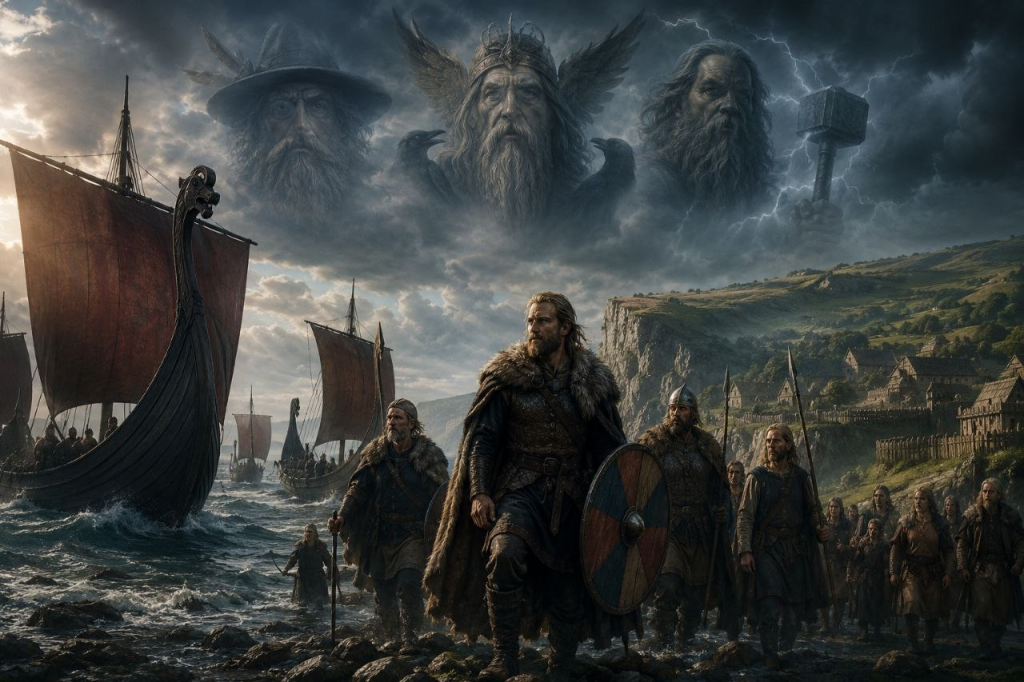
Medieval chronicles—most notably those of the monk Bede the Venerable—report that in the years 449–450 AD, following the withdrawal of Roman legions from Britain, Germanic tribes crossed the North Sea. These tribes were primarily the Angles, Saxons, and Jutes.
The Angles likely originated from the region of Angeln in present-day Schleswig-Holstein. The Saxons came from northwestern Germany, while the Jutes migrated from the area of modern-day Jutland in Denmark. Initially summoned as mercenaries, they soon emerged as the new rulers of large parts of Britain.
In mythological tradition, this migration appears not merely as a political conquest but as a fateful journey for a people. The sea marked the boundary between the old world and the new. Their ships carried families, weapons, images of gods, and memories of their homeland across the stormy North Sea. With them, ancient Germanic beliefs also arrived in Britain.
The Angles and Saxons worshipped gods such as Wodan, Thunor, and Tiw. Their names live on to this day in the English names for the days of the week:
Tuesday – Day of Tiw/Tyr
Wednesday – Day of Wodan/Odin
Thursday – Day of Thunor/Donar
Thus, the memory of the old mythology endured even after Christianization.
Historically, however, a unified England did not emerge immediately. Initially, numerous Anglo-Saxon kingdoms were formed—including Kent, Sussex, Essex, Wessex, Mercia, East Anglia, and Northumbria. It was not until several centuries later that the Kingdom of England evolved from these foundations. The name *Engla Land* thus became the symbol of a new identity: a people emerged from various Germanic tribes, and their language—Old English—formed the foundation of modern English.
History and mythology intertwine here. Historically, the story involves migrations, power struggles, and the founding of states. Mythologically, the legends tell of a people who heard the call of the sea, left their homeland, and established a new realm on an island—a realm whose name still recalls the Angles to this day: *Engla Land*—England.
From Huter der Irminsul
Roth Note: History teaches us that people groups move across the earth, one group displacing another. We saw Europeans displace Native Americans. We see a similar movement today, only we are those being displaced. One only keeps their land if they are strong enough and willing to fight for it. Are we Heritage Americans strong enough and willing?
4 responses to “Engla Land – The Origins of England: Between History and Myth”
I just have to smirk. Here you are, documenting the hardy, brave folks who settled *Engla Land* after the Romans left. They established governments, fought off Vikings, sent their men on Crusades against the murderous Muslims, and, until 1914, ruled the waves.
Yet, just above your post is a documentation of the rapes taking place in Glasgow. So where are the Willam Wallaces and Rob Roys? This is pathetic. I would think that recent Armie Hammer fantasy vigilante movie would motivate the Scots to rise up and defend their women. Years ago, when I was working as a Peace Officer in SoCal, there were times when I investigated crimes of vigilante justice. And I did not investigate them all that hard. I guess now the Scotsmen are more interested in drinking up all the beer in Boston while attending this ridiculous World Cup bread-and-circuses distraction. Scotland ist verloren. Schade!
My theory is that most of the real men in Europe were killed in the two World Wars. The few who were left sired sons who became ‘girly men’ by way of the education system and feminism.
Right on Roth! We need to find some real vikings layered in muscle and principle!
Eerie…I thought the same thing. Men of Scotland WTF are you???? They are your sisters!!! EYEDOTS! Eidjits, so on and so on….a beer mug does not a man make!