Note: There is no reason one cannot accept and worship Christ while embracing one’s pre-Church life-ways. Christ is not my enemy. Modernity and the Church doctrines are.
For many people, paganism is not a new religious trend, but rather an expression of a worldview that they understand to be deeply rooted in nature, in the life and in the traditions of their ancestors. From this point of view, people do not only become pagans through a conscious decision, but rather rediscover something that is perceived as an original connection with the world.
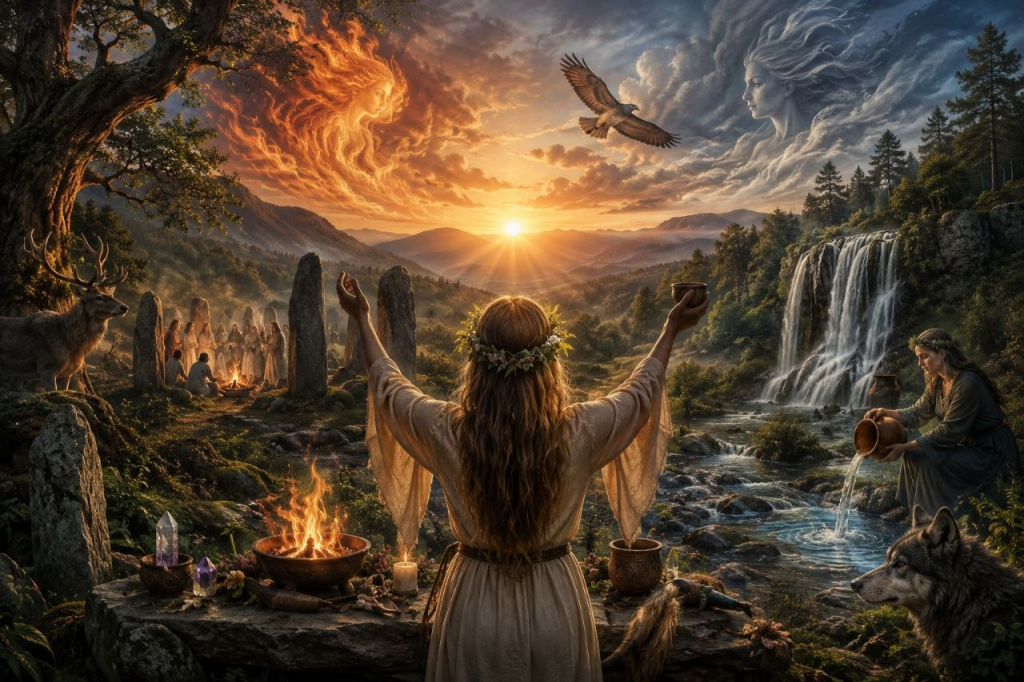
The pagan soul is like an old song that sounds through the forests, a whisper from the earth that reminds people of their origins. It lives in respect for the forces of nature, in awe of the circle of life and in the awareness of being part of a larger whole. The earth is not seen as a mere resource, but as a living soil full of memories, stories and experiences of past generations.
This connection is revealed in the elements. Fire stands for change, creativity and renewal. The water reminds us of the depth of life and the ways of our ancestors. The wind embodies freedom and movement, while the earth gives stability, home and fertility. Nature is not viewed as something alien, but rather as a living counterpart with which humans have a relationship.
Over the course of history, the religious and cultural landscapes of Europe changed profoundly. With the spread of Christianity, many pagan traditions disappeared or were transformed into new forms. Historians point out that this process affected not only religious ideas, but also social structures, customs and forms of communal identity.
Those areas that shaped daily life were particularly affected. Healers, seers and knowledge keepers lost their social status or were viewed as carriers of unwanted teachings. In many places, festivals and calendars that were based on the seasons were replaced or superimposed by Christian holidays. The veneration of ancestors, the memory of one’s origins and the connection to the community received new interpretations.
Sacred places also experienced change. In many places, springs, groves, mountains and other places of worship lost their original meaning or were integrated into new religious contexts. Rituals that previously accompanied social life, jurisprudence or community decisions were replaced by ecclesiastical forms. This not only changed religious practices, but also the way communities organized their coexistence.
In many pre-Christian traditions, women played an important role as guardians of knowledge, healing and customs. With social change, many of these functions were restricted or lost public importance. Likewise, oral stories, songs and narratives came under pressure, even though they had been carriers of memory and identity for centuries.
Nevertheless, the old ideas never completely disappeared. They lived on in folk customs, legends, songs, festivals and in the close relationship many people have with nature. In this perspective, paganism is understood less as a clearly defined religion than as an attitude towards life: respect for nature, responsibility for the community, remembrance of one’s ancestors and the willingness to actively shape one’s own destiny.
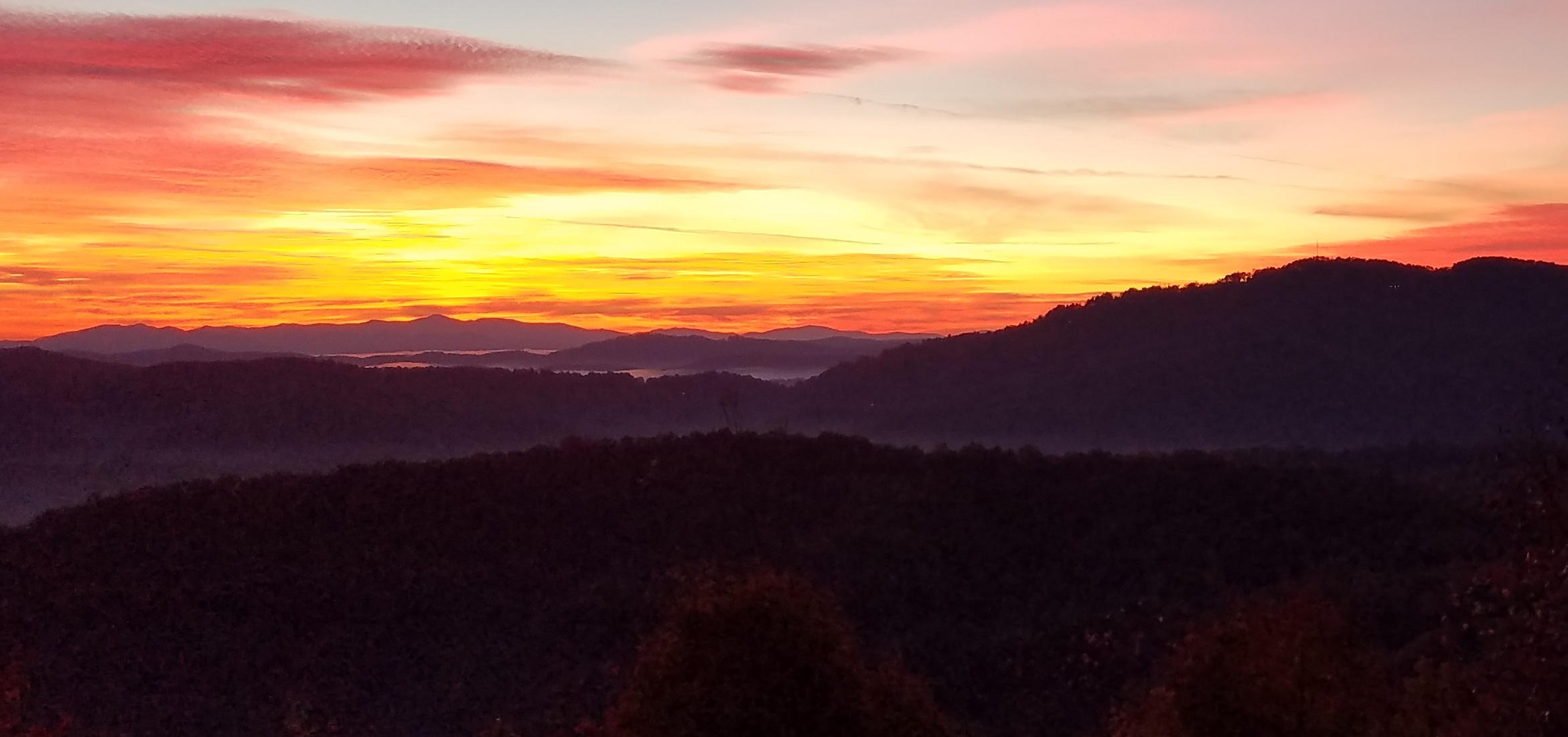
Every sunrise is seen as a new promise, every rain as a blessing and every season as part of an eternal cycle of growth and decay. The songs of the birds, the rustling of the forests and the flowing waters remind us that all life is connected.
From Huter der Irminsul
11 responses to “The Heathen Soul – Memory, Freedom and Connection”
Memory, Freedom, Connection, Human sacrifice, solstice murders, etc: https://www.thegatewaypundit.com/2026/06/horror-british-man-is-brutally-murdered-bronze-age/
This is where all of these pagan cults end up. I think it is ironic, given the murder of Henry Nowak that these clueless Brits still think they are head and shoulders above Christianity by standing around naked in some Wiccan circle summoning the spirits of thunder and lightning. Now, if the victim of their paganism had been a Prajeet groomer, I would have applauded.
Worship trees, rocks, creeks, birds, etc. Just remember my clueless Pagans, the Creator, The Great I Am, made them all. And his Son will come again in glory to judge the living and the dead. Mr. Gerolamo, please edit this pagan crap. It’s an annoying distraction. Thanks.
The Old Ways is not about ‘worshipping’ trees, rocks, creeks, and birds. It’s about respecting them.
FYI: Pagan is a catch all that includes anyone not Christian. That includes a lot of territory. European folks were not like the third world pagans infecting our shores. They revered their ancestors and saw the divine hand in nature. Wiccans are neo-pagan and not followers of The Old Ways. Instead of the knee jerking, why not do a bit more research? I used to believe exactly what you evidently do, but changed my mind after doing a deep dive. You should try it.
As for my posts, they’re not a distraction if you ignore them. It seems some folks can spout religion all day long and expect everyone to respect their way of thinking, but become incensed if anyone offers a different path.
So, I guess the human sacrifice of the Druids (the mummified bog man) is not “worshipping”? My “Deep Dive”, if you will, is centered around the Gospel of Matthew, Chapters 24 & 25, and Paul’s Second Letter to Timothy, Chapter 3, verses 1-9. That is truth, spoken by My Lord and Savior, Jesus Christ and his Apostle, Paul.
I confine my respect of nature to my raspberries, sunchokes, kale, and other garden staples, as the growing season here in North Idaho is short. And I make sure the coveys of quail and flocks of doves have plenty of seed in the feeders. Proverbs 27:12. Enjoy the decline.
No human sacrifices were committed in Stonehenge.
Deu 12:2 and 12:3 My shorts are not twisted and bunched up, who else but you Roth has been given the green light to sell their pagan worship here. I do not see or agree with your views, I will seek God Almighty and my Lord and Saviour Jesus Christ.
Good post, Tom. I couldn’t agree more with every aspect of it.
To Tom, and all others: I stand on the Rock of Jesus Christ and by his grace I shall not be moved. Here’s how I came to know him:
From the time I was 14 years old, until my 23rd year, my life was a mess. I was a drug addict and alcoholic. When I tried to quit drinking I quickly discovered that I was physically addicted to alcohol and could not break free by way of my own efforts.
Over a period of a couple of years, beginning in my 21st year, my faith in Jesus Christ grew rapidly as I read and studied the King James Bible. “So then faith cometh by hearing, and hearing by the word of God”. Romans 10:17. The goodness of God led me to repentance, (Romans 2:4). On April 3, 1984, at 23 years of age, I finally repented and submitted my life to the Lordship of Jesus Christ, the Son of Almighty God. “For godly sorrow worketh repentance to salvation not to be repented of: but the sorrow of the world worketh death.” II Corinthians 7:10. I have been completely free from that night unto today, “If the Son therefore shall make you free, ye shall be free indeed.” John 8:36. This is all to the glory of God…not me.
This didn’t happen because I “got religious”, but because I was seeking Him with all of my heart. Jeremiah 29:13.
Anyone that tries to convince me that Jesus Christ is not who he said he is, (the Son of God), is more than 42 years TOO LATE!!
My deliverance was just the beginning. Since then I have walked with God. He has revealed himself and shown himself to me in so, so many ways over these many wonderful years. He is Faithful and True. He will never leave me nor forsake me. “For the eyes of the Lord run to and fro throughout the whole earth, to shew himself strong in the behalf of them whose heart is perfect toward him.” II Chronicles 16:9.
BLESSED BE THE NAME OF THE LORD!!!
[…] recent post caused some concern in the comments section. Shorts in a twist, as it were. It should be understood […]
Thank you Mr. Harbard.
The Catholic church decided what was to be considered the Word of God, and how faith is supposed to be practiced. Protestants mostly follow Catholicism.
I have found these to be nothing but systems of con-troll. They con us and then they troll us to keep us in line. Disrespecting the old ways causes us to lose wisdom, insight, and even health.
I love Jesus. Churches lie to me. I appreciate you sharing your wisdom of the old ways with me. I’m half German.
There is no ‘pagan religion’. Pagan is a term invented by christians to describe non-christians, like the muslims use ‘infidel’ to describe non-muslims, and the jews use ‘goyim’ to describe non-jews. As for anyone who says “I’m a pagan, but I believe in jesus christ”, well, You are the Oxy Moron…
“christianity” of the church of Rome methodically Destroyed, by Murder and Persecution, any and all Beliefs that they saw as non-christian. This is one of the reasons that what is called “Paganism” today is a fractured Remanent of the original White European Understanding of the World. this was accomplished by the Murder of the Elders who passed on Knowledge and Beliefs in societies with little or no Written Records. In addition, any Records, and a lot of Monuments were destroyed as well. Places like Stonehenge survive only because the early Roman ‘church’ didn’t have Explosives or Heavy Machinery. And a Lot of Deliberate Damage to Cultural Heritage Sites was done in both jew war I and jew war II.
I Despise and Disrespect any White Man who endorses ‘christianity’, for it is a creation of a Brone-Age Death Cult that worships a ‘god’ who Hates the non-jew. Do some research into the ‘babylonian talmud’, the Root of this Evil.
Brother, I was one with you until the last paragraph. We are of one mind until then. However, I cannot despise and disrespect white Christians because they are my Folk. My family were and are all Christian. We and they, together, must fight the evil in the world. We can bicker among ourselves later. I don’t disagree that I believe they are mistaken in following what I consider a Jewish religion, but they think I’m lost because I don’t see Jesus as my savior. So we should just agree to disagree amicably and get on with fighting the enemy that could destroy all white folk. As to the Talmud, you are absolutely correct. Those who dare to actually do a bit of study should come to the conclusion that Islam is a symptom only. Talmudic Judaism/Zionism is the cancer. It’s the Jews. Always has been. They hate us because of Rome.