
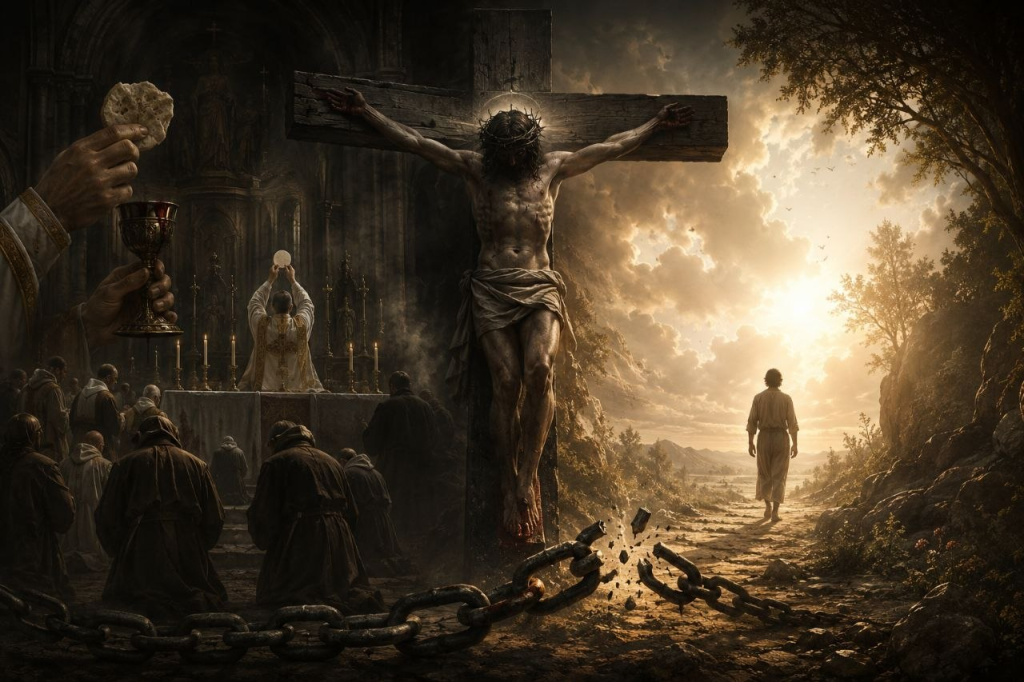
Note: This is just something to consider. It is not an attack on anyone’s faith. I certainly have no issues with most of the teachings of Jesus, I aplaud most of them. Rather, this post only questions the legitimacy of ‘the church.’ As many of us have discovered, organized religion is about power and control. One may want to consider stepping outside of that box to determine one’s own path rather than one dictated by an institution. One’s spiritual journey should be personal, not a bludgeon to be used against others.
A piece of bread is declared to be the body of a sacrificial victim.
A chalice holds the blood of an executed man.
People kneel to take part in a ritual whose central symbols are death, sacrifice, and redemption.
Viewed through the eyes of an outsider, it does not seem holy. It seems eerie.
Over centuries, the Church has built a massive edifice out of these images—not of stone alone, but of dogmas, rules, and authority. Where there may once have been a direct spiritual experience, an institution emerged. Where there were questions, answers were prescribed. Where there was a quest, obedience took its place.
And so, millions of people wear the image of a dying man around their necks. Not a laughing teacher. Not a seeker. Not a person calling for inner freedom. But a tortured man. A body nailed to the wood.
An instrument of torture became a holy symbol. How strange that actually is. Imagine another culture building its identity around the public execution of a human being.
Would we recognize spirituality in that?
Or would we speak of a morbid cult?
Perhaps a deeper truth about religion and power reveals itself here:
Whoever controls the interpretation of guilt also controls the interpretation of redemption.
For millennia, people have been told that something fundamental is wrong with them. That they have fallen. That they are guilty. That they must be saved. An institution that places itself between the individual and redemption thereby becomes indispensable. For whoever first convinces people of their neediness can subsequently offer them the path to salvation.
That is how dependency arises. Not through chains. But through articles of faith. Perhaps this is the Church’s true masterstroke:
Not to liberate people, but to convince them that freedom is possible only through the Church itself. The history of Christianity might originally have been an invitation to inner transformation. The history of the Church, by contrast, often became a matter of managing guilt.
The one turns the gaze inward. The other directs it toward authorities.
The one asks questions. The other proclaims.
The one seeks truth. The other claims to already possess it.
But what if the great mystics never came to explain people’s unworthiness to them? What if they came to remind them of their dignity?
Then the true tragedy would not be the crucifixion of a human being. But rather the centuries-long transformation of a potential teaching of liberation into a system of spiritual dependency.
Then spirituality would not be redemption from innate guilt. But rather liberation from the very idea of having been born guilty.
And perhaps the true search begins exactly where symbols lose their power.
When no institution stands between the individual and the truth.
Then only the quiet and uncomfortable question remains:
Who am I when no one tells me anymore who I am supposed to be?
Perhaps therein lies the deeper message of many historical symbols: their original purpose was not to divide people, but to serve as a reminder of a unifying bond greater than any party, any ideology, or any flag.
Huter der Irminsul
6 responses to “A Macabre Game – Early Christianity vs. The Church”
Interesting perspective.
Believing Christ died for my sins is not spiritual dependency. Being born and raised as a Roman Catholic, the fundamental doctrine of Atonement as the remission of the sin of Adam is not just a Catholic thing. Protestant theology tackles this truth as well.
Those who criticize Mother Church by saying Catholicism is nothing more than ritual, mystery, and guilt fail to understand the corruption, both in ancient times and today is the result of human failings: greed and power. These failings are part of human nature and part of history, be it politics, social mores, or religion.
The Holy Sacrifice of the Mass commemorates the Last Supper: “Do this in memory of Me.” It is not worshipping a piece of bread or a cup of wine. And sadly, those who do not understand the purpose behind the ritual, ridicule it. And those who expose the corruption in dioceses, archdioceses, or all the way to the Vatican are exposing the embezzlement, pedophilia, and murder committed by humans. Ultimately, Divine Judgement will happen to all of us.
I believe a fine Islay/Campletown dram, bbq and tasty tobacco, whilst lounging about a campfire, would be pleasant. Meatspace…some fine topics and potential conversationalists reside on this site.
Yes. I would believe in that also; since I rejected Vatican II and the Marxist-Pedo cabal now chaired by the Chicago Democrat in the Vatican.
Blame not the scriptures mutilated by Formal Religion created by man’s desire to change the Breathed word of God to suit their scorched souls.
2 Timothy 3:16-17
New International Version
16 All Scripture is God-breathed and is useful for teaching, rebuking, correcting and training in righteousness, 17 so that the servant of God[a] may be thoroughly equipped for every good work.
That men would do so was spoken long ago:
2nd Timothy 4:3 Amplified Verse
AMP
For the time will come when people will not tolerate sound doctrine and accurate instruction [that challenges them with God’s truth]; but wanting to have their ears tickled [with something pleasing], they will accumulate for themselves [many] teachers [one after another, chosen] to satisfy their own desires and to support the errors they hold.
But all will stand before God in judgement. As the scripture says, “all must work out their own salvation in fear and trembling”.
2 Corinthians 5:10
Philippians 2:12 instructs believers to “work out your own salvation with fear and trembling,” emphasizing personal responsibility in spiritual growth while relying on God’s guidance.
It’s not the Church; it’s your personal relationship with God and His Son.
The great commission says we must offer the Grace and Good News (Gospel) to others. What they do with it isn’t our responsibility.
I’ve worked with many a moral and most importantly to me Good Neighbors that were not Christian. They don’t rub it in my face, so I respect that and don’t rub it into their face.
There two religions I have learned never to trust. Wisdom often costs you.
Well thought out and explained. I pretty much agree and have for most of my life. The organized religions are nothing more than a means of control.
No where did Jesus say build me a church with expensive trappings and leaders that change what you are supposed to believe based on their whims and power goals. How many gospels have been banned or hidden by the various churches because they didn’t match what Church leaders wanted or exposed the truth for man to discover themselves? How many wars have been started and how many have died for nothing but more control by religious leadership? Killing people to prove your god is superior or better or kinder or gentler than their god is insane..
Each of us are the church not some grandiose temple that you are supposed to pay to be allowed to enter. The relationship is deeply personal and shouldn’t be used as a means of control because the church says YOU CAN’T talk to god except thru the church leaders and temple presence or threatened with excommunication if you break a rule imposed by church leadership who magically seem to be pedophiles, gays or other variations of sexual predators in most of the religions..