
A Brief Overview of Folkishness Before 1945
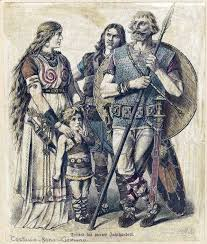
The word “folkish” has seen an uptick in popularity in the English-speaking world in recent years. Although folkishness remains a minority position, the number of people who associate themselves with it is growing. Yet there is not much material in English that could provide an accessible overview of the original German folkish movement and its ideas in a manner which does not simply treat it as a subject for critique. It is hoped that this essay will go some way towards correcting that. Although I will touch on historical matters, this is not a history. It is an attempt to reconstruct the basic features of the folkish worldview and introduce some of the key thinkers and organisations. The essay will proceed from an outline of fundamental folkish concepts to their application to various fields, such as history, culture, politics, and religion. None of the accounts are exhaustive, but they should be sufficient to give the reader a working understanding of what the folkish worldview was before 1945 and what its implications were for life.
The Völkische Bewegung (folkish movement) originated in late 19th century Germany, but it did not emerge sui generis. Its founders drew upon several earlier ideological currents. Three in particular stand out: German Romanticism, German nationalism, and biological and racial theories developed from the late 18th century onwards. German Romanticism was a source of many central ideas, including holism, organicism, a scepticism of Enlightenment rationalism, a respect for myth and tradition, and the conviction of the spiritual emptiness of modern civilisation.
The distinctive core of the folkish worldview during this period was a preoccupation with the idea of a folk (Volk). A folk may be defined provisionally as a group sharing common ancestry, language, culture, and collective consciousness. Examples include the German folk, the French folk, and the English folk.
Importantly, there was no single religious approach in the folkish movement, although almost all of the leading figures were religious in some way.
From the essay: Chamberlain explained every great achievement of Western civilisation with reference to the quality of the racial stock at any given place and time. Rome ultimately fell because of “racial bastardisation”, Rome being a “cloaca gentium” or “drain of the peoples”. He speaks of a time when
“…the people of ancient Rome had disappeared from the face of the earth and Rome was merely the administrative centre of a nationless mixture; whoever speaks of Rome talks of the chaos of races.”
Now consider the USA in 2026 … See the similarity?