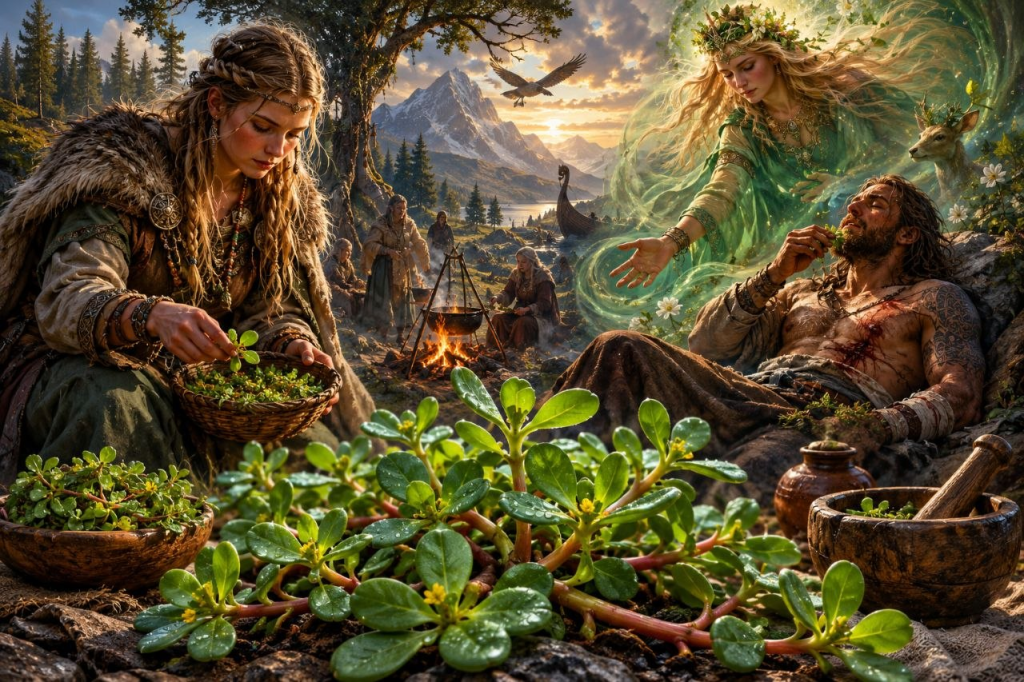
In the age of long winters and harsh winds, when the northern forests were still considered halls of the gods, the ancient Germanic tribes knew of a plant that appeared small yet carried within it the very power of the earth. They called it the “creeping green of Nerthus,” for it was believed that Mother Earth had left her mark across the fields, leaving this succulent plant: purslane.
When the summers were short and the warriors returned exhausted from hunting and travel, the women and healers gathered the fleshy leaves among stones and along dry paths. The seers said that the water of Midgard itself flowed in the thick shoots—cooling the blood, strengthening the heart and mind.
Thus, purslane was honored not only as food but also as a gift from the ancestors. The skalds recounted how a wounded traveler once lay beneath the roots of an old ash tree. For three nights, he had neither strength nor hope. Then, in a dream, the goddess Freyja appeared to him, shrouded in green veils. She spoke:
“It is not iron alone that heals the warrior. What creeps from the earth and preserves the sunlight carries wisdom older than kings.”
When the man awoke, he found purslane growing around him. He ate the slightly sour leaves and gained new strength. His wounds healed more quickly, his mind became clear, and his breathing as calm as a still fjord.
The ancients believed that the plant: keeps the blood as supple as fresh spring water, renews the body after long winters, strengthens digestion like the fire of a hearth, and protects the mind from the “gray fog of weariness.”
Today we know that purslane is rich in omega-3 fatty acids, minerals, and healing plant compounds—but for the ancestors, this was not science, but lived experience. They saw in it the connection between humankind, the earth, and the forces of nature.
Some Nordic traditions still say:
“He who honors the green gift of the earth does not forget the breath of his ancestors.”
And so purslane continues to grow—unobtrusively among stones and paths—like a silent reminder of the time of the pagan tribes, when healing, nourishment, and myth were one.
From Huter der Irminsul
2 responses to “Purslane”
Well, I do not know about Nordic legends, but Purslane grows wild in our back yard. I harvest it and eat in in salads. It has an earthy flavor and there is plenty of info on the Net about its nutritional value.
I get this growing in my garden every year and just leave it as ground cover. Between it and mallow, I have some pretty good salad stuff. Wish I could eat my dandelions, but the dogs seem to think every dandelion is a place to pee. I do have some chicory plants growing that I haven’t tried out yet. I’ve also been nurturing wild lettuce to try out the painkilling properties.
I have yucca growing on my property, and look forward every year to harvesting blossoms to make a pan of bacon, onions, and blossoms. They are quite tasty just off the plant.
Joe Average sees weeds. I see Nature’s bounty.