Pentecost – The Awakening of the Sun and the Ancient Earth
Pentecost – a word that echoes through the ages like a distant bell. Its modern name comes from the Greek Pentekostē, the “fiftieth day,” celebrated fifty days after Easter as a sign of spiritual renewal and the resurrection of Christ. Yet beneath the layers of history slumbers a much older breath – ancient, earthy, sun-warmed, and steeped in pagan memory.
For long before church bells rang, our ancestors were already listening to the call of awakening summer. When the last mists of winter dissipated and the Ice Saints passed, that sacred time of High May began: the time of burgeoning life, the green fire of the earth, and the returning sun.
During these days, the Germanic peoples honored Nerthus and Frigg – the Great Mother, guardian of fertility, the hearth fire, and becoming. The earth itself was considered a living being. Forests rustled like oracles, springs were considered gateways between worlds, and every breeze carried the voices of the ancestors.
Pentecost was not just a festival—it was a transition. Winter had been defeated. The sun had triumphed. Life visibly returned to all things.
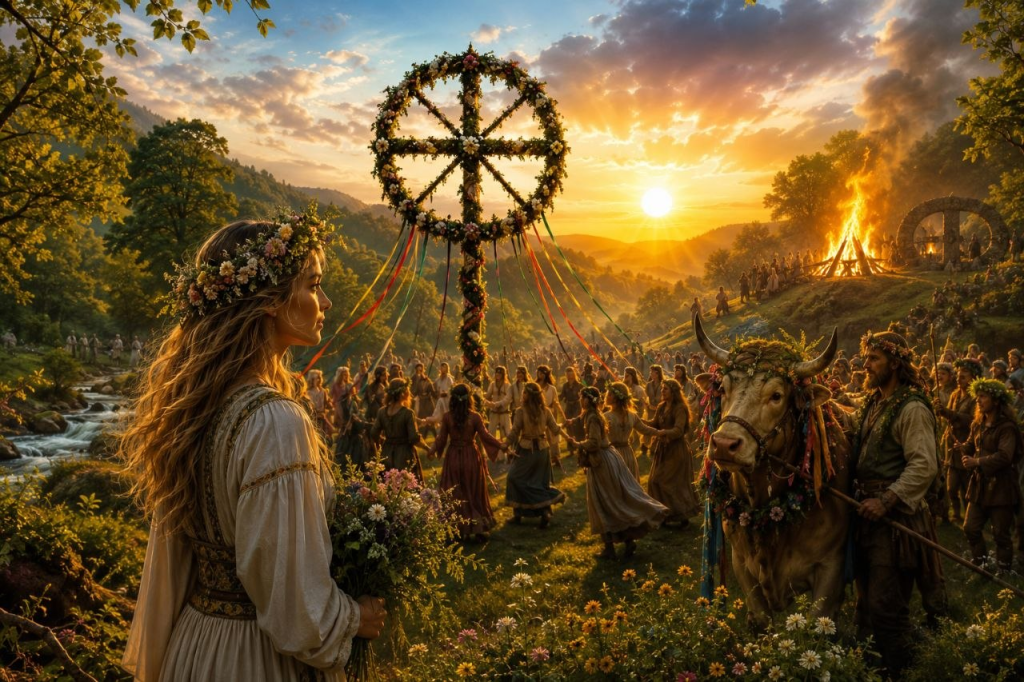
In the ancient spring processions, branches, flowers, and young birch trees were carried through the villages. People decorated houses and barns with fresh greenery to drive away the last vestiges of winter and invite good fortune, protection, and fertility. Fires blazed on the hills—the Pentecost fires—reflecting the sun’s power on earth. Their smoke rose to heaven like prayers.
In the southern Harz Mountains, an echo of this ancient time lives on to this day: the Questenberg Festival, one of the oldest Germanic folk festivals on German soil. The quest – a massive wreath in the shape of a sun wheel – is a reminder of the cosmic order of the four cardinal directions and the four elements: air, earth, fire, and water. Like a sun cross, it connects heaven and earth, humanity and nature, light and the cycle of the year.
The Pentecost tree also speaks of growth and fertility. Around it, people danced, laughed, and sang – a sacred center between the worlds. Roses adorned doors and hair as symbols of love, sensuality, and blossoming life.
The first drive of the cattle to pasture was a particularly venerable occasion. The animals were decorated with flower wreaths, colorful ribbons, and bells. Often, the strongest ox – the “Pentecost ox” – led the way, a living symbol of strength, fertility, and prosperity. This image lives on in our language even today: “decorated like a Pentecost ox.”
In some places, shepherds veiled themselves with branches and blossoms, appearing as green beings of growth – half human, half nature spirit. They embodied the very spirit of recurring life. Thus, Pentecost to this day carries two souls within it: the Christian celebration of the Spirit and the ancient natural mystery of the awakening Earth.
Perhaps that is why we sense something special in the air during these days: a faint shimmering between heaven and earth, a remembrance of something very ancient by the soul. For Pentecost is more than a calendar festival. It is the festival of breathing life. The festival of the sun. The festival of the blossoming Earth.
And perhaps also the festival of remembrance that humankind once knew it was not above nature—but rather part of its sacred cycle. May the spirit of awakening summer, the light of the sun, and the power of the ancient Earth accompany you.
From Huter der Irminsul
Christian reader, you can have both. You can celebrate nature … creation, as well as the Creator.
16 responses to “Pentecost”
One way we can celebrate nature is to stand up with our neighbors to stop data centers. If we continue to do ignore the elephant in the room, nothing will be left for children. The US has 5400 data centers. Strange, no one discusses it here.
https://www.cargoson.com/en/blog/number-of-data-centers-by-country
Heretical garbage.
Amen to that!
“For the wrath of God is revealed from heaven against all ungodliness and unrighteousness of men, who hold the truth in unrighteousness; BECAUSE THAT WHICH MAY BE KNOWN OF GOD IS MANIFEST IN THEM; FOR GOD HATH SHEWED IT UNTO THEM. For the invisible things of him from the creation of the world are clearly seen, being understood by the things that are made, even his ETERNAL power and Godhead; so that they are WITHOUT EXCUSE: Because that, when they knew God, they glorified him not as God, neither were thankful; but became vain in their imaginations, and their foolish heart was darkened. PROFESSING THEMSELVES TO BE WISE, THEY BECAME FOOLS, AND CHANGED THE GLORY OF THE UNCORRUPTIBLE GOD INTO AN IMAGE MADE LIKE TO CORRUPTIBLE MAN, AND TO BIRDS, AND FOURFOOTED BEASTS, AND CREEPING THINGS.” Romans 1: 18-23
satan is the hidden entity behind all forms of paganism and idolatry, rather it is shamanism, druidism, witchcraft, baal worship, moloch worship, or any other form. That is why virtually all of those “religions” involve human sacrifice. Hey, Roth, have you ever heard of stonehenge?….That is precisely what went on there!!
Those of us who truly know Jesus Christ as our Lord and Savior are worshiping the eternal Creator, not the temporal creature or the temporal creation.
To all who have been seduced by the novelty of “ancestral paganism”: The Lord God Omnipotent is calling you out of darkness into His marvelous light!
No, there is no conclusive or systematic evidence of human sacrifice at Stonehenge.
Archaeologists who have studied the site for decades (including teams from English Heritage and major excavations) consistently conclude that the human remains found there represent respectful burials or cremations, not ritual killings. Stonehenge served primarily as a cemetery and ceremonial site focused on ancestors, the dead, and solar alignments—not a place for regular human sacrifices.
english-heritage.org.uk
I believe in Christianity. I do not believe in spreading false information.
You never should have published this pagan garbage on Appalachian Renegade in the first place.
Rather than throwing derogatory remarks, please explain to me how anything in the article posted is an attack on your preferred religion. How is it ‘garbage’ to remind the reader of historical reality? How is it garbage to celebrate … not worship … celebrate the coming of Spring?
I’ll bet you’ve sung these words in church:
For the beauty of the earth,
for the glory of the skies,
for the love which from our birth
over and around us lies.
For the wonder of each hour
of the day and of the night,
hill and vale and tree and flower,
sun and moon and stars of light.
Why would anyone be threatened by acknowledging and celebrating the creation the Creator has bequeathed us, regardless of who or what that Creator is?
David, upon reading your reply, I have dug deeper into the Stonehenge question.
It would seem that you are correct, in that there is no conclusive or systematic evidence of human sacrifice at the English Stonehenge. If I wrote in error about that, I apologize. It WAS NOT done intentionally.
However, there is a greater consensus among archaeologists that human sacrifice did take place at the German Stonehenge, (very similar in age, design, and size to the English Stonehenge). It is located near the village of Pommelte, about 85 miles southwest of Berlin.
https://www.livescience.com/german-stonehenge-residential-area.html
It’s a shame how much we have all been misled. I have no doubt that our Lord reveals Himself to other people and cultures. That does not mean that we are not following the same God.
A good example is outlined in the book “The Real George Washington” as the Indians were told not to kill him because he was destined to become the leader of a great nation.
The sacred cycle now must contend with AI data centers, Starlink, Flock, Open AI, robots, Stargate, missiles, bombs, Claude, Lavender, Tik Tok, WordPress, and whatever you would like to add to the list.
One more simple thought here. Historical reality can be defined as suffering for all people. Go see the caves near Pompeii. No food, no medical doctor to operate on kidney stones, no food or drug store. Etc. etc.
I thoroughly enjoy these Germanic excursions into history and nature. Well done.
Truth right there at Romans 1:18-23. Plain as day. The Germanic people were just one of many people who drifted away from what God put in the hearts of humans meant to acknowledge him for the beauty and seasons of creation. Sadly over time they invented gods of creation and worshiped them and created whole new cultures around that. It’s a matter of the heart not the beauty. And before ya’ throw buzz words around like “derogatory”, you must be fair yourself first in that it is okay in an adult conversation to say what you believe. Try a debate class in High School to learn not to “fall for the Bait words” and dissolve into over sensitivity. Roth, you post a lot of what I would call “slipping down the slimy slope of making paganism okay again” and I am German, Nordic/Saxon! You are free to believe whatever you want but I visit this site a whole lot less now because of that. I hope David and Wes aren’t getting burnt out. If you are guys, remember Jonathan Edwards originally wrote much the Great Awakening in 1735 that grew up in the hearts and minds of the likes of Samuel Adams, etc. Your words might take a generation to make an impact too.
“You never should have published this pagan garbage on Appalachian Renegade in the first place.”
… please explain to me how anything in the article posted is an attack on your preferred religion. How is it ‘garbage’ to remind the reader of historical reality? How is it garbage to celebrate … not worship … celebrate the coming of Spring?
Rather than answer the questions, it appears that some actually do ‘dissolve into over sensitivity.’ It would appear that many here can quote Scripture at will and zealously ‘push’ their faith. That’s fine. I do not object because, as you suggest, “… it is okay in an adult conversation to say what you believe” unless, of course, it differs from your opinion, then it’s derided and there are attacks and veiled calls for censoring those views. I respect your right to believe what you want. While I’m aware that many readers at this site are Christians, I try to be respectful of their beliefs. Can you not offer the same courtesy? If you don’t like my posts, don’t read them. Simple as.
The pagan cultures of old lived closer to nature and had a deep respect for all of creation. This is something modern Christian society seems to fall short of. Remember that all of creation belongs to God and we, as Christians, are supposed to be its’ caretakers. As things stand it looks like the Amish are doing the best at this job. Slow down once in a while and just enjoy sitting under a tree and listening to the birds. The rhythm of the raindrops on a soft rainy day. The sweet smell of flowers. You don’t have as much time here as you think.
As a Christian I celebrate spring by planting a garden! I enjoy my morning coffee in Amish country on my porch listening to nature and thank God for it. Good advice Steve.