
From Hüter der Irminsul on Telegram
If you really look deeper, it (the Easter celebration) becomes clear: What is taken for granted today is the result of a conscious reinterpretation – and in many cases also of repression.
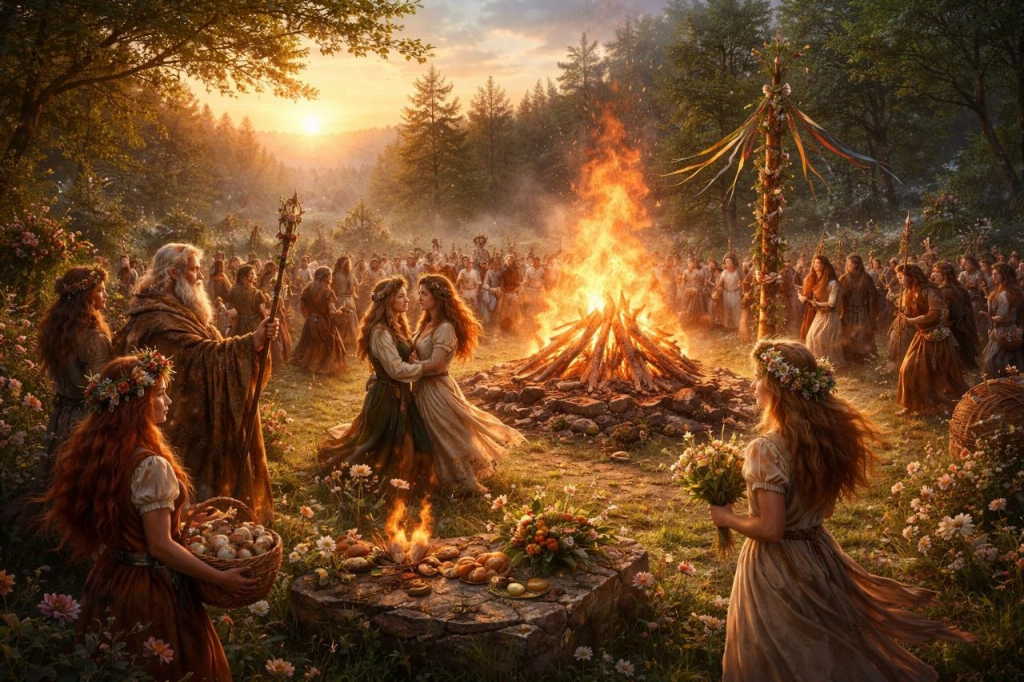
The pre-Christian spring festivals of the Germanic and other European cultures were not a marginal phenomenon, but rather a central part of their lives. These people did not live apart from nature, they were part of it. The cycle of the year determined their thinking, their actions and their celebrations. The transition from winter to spring was therefore not a symbolic act, but rather existential: survival was assured, light and warmth returned, new life began.
Archaeological finds, traditional customs and comparative religious research show that these festivals were characterized by fertility symbolism, fire, community and gratitude towards the forces of nature. It wasn’t about guilt or redemption, but about cycles, about becoming and passing away as a natural order. Man was involved in it – not as sinners, but as part of a larger whole.
With the spread of Christianity from late antiquity and especially in the course of the missionization of Germanic areas by forces like Boniface, this world view was systematically transformed. Holy places were rededicated, festivals were reinterpreted, and existing customs were often consciously integrated – albeit under completely different circumstances.
Today’s Easter is an example of this overlap: the timing remained closely aligned with the old spring festival, but the meaning was shifted. Direct experience of nature was replaced by a theological interpretation. This becomes particularly clear on Good Friday: a day that is placed in a phase that has stood for new beginnings and vitality for thousands of years becomes the central symbol of suffering, sacrifice and death.
This shift is not neutral. It draws attention away from life in the here and now towards a system of interpretation that is strongly influenced by guilt, atonement and the need for redemption. While ancient cultures celebrated life itself, the focus was placed on suffering – and the need to accept that suffering as meaningful.
More is lost than just “old customs”. An attitude is lost: the immediate connection to the world, the trust in natural cycles, the experience of joy without justification. Instead, there is a mediated worldview that dictates how this time should be interpreted and felt.
Historically, this was not a random process but part of a broader cultural transformation. The old traditions were not simply forgotten – they were overlaid, adapted, and sometimes deliberately pushed back to make room for a new order.
And yet the original has never completely disappeared. It can be seen in symbols, in customs, in the feeling of many people that this time “actually” carries something different: lightness, new beginnings, liveliness.
A real reflection therefore means getting to the bottom of these layers again. Not to romanticize history, but to recognize that, alongside the traditional interpretation, there is also an older, deeply rooted perspective.
Nature itself has never changed. It follows no dogma, no penitential order, no mourning ritual. It returns – year after year, powerful and unstoppable.
And perhaps that is exactly the most uncomfortable realization: that this original truth never disappeared – it was just covered up.
2 responses to “Old Ways ‘Easter’”
This summarizes better than I, what disgusts me about The Church, Inc. Nearly every instance of an organized religion I have tried to engage with was visibly and obviously corrupted from about the 2nd or 3rd visit.
The organization know as The Church, the legal entity, not worshippers, has done more harm to God and religion than anything else.
I met one fellow down here who had it right. I forget the term he used, but he said their church was small, usually 5-10 families, the preacher’s job rotated, they met for worship at each other’s homes, supper was potluck afterwards. Communion, sharing, healing, love. Nobody asked to see your bank statements like all the Baptists I’ve tried. Corrupted, yet they call themselves holier than thou…? God will not be mocked. I think thats why we are where we are, seeing what we are seeing: its time for another flood.
Easter, you mention the pagan festival celebrating a demonic entity? No thanks as the Father addressed it Jeremiah 7:17-18. I am grateful for Christ’s resurrection, however.