Latest Articles

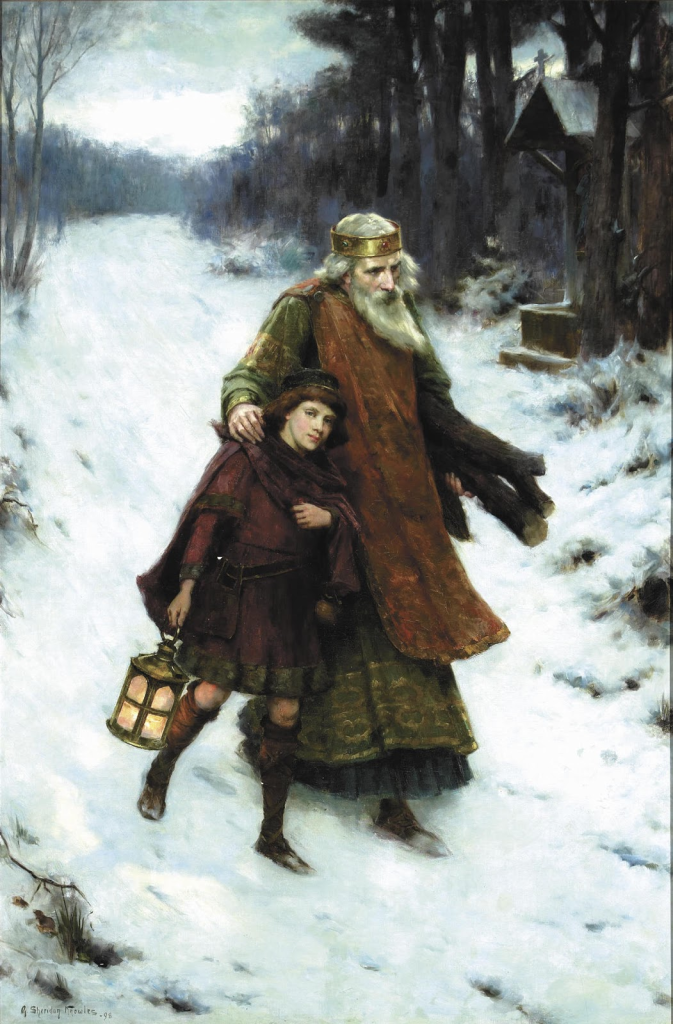
  • The Slow Hate of the Saxon

    On the Patience of a People Who Have Never Been Finally Defeated
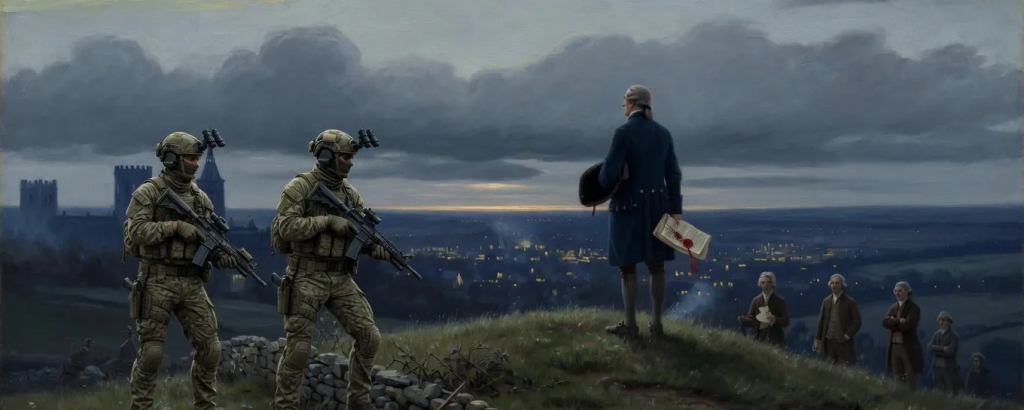
    Here is the first thing to understand about the Saxon: he does not hate quickly, and he does not hate easily. But when he has been brought to the place where strength diminishes and he still advances—that is not the heat of a moment. That is something that was decided long before the battle began. Something cold. Something final.

    The historians of other traditions have often mistaken Saxon patience for Saxon weakness. This is an error that has been made repeatedly, by peoples who did not live long enough to understand what they had provoked. We Saxons have outlived every empire that has ever been. Such only the empire we built remains.

    The common law followed the flag. Wherever the English settled—in Virginia, in Massachusetts, in New South Wales, in New Zealand, in Canada, in Natal, in the Punjab—they brought with them the assumption that law was not the will of the ruler but the evolved inheritance of the community, and that no man, however powerful, stood above it. This was not an imperial imposition. It was an export of the thing the English valued most: the principle that power is bounded, that the individual has rights that the state cannot extinguish, and that those rights are defended not by the goodwill of rulers but by the structure of law itself.

    The empire was, at its best, the globalization of this principle. Its worst chapters—and they were real, and they were many—were the moments when the principle was violated by its own carriers. The slave trade. The famines. The Amritsar massacre. The Highland Clearances. These were not expressions of the Saxon character at its most characteristic; they were betrayals of it, recognized as betrayals at the time by the men within the tradition who opposed them—Wilberforce, Burke, Bright, the Clapham Sect, the anti-Corn Law campaigners. The empire’s capacity to reform itself again and again from within was itself an expression of the tradition: the tradition that holds that a wrong, once recognized, must be named and corrected, regardless of the cost to the powerful.


    Read Burlingame’s entire essay … It’s quite good.

  • Palantir Hacked?

  • Why Democracy Won’t Last Forever, Follow-up

    There were some comments to the original post which made the self-evident point that the United States was established as a Republic, not a democracy. Democracies devolve into situations where 50.1% of the population which are low IQ morons can win out over 49.9% geniuses. Again, self-evident. But the argument over republic versus democracy is not the point of the video.

    Those who actually watch the video will notice that it pertains primarily to England and secondarily to Angloshere in general; and between good king, bad king, and democracy. It’s obvious democracies don’t work and the video attempts to argue that kings along the lines of those existing prior to 1066 were, again arguably, the best form of government because they don’t rule over the people, but for them (and could be de-throned if they failed the people). Examples and reasons are provided in the video. For the open minded, it’s well worth the small investment in time.

    Comments were made that we were given ‘a Republic, if we can keep it.’ I suspect the Founders perfectly well knew how difficult that would be, hence Jeffersons admonition about watering the Tree of Liberty from time to time. Well, we failed to ‘water the tree’ and Republics always fail. Always. From the Roman Republic to the Weimar Republic, the same patterns emerge: erosion of civic virtue, consolidation of power, economic instability, and the decay of the rule of law. One can read the details here. We, in America, are finding ourselves at the end stage of our Republic as we’ve checked all the aforementioned boxes. One could convincingly argue our Republic is already gone.

    And yes, we were all taught in school how kings are bad and republics and democracies are better. But we were taught a lot of things in school that weren’t necessarily accurate. Kings post Norman invasion of England were generally bad, but before? There’s a reason that kingdoms were the natural norm prior to modernity and that seems to be because they ruled with the consent of the population and before the divine right of kings doctrine emerged.

    For those who watch the video, one point will become quite apparent. Kingdoms, with a ‘good king,’ require a homogeneous population; a Folk. The king has no divine right and can be de-throned if he fails the Folk. I leave it to the reader to develop their own opinion on how it might be possible to salvage any form of ‘good’ government in what is known as the United States of America that would truly represent the people.

    I’ve always appreciated our Constitutional Republic as the best form of government yet devised, but it failed. On reflection and after studying history, my thinking is evolving. In my most hopeful moments, I envision a good king along the lines outlined in the video, with no divine right, ruling for a folkish population. One race, one culture, one soil. But that’s just a dream …

  • Israeli Coup in the US

  • Why Democracy Won’t Last Forever

    The true king … not what we’ve come to believe.

    We’re taught that democracy is the end of history: the final, perfected form of government, the thing all of history was building toward. To question it is to step outside respectable discourse.

    This video makes the case that we’ve forgotten what a king actually was. Not the tyrant of popular memory, but something older: a ruler as the vessel for the collective spirit of the people.

  • STRAIT IS ALL YOURs

    Watch the second video. The Jamaica musical one. Sometimes, when everything goes pear shaped and we want to cry, it’s good to laugh. Loosen up and enjoy this one. It’s the weekend!

  • Trump’s Oil Confabulations

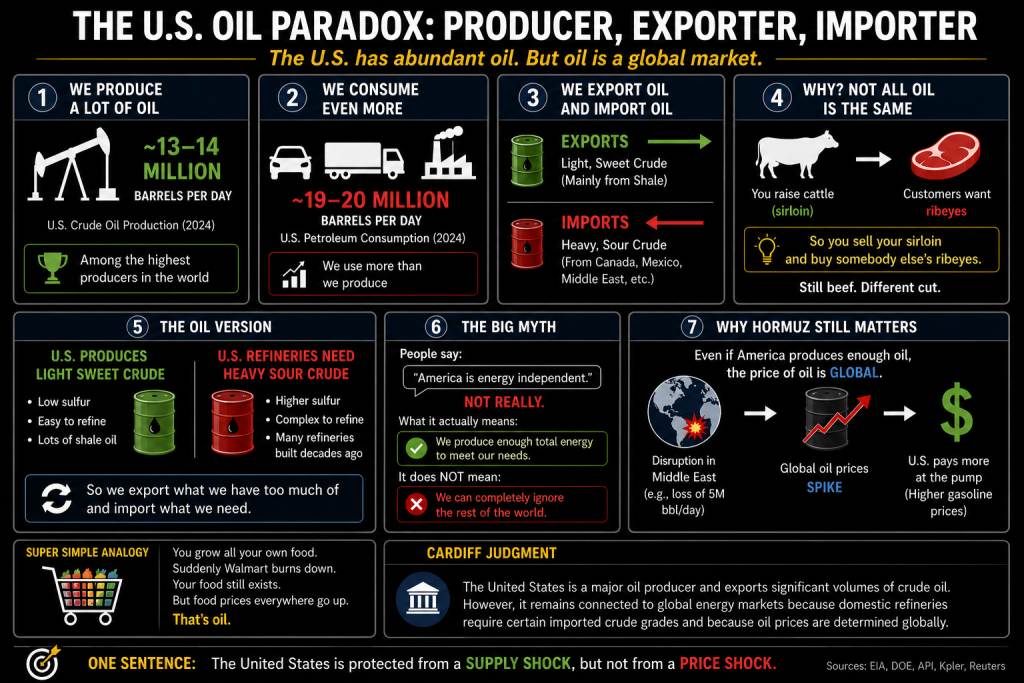
    Read ‘ONE SENTENCE’ at the bottom of the graphic.

    The United States is protected from SUPPLY SHOCK, but not from PRICE SHOCK.

    Larry Johnson writes, Donald Trump has repeatedly claimed that the United States is producing more oil than Russia and Saudi Arabia combined. He has made this statement multiple times in 2026, often emphasizing it as a result of his “Drill, Baby, Drill” policies. Only one little problem… It ain’t exactly true.

    Read the details at Sonar21 …

  • The Goalposts Move

    I was definitely surprised by The Economist publicly taking aim at the current refugee rights system:

    Western attitudes are hardening. In Europe the views of social democrats and right-wing populists are converging.

    The system is not working. Designed for post-war Europe, it cannot cope with a world of proliferating conflict, cheap travel and huge wage disparities. Roughly 900m people would like to migrate permanently. Since it is almost impossible for a citizen of a poor country to move legally to a rich one, many move without permission. In the past two decades many have discovered that asylum offers a back door. Instead of crossing a border stealthily, as in the past, they walk up to a border guard and request asylum, knowing that the claim will take years to adjudicate and, in the meantime, they can melt into the shadows and find work.

    Voters are right to think the system has been gamed. Most asylum claims in the European Union are now rejected outright. Fear of border chaos has fuelled the rise of populism, from Brexit to Donald Trump, and poisoned the debate about legal migration. To create a system that offers safety for those who need it but also a reasonable flow of labour migration, policymakers need to separate one from the other.

    Around 123m people have been displaced by conflict, disaster or persecution, three times more than in 2010, partly because wars are lasting longer. All these people have a right to seek safety. But “safety” need not mean access to a rich country’s labour market.

    It’s obvious why they are alarmed. In Britain, the two mainstream parties have been destroyed. And the convergence of SOCIALIST democrats and right-wing NATIONAL populists is always going to terrify a media controlled by a small group of people who were not historically very popular with socialist nationalists.

    And then I saw this:

    Mr Trump’s policy of mass deportation is both cruel and expensive. Far better to let those who have put down roots stay, while securing the border and changing the incentives for future arrivals. If liberals do not build a better system, populists will build a worse one.

    After their policies fail, they always try to move the goalposts in order to prevent those failures from being adequately addressed. At this point, they’re just trying to lock in their gains.

    From Vox Popoli

  • New Jersey State Police Retreat

  • The Government Sold Us Out

  • NDAA Hidden Israeli Merge

  • Tucker on Nephilim

  • Do Not Buy a Spaceship from Amazon

  • The Beginning of the Great Taking

  • Slave Frustration

Menu

CADD Graphics

Laser Engraving by CADD Graphics

Carolina Readiness Supply

Social Media and Websites

NC Renegade on Twitter
NC Renegade on Gab
NC Renegade on Truth Social
Wes Rhinier on Gab


12 Round Blog
Barnhardt
Cold Fury
The Feral Irishman
Hammer’s Thor
Knuckledraggin My Life Away
Liberty’s Torch
90 Miles From Tyranny
Publius-Huldah’s Blog
Smoky Mountain Myco
Straight Line Logic
The Tactical Hermit
Western Rifle Shooters Association

Recent Comments

  1. Well, I genuinely try to give everyone a fair shake until I’ve determined through a pattern of behavior that they…

  2. He’s a kike or a fed which pretty much the same thing these days Brother which is why I just…

  3. Keep your powder dry and watch your topknot! Been saying for years, let’s fix our country first, then worry about…

  4. Do come on now. You seem to be intent on defending her reputation, despite the fact she was an active…