Latest Articles

  • The Judgment of the Kin – On Counsel, Honor, and Community Among the Ancient Germanic Peoples

    The image we hold of the Germanic tribes today is incomplete. Much of what has been handed down comes from the records of Roman or, later, Christian authors. While their accounts are valuable, they invariably reflect an outsider’s perspective. A great deal of the Germanic peoples’ actual worldview, their stories, and their oral traditions has been lost over the centuries.

    Nevertheless, the sources paint a consistent picture: the community stood above the individual.

    The tribal elder—often respected for his age, wisdom, and proven judgment—did not rule as an absolute monarch. Rather, he was a guardian of memory, an advisor, and a mediator. His words carried weight because they were grounded in experience, yet his voice did not supersede the will of the kin group.

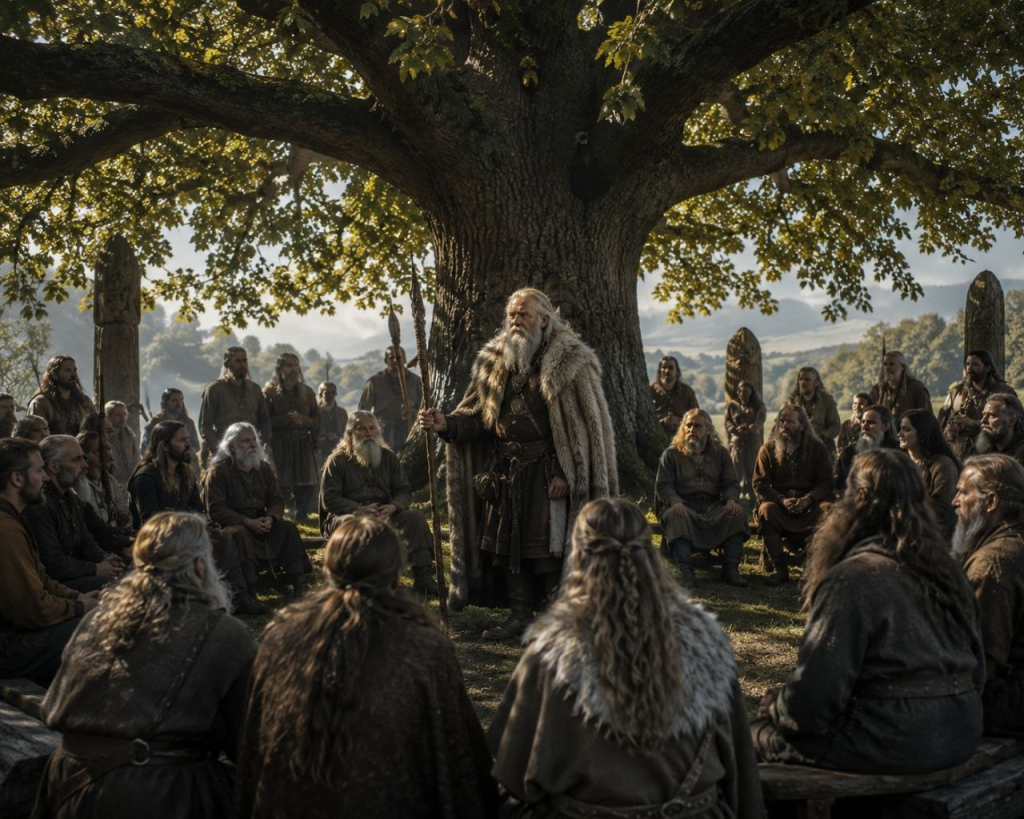
    Important decisions were made collectively. At assemblies, free men and women—practices varied by tribe and era—gathered to deliberate on matters of war and peace, alliances, disputes, and the well-being of the community. There, they spoke, listened to one another, and strove to reach a decision. It was not the power of a single individual that was to determine the fate of all, but the shared will of the community.

    Underlying this concept was a profound mythological idea: the human being was not an isolated entity, but a thread in the great tapestry of the kin group. Every action affected the fate of all. Honor, therefore, was not merely personal renown but the standing of the entire lineage. Those who acted justly strengthened the community. Those who committed treason, murder, robbery, or perjury did not merely harm individuals; they disrupted the order that bound ancestors, the living, and future generations together.

    For this reason, a chieftain alone did not adjudicate serious transgressions. The community deliberated on what form of restitution or punishment corresponded to the wrong that had been committed. Depending on the deed, this might entail compensation, penance, banishment, or—in the case of particularly grave crimes—even death. The goal was not mere retribution, but the restoration of peace within the community. Order had to be renewed so that the trust binding the kin-group could endure.

    In the Germanic worldview, law was not a cold statute but a living covenant among humans, ancestors, and gods. To honor this covenant was to honor the powers that watched over the world; to break it was to set oneself against the very fabric of life.

    Perhaps therein lies the greatest lesson of these ancient traditions: a community is strong when wisdom is heeded, responsibility is shared, and decisions are borne collectively. No individual is greater than the people; no power stands higher than the duty owed to the community.

    The voices of the ancients may have faded, yet their vision lives on: a kin-group consists not only of the living but also of the ancestors, the children, and those yet to be born. Whoever acts for the community acts for the past, the present, and the future alike. In this sense, the *Thing*—the assembly of the people—was more than a place of law. It was a sacred space where the order of the world was reaffirmed time and again through collective judgment.

  • Doctors

  • War

  • CIA Murdered RFK

  • Waiting for the Russian Response

  • Waiting for the Iranian Response

    Trump is trapped. It appears that he is now all in for WWIII. Good luck to the American people who survive this madness.

  • Nearing ‘Winchester’

    Conflict Incapable

    The US military officially maintains a doctrine that states it is able to fight two major wars in different theaters simultaneously. The combination of 5GW and the Iran War has demonstrated that it is no longer even able to fight one major war, outside of a defensive war on US territory.

    … officials told the Washington Post that regional Tomahawk stocks were running dangerously low, with one warning the Pentagon was approaching “Winchester,” the military’s slang for out of ammunition, even as the administration publicly insisted that critical stockpiles had not been dangerously depleted.

    What we’ve witnessed has been the most significant revolution in military affairs since WWII, the decline of the battleship, and the end of the UK as a major military power. The USA is still a major power, but it now has little more ability to project its power against a real opponent than China or Russia.

    Details at Vox Popoli …

  • Anarchy – The Forgotten Primal Source of Freedom

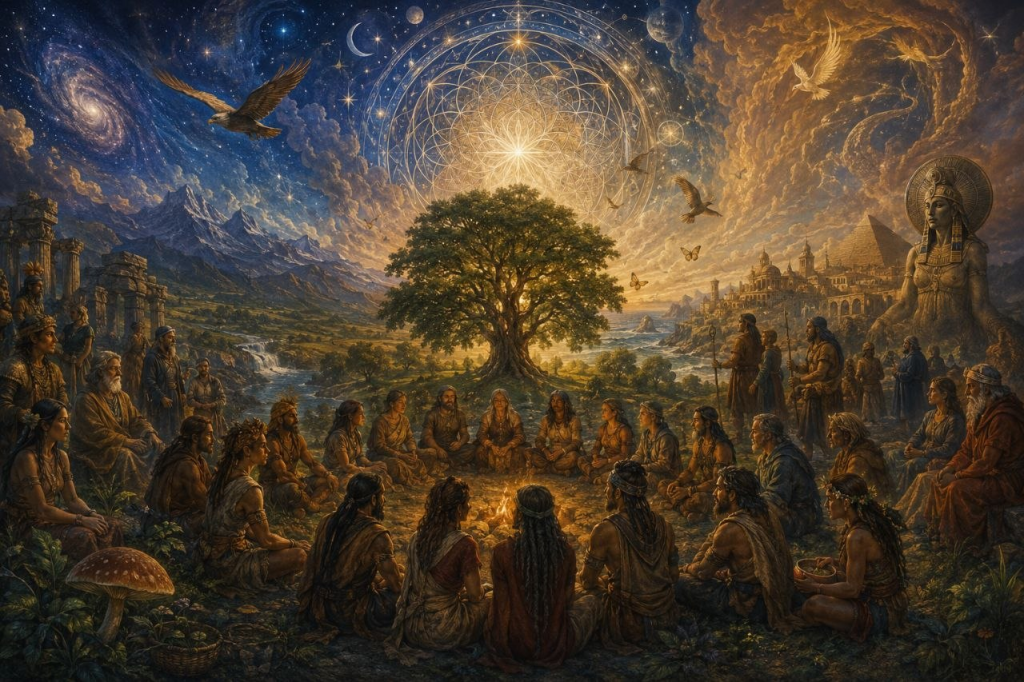
    Anarchy is older than any kingdom, older than any temple of stone, older even than the first laws humans etched into clay and metal. Before crowns were forged, before thrones were erected and borders drawn, humanity lived in an order that knew no ruler. This primordial order was not chaos, but a state of balance. The stars moved without a king. Rivers flowed without command. Forests grew without a parliament. The sun rose without an empire to show it the way.

    The word “anarchy” comes from the Ancient Greek *an-archos*—meaning “without a ruler.” It does not mean “without order,” but rather without the rule of one human over another. Later history deliberately conflated this idea with disorder, because every power structure recognizes its greatest threat in the thought that it might not be necessary at all.

    Traces of this memory can be found in the oldest myths. The Golden Age recounted by Hesiod describes a world where humans needed neither kings nor judges. The earth bestowed its gifts freely, and justice arose from natural proportion. In the North, ancient Germanic peoples spoke of free assemblies held under the open sky, where decisions were made collectively. The Celts knew of tribal confederations whose authority stemmed from recognition rather than coercion. Even in many indigenous cultures, leadership was time-bound and linked to responsibility—not to permanent power.

    Mythology often depicts the cosmos as a living organism. In Egyptian thought, *Ma’at* represented the divine order—created not through subjugation, but through harmony. In Daoism, the *Dao* is the path that all things follow without being forced. Water serves as the supreme symbol here: it does not rule, yet it permeates even the hardest stone. It compels nothing, and yet it transforms everything.

    Perhaps therein lies the deepest secret of anarchy. It is not the absence of order, but the presence of an order that arises from freedom.

    Mystics throughout the ages have described a similar experience. Meister Eckhart spoke of the “divine spark” within every human being. The Sufis viewed the human being as a mirror of the Infinite. The Upanishads state that the highest Self and the universe are ultimately one. If every human being embodies the same divine reality, the notion of natural dominion loses its metaphysical foundation. No one can own another person’s divine spark.

    Historically, relations of domination did not emerge in a single instant. They grew gradually alongside surpluses, property, standing armies, and centralized religions. Where elders once deliberated, princes arose. Where rituals once fostered community, priestly castes emerged. Where protection was once organized, empires came into being. Power began to perpetuate itself and eventually declared itself the natural order.

    Yet, beneath the surface of history, the memory remained alive. It manifested in the free cities of the Middle Ages, in village communities with shared land, in cooperatives, in the ideas of the Enlightenment, and later in the writings of thinkers such as William Godwin, Pierre-Joseph Proudhon, Mikhail Bakunin, and Peter Kropotkin. Their ideas differed, but they were united by the conviction that human beings are capable of cooperating voluntarily and taking responsibility for one another.

    The myth of chaos has dogged the concept of anarchy to this day. Yet in almost all creation myths, primordial chaos is not mere destruction, but the unformed source of all possibilities. From it arise heaven and earth, time and life. There, chaos is not a catastrophe, but creative potential. Order arising from free unfolding differs fundamentally from order imposed by coercion.

    Nature provides countless images of this. Forests have no king. Swarms know no dictator. Fungal networks connect entire landscapes without a central command post. Stars follow the laws of the universe, not the laws of a ruler. Complex systems can achieve stability without a single entity controlling everything.

    The deeper mystical significance of anarchy may therefore lie not in a political theory, but in a spiritual stance. Those who acknowledge no external ruler over them must all the more strongly develop an internal compass: conscience, compassion, responsibility, and wisdom. Freedom without consciousness becomes arbitrariness. Consciousness without freedom becomes captivity. Only together do they form a living order.

    Anarchy is therefore not an invitation to destruction, but a challenge to humanity. It asks: Can a community endure if its members act out of understanding rather than fear? Can dignity be stronger than coercion? Can trust be more powerful than violence?

    Perhaps this is why the idea of ​​anarchy has resurfaced time and again over millennia—and has been fought against just as often. It serves as a reminder that domination is not an inevitable destiny, but rather a historical form of coexistence. At the same time, it reminds us that freedom presupposes responsibility.

    Thus, anarchy—in the mythological, historical, and mystical sense—appears less as a ready-made political system than as an age-old question posed to humanity: whether human beings are capable of living in harmony with others based on their own insight. Myth, history, and spirituality converge in this question. It remains unanswered to this day—and for that very reason, it remains alive.

    From Huter der Irminsul

  • Beware LG Televisions

  • Trump Is Now Biden

    Grok:

    Yes, the core content of the post accurately reflects a real public exchange on July 19, 2026.

    • Trump publicly stated an “understanding” with China that Beijing would not supply weapons to Iran.
    • China quickly denied any such discussion or agreement had taken place.
    • Trump responded by claiming the denial was to hide the truth and reaffirmed pressure on China regardless.

    This matches verified reporting from that day and continues a pattern from earlier 2026 interactions where Trump has repeatedly claimed Chinese assurances on Iran that Beijing has denied. The post’s timeline format is a concise (and somewhat dramatized) summary of the sequence, but the underlying statements are factual.

  • NC AI Center Cancelled

  • Medbeds Are Real

  • Iranian Missile Capabilities

  • AIPAC Funding Cut

  • No Water for Kuwait

    The US struck water plants in Southern Iran. As forewarned, Iran retaliated.

Menu

CADD Graphics

Laser Engraving by CADD Graphics

Carolina Readiness Supply

Social Media and Websites

NC Renegade on Twitter
NC Renegade on Gab
NC Renegade on Truth Social
Wes Rhinier on Gab


12 Round Blog
Barnhardt
Cold Fury
The Feral Irishman
Hammer’s Thor
Knuckledraggin My Life Away
Liberty’s Torch
90 Miles From Tyranny
Publius-Huldah’s Blog
Smoky Mountain Myco
Straight Line Logic
The Tactical Hermit
Western Rifle Shooters Association

Recent Comments

  1. DWEEZIL THE WEASEL on Swan Song

    I have enjoyed your thought-provoking articles. I often wonder if the Romans and Christian missionaries had left the Germans and…

  2. Ok, I was trying to be gentlemanly about it, but I’ll bite. Dolly could easily have taken the shots if…

  3. A lot more than what you think but head knowledge and quoting verses do not get people into the kingdom…

  4. Said it once and I will say it again… our challenge is far far greater than what our founding fathers…