
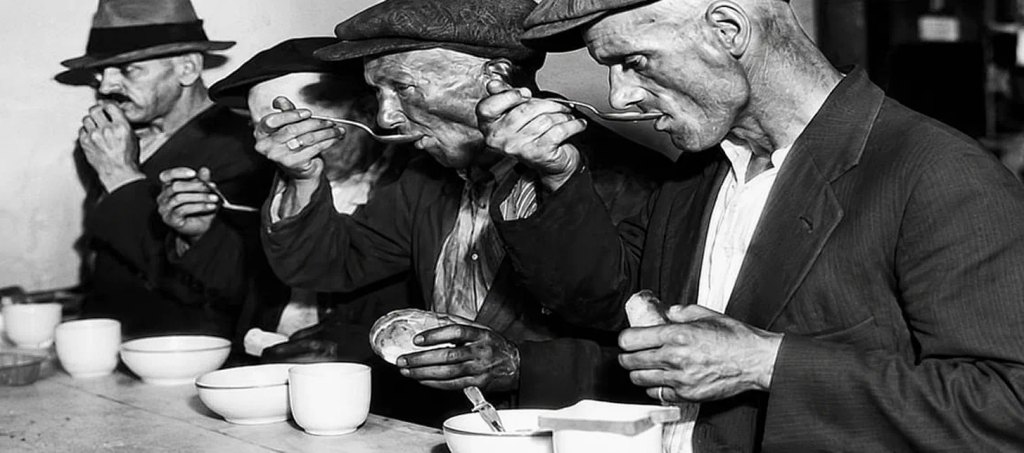
50 Survival Lessons From the Great Depression — The Horrifying Things Americans Did When Money, Jobs, and Hope Disappeared

October 29, 1929, began as a Tuesday and ended as an autopsy. When the stock market shed its skin that Black Tuesday, it revealed something putrid beneath the gilt and glamour of the Roaring Twenties—the entire economic edifice had been a painted facade, a stage set propped up by speculation and debt. Within months, the iron sinews of American industry seized up. Factories that had belched smoke and churned out automobiles now stood silent as tombstones. Construction cranes froze in place, their skeletal arms reaching toward empty skies. The breadlines formed not from laziness but from the sudden, violent evaporation of work itself—fourteen million pairs of boots kicked dust on Main Street, fourteen million stomachs growled in concert.


50 Tips From the Great Depression

1. Move as a clan. When work dried up in Akron or Detroit, families packed their possessions into trucks and rolled toward the horizon like Bedouins. Staying together meant pooling resources, sharing bread, ensuring that when one member stumbled, others could prop them up. The lone wolf starved; the pack endured.

2. Follow the harvest. Migrant farm work was the artery that kept many alive. Cotton in Texas, apples in Washington, wheat in Kansas—each crop had its season, its hunger for hands. A family could stitch together nine or ten months of labor by chasing ripeness across state lines, living in tents that leaked when it rained.

3. Ask not what the job is; ask only if it exists. Pride was a luxury item, quickly pawned. Men who had managed offices took up shovels. Women who had worn silk now scrubbed floors. The work itself mattered less than the doing of it, the exchange of sweat for coins…

Read the rest here…

Conclusion
The photograph fades, but the hunger remains. We stand now at a similar precipice, staring into a future that promises uncertainty, that whispers of contractions and corrections and collapses yet to come. The machines we have built are complex, interconnected, fragile—subject to the same tremors that brought down the house of cards in 1929. We have forgotten, in our age of abundance, how thin the margin is between comfort and catastrophe, between the full pantry and the empty bowl.


Timely. History may not repeat itself, but it certainly rhymes…

5 1 vote
Article Rating

9 responses to “50 Survival Lessons From the Great Depression — The Horrifying Things Americans Did When Money, Jobs, and Hope Disappeared”

  1. This is a very different time
    With very different people
    No, one knows how this is going to pan out.If you think you do, you’re confused.

  2. Imagine a Greater Depression. With more people who feel they are entitled to be fed by American workers’ taxes. Throw in WROL and mix. The government will use this as an opportunity to reduce the population and increase their tyranny. Be assured, they have already provided for themselves and Israel.

    The migrant workers of the Depression will become the Golden Hordes.

    1. DWEEZIL THE WEASEL Avatar
      DWEEZIL THE WEASEL

      You called it, my friend. America was another country in 1929. The Golden Hordes who have been admitted to this corrupt, syphilitic-thinking country since Hart-Cellar and the Reagan-Teddy Kennedy-Joe Biden treason will not sit around mending their clothes and planting carrots. They will form armies and descend on communities like locusts. In the PATRIOTS series by Rawles, that is covered in detail. Even though his books are fiction, there is enough plausibility in them to scare the peanuts out of your M&Ms. Plan accordingly.

      1. I was thinking about the Rawles series as I wrote the comment.

        1. You know, we’ve been thinking about the grid and (more especially) the internet failing (being taken down) as a negative.

          I wonder if the opposite is actually true. If the golden hordes (who are fat and out of shape) are unable to communicate (because they’ve never heard of radios), this might actually be to our benefit.

          The masses cannot function without their phones. Just sayin’…

          1. After the automobile and gasoline is gone perhaps.

            Most cars can go well past 300 miles, even dealing with hurricane style traffic.

            I don’t live 300 miles from Golden Horde folks.

            Also, most of your troubles will be from folks within 20 miles of you. The Meth heads, the in shape but unprepared people with low morals.

            And I’ve seen how “moral peoples” can be flexible when their kids are HUNGRY. I’ve kept an eye on too many well-armed near zero food storage folks.

            They talk about Patriots but when the belly is near the spine…..

          2. Many gang members enlisted in the US military to learn skills that they would then use to apply to strengthening their gang. As PATCON reinforced, never underestimate people and their real intentions.

  3. Just look at the gimme dats now with the supposed law in effect, hard to imagine how they will act when they are starving. Even the so called normal person will be acting a lot different. MY parents and there parents lived through the 1929 depression, the story’s are not pretty. Keep prepping, God’s speed.

  4. My Parents also lived through the Great Depression. The article is well written and fits well with stories they shared and diaries I’ve read.

    Golden Horde and all that is true because we allowed the culture of CAN DO and AmeriCAN warp to it’s a fine lifestyle to be a single mom with many “baby daddies” on multi-generational welfare.

    We have sown the wind and when EBT cards fail will harvest the whirlwind.

    However, a few snips from the excellent article to think about:

    10. Create your own occupation. Women arose before dawn to cook stews and pies, then sold them outside factory gates during lunch breaks. Men sharpened tools on porches, offering services to neighbors. Necessity was the mother of small enterprise.

    11. Cultivate the jack-of-all-trades. The specialist starved. The man who could fix a roof, shoe a horse, and balance books found three times the opportunity. Breadth trumped depth when the market for expertise collapsed.

    12. Accept payment in kind. Farmers took on hands they couldn’t pay in dollars, offering instead bushels of corn or sides of pork. A chicken was as good as a five-dollar bill in many towns.

    13. Crowd under one roof. When the bank took the house, families scattered like seeds—not to the wind, but to the homes of relatives. Three generations in one farmhouse was cramped, but the body heat alone saved on coal.

    Grandmom wasn’t a burden but an asset that kept the children cared for while able-bodied worked for the whole family as a whole.

    Multi-families living under the same roof. Again, kept the bankers from making some of your family homeless.

    NETWORKING with decent folks to trade things you could DO or grow or make or FIX for things you needed.

    If some evil soul set your house ablaze, who could you expect to take you in after the Grid goes down or Economic Disaster occurs.

    I have shelter for others, many in my loose group have shelter for others. Even plans to gather to the best places to handle golden hordes.

    That’s part of the reason most of my solar setup can be moved fairly easily elsewhere and that solar well was installed.

    Tempus fugit.

Leave a Reply

Your email address will not be published. Required fields are marked *

9
0
Would love your thoughts, please comment.x