
Verified by Grok for what that is worth. I believe this is a true assessment since the US did this for Ukraine against Russia.

Ivermectin Dosages
Free PDF Download of The Great Taking
The New Declaration of Independence
AppalachianRenegade YouTube Channel
Free PDF Download of The Great Taking
The New Declaration of Independence
AppalachianRenegade YouTube Channel
State collapse is inevitable when a society’s leaders are insulated from the negative consequences of their bad decisions.
Mike Shelby
Latest Articles
Click on the Title of the Article to View or Add Comments
-
Russia and China
-
Tucker – How this War Changes American Politics
-
Other Considerations
-
Data and AI Centers in the Persian Gulf
Countries Bordering the Gulf of Arabia
The Gulf of Arabia (also known as the Arabian Gulf or Persian Gulf) is bordered by eight countries: Bahrain, Iran, Iraq, Kuwait, Oman, Qatar, Saudi Arabia, and the United Arab Emirates (UAE).
Data Centers
Data centers are physical facilities housing computing infrastructure for data storage, processing, and networking. Based on comprehensive industry databases and recent reports (as of early 2026), the total number of operational data centers across these countries is approximately 171. This includes colocation, hyperscale, and enterprise facilities, with variations in counts due to ongoing expansions and differing definitions (e.g., some sources include upcoming sites). Here’s a breakdown:
Country Number of Data Centers Key Notes Saudi Arabia 61 Riyadh (28) and Dammam (15) are major hubs; rapid growth driven by Vision 2030, with 40+ upcoming facilities adding over 2.7 GW capacity. datacentermap.com +1 UAE 57 Abu Dhabi (32) and Dubai (18) dominate; capacity set to reach 950 MW by 2028, fueled by AI investments like Stargate. datacentermap.com +2 Iran 20 Mostly in Tehran (15); growth to 40 MW by 2030, focused on domestic sovereignty amid sanctions. datacentermap.com +1 Oman 16 Muscat (8) leads; 11 operational colocation sites, with 3 upcoming adding 32 MW. datacentermap.com +1 Qatar 11 All in Doha; 10-13 operational, with 3-5 upcoming; market size projected at USD 1.0B by 2034. datacentermap.com +2 Bahrain 8 Spread across Manama, Saar, and Askar; 3 existing +2 upcoming, market to reach USD 291M by 2029. datacentermap.com +1 Kuwait 5 All in Kuwait City; 6 existing +7 upcoming, capacity to grow to 340 MW by 2029. datacentermap.com +1 Iraq 1-4 Primarily in Baghdad/Erbil (3-4 facilities); limited due to infrastructure challenges, but Nokia partnership for new builds announced in 2025. datacentermap.com +3 Total 171-179 Regional growth driven by digital transformation; Middle East total ~326 facilities. datacentermap.com AI Centers
“AI centers” typically refer to specialized facilities, research labs, or data centers optimized for AI workloads (e.g., GPU clusters for training models). Unlike general data centers, dedicated AI centers are less uniformly tracked, often integrated into data centers or universities. Exact counts are sparse, as many are initiatives rather than standalone sites. Based on reports, the region is rapidly building AI-optimized infrastructure, with ~20-30 dedicated AI facilities or hubs emerging (often within data centers). Breakdown (focusing on key mentions; totals are approximate due to overlap with data centers):
Country Number of AI Centers Key Notes Saudi Arabia 5-10 Humain (national AI initiative with 1.9 GW capacity goal); center3 targeting 1 GW AI-focused; AI hubs in Riyadh/Jeddah; $100B sovereign AI fund supports multiple sites. datacenterdynamics.com +3 UAE 8-12 G42’s Stargate (5 GW AI campus, 200 MW phase in 2026); Khazna expansions for AI; Microsoft/G42 hubs; Abu Dhabi leads with 45% new capacity. emiratesnbdresearch.com +6 Iran 3-5 National AI Center; Parth AI Research Center; GPU data center planned for 2025; AI park by 2027; focus on sovereign AI amid sanctions. recordedfuture.com Oman 2-4 Oman Digital Triangle (3 hubs for AI data centers); National Center for Space, AI and Advanced Technologies; AI infrastructure in Muscat/Salalah. capacityglobal.com +3 Qatar 2-3 Ooredoo’s AI cloud (Nvidia-powered); National Center for AI; AI infrastructure in Doha data centers. globenewswire.com +4 Bahrain 1-3 Nasser AI R&D Center; AI Academy (with Microsoft); National AI Policy supports hubs. weforum.org +3 Kuwait 1-2 Microsoft Azure AI region; AI Innovation Center planned. finance.yahoo.com +2 Iraq 1-2 National AI Advisory Office; plans for AI college in Baghdad; limited due to infrastructure. jummar.media +1 Total 23-41 AI often embedded in data centers; regional AI market to hit $3.9B (Saudi) and $17.5B (UAE) by 2033. grandviewresearch.com +1 Overall Insights
- Total Data and AI Centers: ~194-220 (combined, with AI often overlapping data centers).
- Growth is driven by digital sovereignty, AI adoption, and energy resources. AI-specific facilities are surging (e.g., UAE/Saudi lead with GW-scale projects), but exact AI counts are lower due to integration.
- Challenges: Sanctions (Iran/Iraq), talent shortages, and high cooling needs in arid climates.
- Projections: Region’s data center capacity to triple by 2030, with AI driving 20-30% CAGR in related infrastructure.
If 25% of these centers were destroyed, what would be the impact?
Hypothetical Scenario OverviewIn this hypothetical, we’re assuming the destruction of approximately 25% of the ~194-220 data and AI centers in the Gulf of Arabia region (roughly 49-55 facilities, including ~43-45 data centers and ~6-10 dedicated AI centers). The impacts would vary based on which specific centers are affected—e.g., major hyperscale facilities in Saudi Arabia or the UAE (like AWS, Microsoft Azure, or G42’s Stargate) would cause far greater disruption than smaller enterprise sites in Iraq or Kuwait. Destruction could stem from conflict, natural disasters, or other events, but recent real-world incidents (e.g., March 2026 drone strikes on AWS centers in the UAE and Bahrain amid US-Iran tensions) provide a stark illustration of potential effects. These strikes caused structural damage, fires, power outages, and water damage, leading to localized service disruptions and recommendations for workload migrations.Impacts would unfold in phases: immediate operational failures, short-term economic losses, and long-term strategic shifts. Below is a categorized breakdown, drawing on the region’s heavy reliance on these centers for economic diversification from oil, digital transformation, and global AI leadership.Immediate Technological and Operational ImpactsDestruction would disrupt computing infrastructure, leading to downtime, data inaccessibility, and cascading failures. Gulf centers handle regional workloads but also support global clients in Africa, South Asia, and Southeast Asia via hyperscalers.
- Service Outages and Data Loss: Affected services (e.g., cloud storage like S3, databases like DynamoDB, AI training clusters) could go offline for hours to weeks. In the recent AWS strikes, error rates spiked, degrading availability for banking, payments, and apps. If 25% are hit, this could affect 20-30% of regional capacity, forcing migrations to Europe or the US, potentially overloading those regions.
- AI-Specific Disruptions: Loss of GPU-heavy AI centers (e.g., UAE’s Stargate or Saudi’s Humain) could halt model training, delaying innovations in healthcare, finance, and smart cities. Qatar’s Ooredoo AI cloud or Oman’s Digital Triangle hubs might see interrupted R&D.
- Undersea Cable Vulnerabilities: Gulf data flows through chokepoints like the Strait of Hormuz and Red Sea. If destruction coincides with conflicts (as in 2026 events), cable disruptions could isolate the region, amplifying global latency issues.
Impact Area Estimated Scale Example from Recent Events Downtime Duration Hours to months (rebuild time) AWS UAE/Bahrain strikes: Multi-hour outages, prolonged recovery due to physical damage. reuters.com +2 Affected Services Cloud computing, AI processing, storage Elevated errors in EC2, S3; indirect impacts on dependent zones. businessinsider.com +1 Data Migration Needs Widespread, to other regions Customers advised to shift workloads; potential global capacity strain. governing.com +1 Economic ImpactsThe Gulf’s data/AI centers are pivotal for post-oil diversification, projected to contribute 12-14% to GDP by 2030 (e.g., $135B in Saudi Arabia, 14% of UAE’s economy). Destruction would erase investments and stall growth.
- Direct Losses: Rebuilding 49-55 centers could cost $10-20B, based on average facility costs ($200-500M each). Lost infrastructure (e.g., 500-700 MW capacity) would hit AI markets valued at $3.9B (Saudi) to $17.5B (UAE) by 2033.
- Indirect Losses: Disruptions to sectors like finance (e.g., UAE banking outages), logistics, and e-commerce. In 2026 strikes, UAE taxi apps and payments failed; scaled up, this could shave 1-2% off regional GDP annually during recovery.
- Investment Deterrence: The region attracts billions in AI funding (e.g., Saudi’s $100B fund, UAE’s $1.5B Microsoft deal). Perceived risks could slow inflows, making the Gulf less competitive vs. stable hubs like the US.
- Global Ripple: If hyperscalers are hit, international firms (e.g., those using UAE for Asian/African ops) face higher costs from migrations. Oil price spikes (as seen in 2026 conflicts) could compound effects, with tanker halts disrupting energy supplies.
Country/Group Potential GDP Hit (Short-Term) Key Economic Role Saudi Arabia/UAE 1-3% annual loss during outage AI as 12-14% of 2030 GDP; $135B+ contribution. pwc.com +1 Qatar/Oman/Bahrain 0.5-1.5% loss Emerging AI hubs; $1B+ market growth by 2034. datacentremagazine.com +1 Global Indirect: $5-10B in migration costs Workload shifts strain US/EU centers; affects AI supply chains. governing.com +1 Geopolitical and Security ImpactsData centers are increasingly “dual-use” targets in conflicts, as seen in 2026 Iran strikes viewing them as extensions of US infrastructure.
- Regional Instability: Iran/Iraq centers (less integrated) might see minimal global effects, but hits in UAE/Saudi could escalate tensions, deterring tech expansions.
- Global Security: Exposes Big Tech’s vulnerability; first major military disruption to a US data center in 2026. Could prompt diversified builds elsewhere, reducing Gulf’s strategic leverage in “compute era” geopolitics.
- Sovereignty Shifts: Gulf states aim for AI independence (e.g., Iran’s sovereign AI amid sanctions). Widespread destruction might accelerate this but at high cost, while highlighting risks of concentrating infra in conflict-prone areas.
Long-Term Projections
- Recovery Timeline: 6-18 months for rebuilds, with capacity tripling delayed from 2030 projections. datacenterdynamics.com AI adoption could slow 10-20% regionally.
- Mitigations: Enhanced redundancy (e.g., multi-region backups), but arid climate and energy needs complicate this. Gulf’s cheap power/land advantages persist, but investors may demand bomb-resistant designs.
- Overall: A 25% loss would set back the region’s $320B AI opportunity by years, underscoring how digital infrastructure is now as critical as oil fields. Global effects remain contained if isolated, but in conflict scenarios, they could amplify to widespread disruptions.
Did you factor in the loss of insurance claims if the cause was war?
No, in my previous analysis of the hypothetical 25% destruction scenario, I did not explicitly factor in the potential denial of insurance claims, particularly if the cause were attributed to war, terrorism, or hostile acts (as in the referenced 2026 drone strikes amid geopolitical tensions). This omission means my estimated direct economic losses ($10-20B for rebuilding) and GDP impacts (1-3% short-term hits for major players like Saudi Arabia and the UAE) likely understate the net financial burden, as affected parties might bear the full costs without payouts.To elaborate: Standard property and cyber insurance policies for data centers often include broad exclusions for war, undeclared war, warlike actions, or state-sponsored hostilities. wiggin.com +4 These exclusions are common globally, including in the Gulf region, where infrastructure is increasingly insured against physical and digital risks but with carve-outs for conflict-related events.
For instance:
- Property Insurance Exclusions: Policies typically bar coverage for physical damage from war or terrorism, which could apply to drone attacks or military actions. This would leave owners (e.g., hyperscalers like AWS or local firms like G42) responsible for 100% of repair/replacement costs, potentially adding billions to the tally if 49-55 facilities are involved.
- Cyber Insurance Nuances: If destruction involves hybrid cyber-physical attacks (e.g., malware triggering failures during conflict), cyber policies might also deny claims under war clauses, as seen in real cases like the NotPetya malware incident where insurers cited “hostile acts” exclusions. Data loss or AI disruptions would similarly go uncovered.
- Regional Context: In the Gulf, where tensions (e.g., US-Iran proxy conflicts) heighten risks, insurers are tightening terms, and some policies exclude emerging AI-specific perils. morganlewis.com +1 Governments like Saudi Arabia or the UAE might step in with sovereign funds for strategic assets, but private entities could face bankruptcy-level hits without recourse.
Incorporating this, the overall economic impact could rise 20-50% higher than my initial estimates, depending on coverage specifics—pushing total losses toward $12-30B and extending recovery timelines as litigation over claims delays rebuilding. If non-war causes (e.g., natural disasters) were involved, standard insurance might apply, mitigating some costs, but war attribution would amplify unrecoverable losses and deter future investments even more.
, claims often denied under exclusions. Policies bar warlike acts, leaving owners to foot full bills. Could bump losses 20-50% to $12-30B, extend recovery via litigation. Sovereign funds might help, but private firms crushed. #Insurance6/8: Why exclusions? Standard for property/cyber policies globally, incl. Gulf. Hybrid attacks (cyber-physical) also uncovered (e.g., NotPetya precedent). Heightens risks in tense regions—investors demand bomb-resistant designs. Non-war causes (disasters) might pay out, but conflict amps unrecoverable hits. #RiskManagement7/8: Overall insights: Gulf’s cheap energy/land fuels AI surge, but vulnerabilities exposed. Challenges: Sanctions (Iran/Iraq), cooling in arid climates, talent gaps. Projections: Capacity triples by 2030, but destruction sets back $320B AI opportunity. Compute is the new oil—protect it!
-
Blackrock in Trouble?
-
AI Homeschooling
Estimated Daily Hours by Grade LevelThese estimates draw from AI-specific homeschool models, which report 2-3x faster mastery compared to conventional methods. Traditional homeschooling might take 3-5 hours, but AI optimization reduces this.
Grade Level Typical AI Curriculum Hours/Day Rationale/Examples K-2 (Ages 5-7) 1-2 hours Focus on short, engaging bursts for foundational skills. AI generates bite-sized lessons (e.g., 15-30 minutes per subject like phonics or basic math), allowing play-based learning to fill the rest. adaptipath.com Programs emphasize intentional outcomes over clock-watching. littlelit.ai 3-5 (Ages 8-10) 2-3 hours Core subjects covered via adaptive apps that personalize content, often in 20-45 minute modules. This leaves time for projects or real-world application, with AI handling planning to save parental effort. adaptipath.com +1 6-8 (Ages 11-13) 2-4 hours Deeper topics like algebra or history are streamlined; AI tutors provide 1:1 guidance, compressing what might take 6+ hours traditionally into focused sessions (e.g., 2 hours of academics plus optional enrichment). 2hourlearning.com +1 9-12 (Ages 14-18) 3-5 hours Advanced coursework benefits from AI’s efficiency in subjects like calculus or essays, but electives and projects may add time. High-achieving models report mastery in 2-3 hours for core work, freeing up afternoons for passions or internships. No indoctrination. No bullying. No transsexual agenda.
A student’s progress is automatically monitored. Deficiencies are measured and addressed. Imagine the cost of property taxes if this child prison system is replaced.
-
Jobs Shock: US Lost 92K Payrolls In February, Far Below Lowest Estimate, As Unemployment Rate Rises
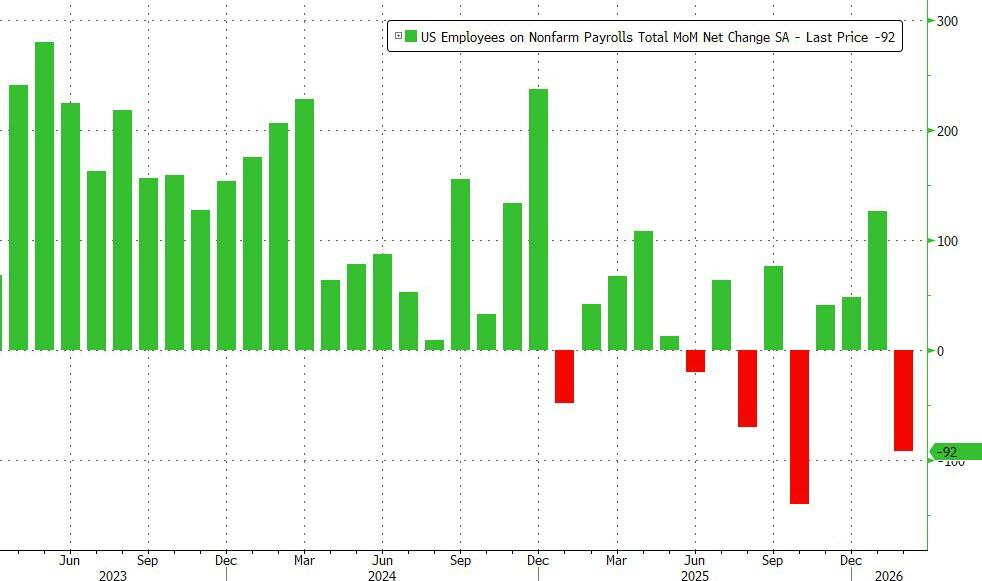
In our nonfarm payrolls preview, we quoted JPMorgan’s Market Intel desk which said that “for this print, the stronger the better”, which by implication means that a poor number would be bad. By that logic, the actual number couldn’t be any worse, because moments ago the BLS reported that in February, the US lost 92,000 jobs, a huge drop from the downward revised (of course) 126K in January, and the second worst print since 2020 (only October’s shock -140K was worse), and this time, the massive drop can’t be dismissed as a one-time drop in government payrolls. The number of private payrolls dropped by 86K, also a huge miss to estimates of a 60K increase.
-
CNN in Iran
-
AI and Data Centers
-
The Revised State of the Union
-
Ego
Israel and the United States are now the world’s pariahs.
-
Reality Check
Do you like watching the world go down in flames for one man’s ego? Or one man’s dream for Greater Israel?
Or is this war a diversion from the Epstein Files? It seems that everything impacting our lives negatively is the product of an evil government.
-
War Brings Economic Collapse
-
Regular People Know the State of the Economy
-
For Our Consideration
Global shipping relies on cheap insurance and security. The security was provided by the US Navy which subsidized the low cost of insurance. How will the loss of the “just in time” global shipping supply chain impact the world? The idea of Trump’s tariffs as a means of blackmail is now worthless. Cheap imports from China will be gone. Electronics and semiconductors will be restricted. Global shipping will collapse. The US will be impacted but third world countries will collapse and people will revolt. Good people do bad things when their children are starving.
Trump really screwed the world serving his Israeli masters.
Menu
CADD Graphics

Carolina Readiness Supply

Social Media and Websites
NC Renegade on TwitterNC Renegade on Gab
NC Renegade on Truth Social
Wes Rhinier on Gab
12 Round Blog
Barnhardt
Cold Fury
The Feral Irishman
Hammer’s Thor
Knuckledraggin My Life Away
Liberty’s Torch
90 Miles From Tyranny
Publius-Huldah’s Blog
Smoky Mountain Myco
Straight Line Logic
The Tactical Hermit
Western Rifle Shooters Association
Recent Comments
I believe this might be why military bases will be required to become self-sufficient for at least ninety days. The…
Just another glaring example of “it’s different when we (leftists) do it”.
Yes he was. First the traitors then the invaders. Judges should be judged by their actions just like you and…
Jim Risch is a disease of the skin. Todd Achilles is a disease of the heart. Risch is 83 and…


Win or lose the Marxists will most likely take to the streets anyway because this is what the demonrat Nazi…