
🔥 When diesel spikes, EVERYTHING spikes. Clothes, food, shipping, supply chains, and household basics all get dragged into the crisis. The oil collapse may hit right as America turns 250. @ProfessorPape breaks down the sequence. pic.twitter.com/Q1Rxll6pPO
— Redacted (@RedactedNews) June 6, 2026

Ivermectin Dosages
Free PDF Download of The Great Taking
The New Declaration of Independence
AppalachianRenegade YouTube Channel
Free PDF Download of The Great Taking
The New Declaration of Independence
AppalachianRenegade YouTube Channel
State collapse is inevitable when a society’s leaders are insulated from the negative consequences of their bad decisions.
Mike Shelby
Latest Articles
Click on the Title of the Article to View or Add Comments
-
The Consequences of the Supply Chain Breaking
-
Time for NPCs to Wake Up
-
Free Citizen?

Note: Yes, I know we’re a Republic and not a democracy, but it matters little at this point. Same result.
-
Nothing Changes
-
Do Not Forget
-
The Crooks’ Conspiracy Is Expanding
-
Economic Vigilance
The oil crisis has already exploded and the world’s reserves are depleted. Two more weeks or two more months are not accurately reflecting the true crisis: we are past the point of no return to a functional world economy. The world’s economies and distribution lines will take time to recover whenever this Israeli driven war ends. And that makes an assumption that most governments will recover.
While it is pointless to speculate how this crisis ends, let’s consider a best case scenario. The AI bubble has been exposed as a Ponzi scheme which will collapse the stock market. And banks. And the technology sector.
This is inevitable: the US debt will shortly breach the $40 trillion mark. Most Western nations are in the same economic situation. Oil is just one of many catalysts but it will be the scapegoat for the worldwide depression.
Couple economic collapse with massive civil unrest and governments will be falling quickly. It looks like French style revolutions are back on the menu. And as I said, that is a best case scenario.
-
When We Had Morals
-
The Confederate Way of War
When to fight? Only to protect one’s folk and land.
If it’s not for those reasons … just say no.
-
If You or Someone Close Wants to Join the US Military
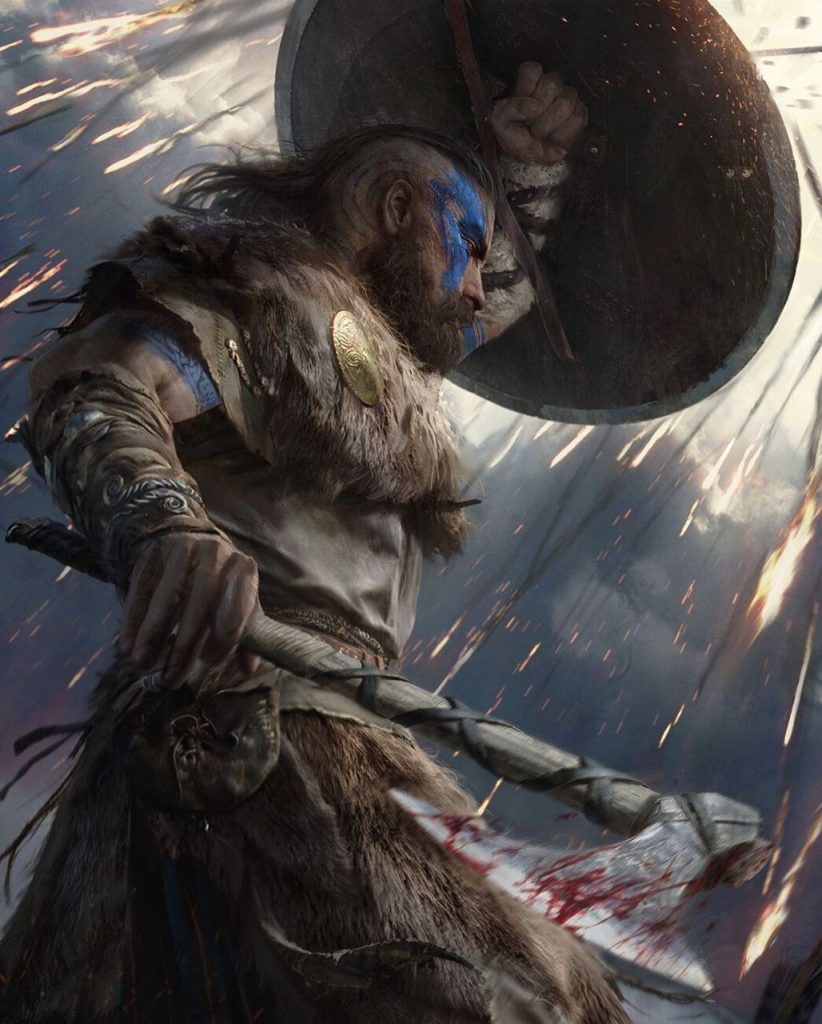
Note: What follows is from Pagan Revivalism Telegram channel. I have edited it to avoid enflaming the sensibilities of some readers. It should apply to Christians as well as followers of The Old Ways.
Though some may be called to be a warrior, you don’t have to join a force that is against you. Firstly, this fight is not our fight. Why leave to fight someone else’s war? This fight is between Iran and Israel, and we should not be involved. If the Israelis are too weak/cowardly to fight their war, that’s on them, not us. Millennials faced the same issue in Iraq and Afghanistan, fighting Israel’s wars for them and many coming back, traumatized, disabled and ending up losing the conflict. Say NO to GWOT 2.0!
More importantly though:
A. The fight is here at home. Some Christian and Catholic churches and Western governments imported invaders into our lands, why leave your family and friends defenseless to fight for sand-people over a pile of sand? The answer is to thin our folk of warriors, like you, so they can destroy our race with no resistance through faux conflicts overseas.
B. Why join an organization that hates you for being European or of European descent, and now hates you more for following the Gods of our Ancestors or your Christian God?
C. Why join an organization who’s mission, according to whistle-blowers, is to push for nuclear annihilation, to kill all life on Earth?
D. This conflict was pushed by the same administration which, in part, covered-up the Epstein scandal, lest their Israeli masters & powerful friends get implicated and exposed.
E. This unnecessary war is a waste of blood and money. If there are no volunteers, there’s no fight meaning no unnecessary loss of your life, and also the US is, as of now, over $39 trillion in debt with a dying economy. As the war continues, the worse our economic future, so be the solution by saying NO!
Being a warrior, defending one’s kin & land, is demanded of us by the Gods. If a fight is not defending or expanding one’s kin or one’s land it is not a fight that’s honored. Sometimes Germanics would serve as foreign mercenaries, particularly the Byzantine Varangian guard. There was a law, the Västergötlagen of Sweden, which stated that anyone who did so was cut-off from their ancestral inheritance. The ancestors, though originally not opposed to being a mercenary, later on were and for good reason. We should train, but not fight on behalf of our self-admitted enemy. What does Odin/Wotan say: “To his friend a man should bear him as friend, and gift for gift bestow, laughter for laughter let him exchange, but repay treachery with treachery. To his friend a man should bear him as friend, to him and a friend of his; but let him beware that he be not the friend of one who is friend to his foe.”
During this time, just like the Covid-era prior, we have to learn to say no. If you wish to be a warrior, train amongst your tribe, not on behalf of an enemy that hates you and wishes us to die. If things change in the future, awesome. But until they do, our folk should not join a war that will get them injured or killed in a far-away land on behalf of a foreign people, to weaken us and destroy our future. -
Albania Kicks Out Jared and Ivanka
-
If
Let me shorten this: it is past time to stand up against an evil tyranny.
-
This Is a Joke … Right?

I’ve read that the IDF has officers imbedded in the Pentagon, so how is this a threat when the US Military openly allow it?
-
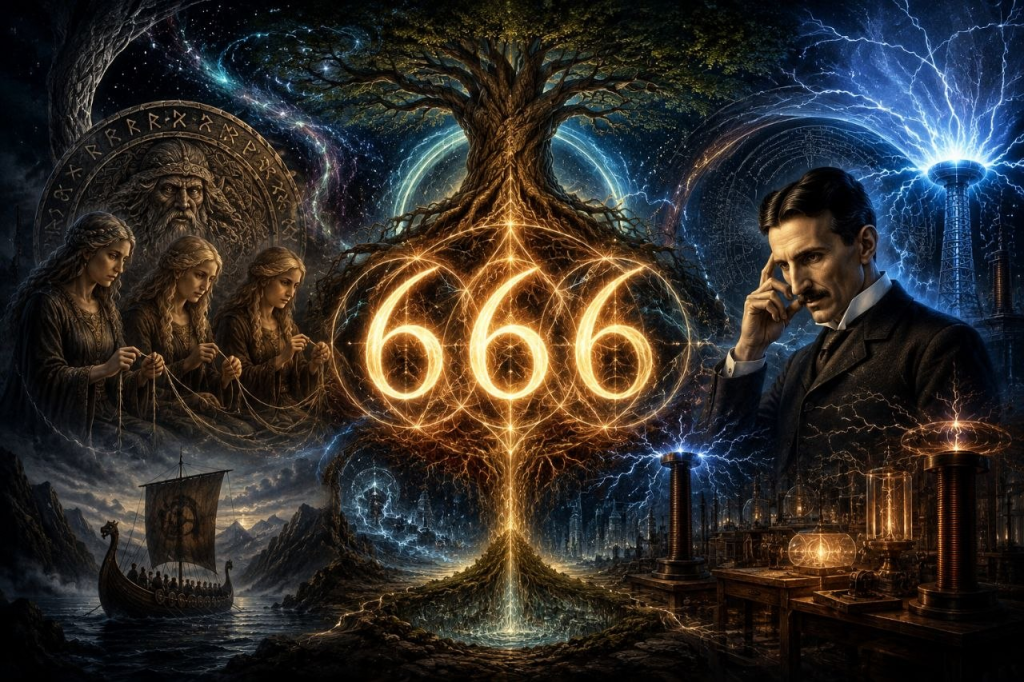
The Triple Six – Myth Between the Norse Peoples and Tesla’s Visions
From Huter der Irminsul
In the mists of the North, where the ancient Germanic and Norse peoples told their stories around the fire, the universe was not considered a collection of inanimate matter, but a living web of forces, sounds, and invisible currents. The worlds hung from the branches of the World Tree, and every movement of a leaf sent vibrations through the realms of gods, humans, and spirits.
Thousands of years later, Nikola Tesla spoke of a similar concept, albeit in a different language. Not the language of skalds and seers, but that of energy, frequency, and vibration. For him, the universe was a resonating chamber in which everything was interconnected. Where the ancients spoke of cosmic currents, Tesla spoke of electric fields. Where the priests drew runes, he designed circuit diagrams.
In ancient myths, we repeatedly encounter the number three. Three Norns weave the threads of fate. Past, present, and future form a sacred circle. From three arises the doubling to six—a number of reflection and harmony. It connects two triangles: heaven and earth, spirit and matter, origin and completion.
However, in many later religious interpretations, the number six acquired a different meaning. It was declared the number of imperfection because it lay just below seven, which was considered a symbol of divine perfection. When the triple repetition finally appeared—6, 6, 6—the symbolism changed completely. From a number of order, it became a sign of fear. Not because six was inherently evil, but because its triple repetition was interpreted as an exaggeration of the earthly.
From a mythological perspective, one could say: The triple six was “demonized” because it represented the power of matter, while religious symbolism emphasized the primacy of the spiritual. From this contrast arose a shadow image. The number was not condemned because of its mathematical nature, but because of the meanings that people ascribed to it.
Here, the ancient Norse myths and Tesla’s visions intersect in a surprising way. Both speak of hidden forces at work beneath the visible world. Tesla spoke of energies that could flow through the earth. Norse traditions told of currents flowing between the worlds, of forces hidden deep beneath the roots of the World Tree.
Thus, in a mythological interpretation, the triple six appears not as proof of evil, but as a symbol of an ancient reinterpretation: A number that was once part of cosmic order was transformed by cultural and religious developments into a sign of terror. The repetition of six changed from a pattern of resonance into a symbol of warning.
And perhaps Tesla would have seen in this further confirmation of his conviction: that numbers represent not only quantities, but patterns. That vibrations lie behind them. And that the meaning of a number often resides less in the number itself than in the stories people tell about it.
The triple six is therefore less a mathematical proof than a reflection of human mythology – a symbol of how order can become fear, harmony can become legend, and a number can become a mystery. -
We Lost Everything

Menu
CADD Graphics

Carolina Readiness Supply

Social Media and Websites
NC Renegade on TwitterNC Renegade on Gab
NC Renegade on Truth Social
Wes Rhinier on Gab
12 Round Blog
Barnhardt
Cold Fury
The Feral Irishman
Hammer’s Thor
Knuckledraggin My Life Away
Liberty’s Torch
90 Miles From Tyranny
Publius-Huldah’s Blog
Smoky Mountain Myco
Straight Line Logic
The Tactical Hermit
Western Rifle Shooters Association
Recent Comments
Elon is going to fill that role in the live remake.
The ones that don’t turn themselves in to be arrested have an appointment with a long, sharp, wood pole. Courtesy…
Unfortunately I live in one of the mostly blue counties in south Florida. But at least down here we’ve done…
Shut it down in Ukraine 100%. Let’s get the war over now.


Rebecca Bextel not wrong about democrat subversion in the Republican party in Wyoming. The R party is full of leftist…