


Ivermectin Dosages
Free PDF Download of The Great Taking
The New Declaration of Independence
AppalachianRenegade YouTube Channel
Free PDF Download of The Great Taking
The New Declaration of Independence
AppalachianRenegade YouTube Channel
State collapse is inevitable when a society’s leaders are insulated from the negative consequences of their bad decisions.
Mike Shelby
Latest Articles
Click on the Title of the Article to View or Add Comments
-
Ladies …
-
Raleigh Is Out of Control
-
Chinese Navy Deploying?
-
Where the Justification of Injustice Begins
From Huter der Irminsul
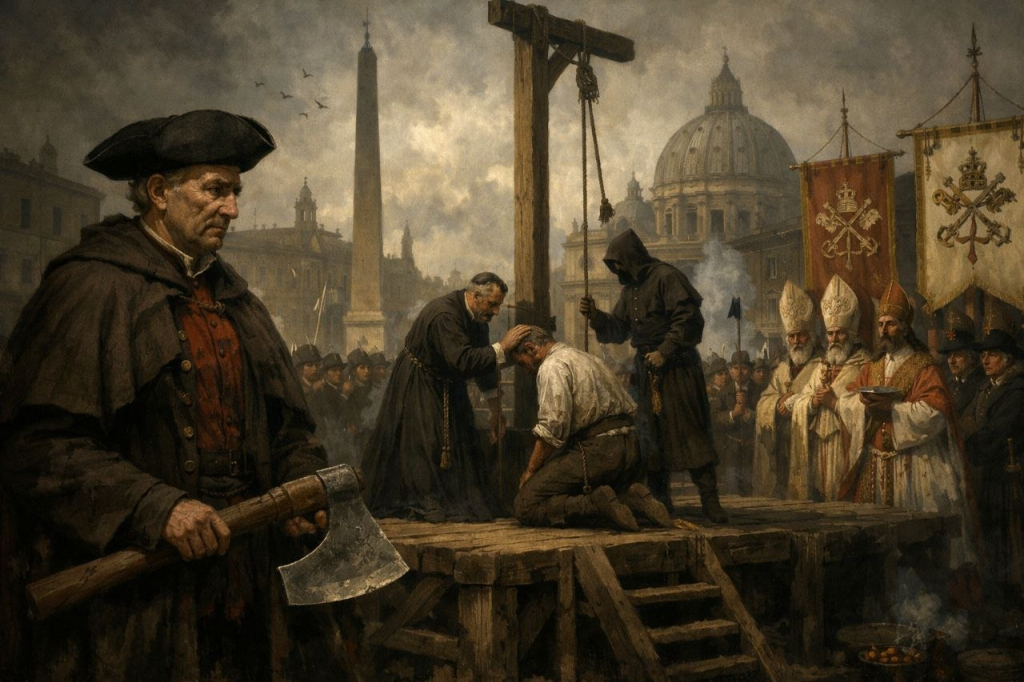
The figure of Giovanni Battista Bugatti is not a macabre historical curiosity—he is a case indictment. 514 executions in the name of a state that saw itself as a moral authority. 514 lives ended under the banner of order, justice, and—particularly cynically—Christian mercy.In the Papal States, violence was not an accident. It was institutionalized. Publicly staged in squares like the Piazza del Popolo, so that everyone could see what happens when you question the “divine order.” This was not just criminal justice—it was a demonstration of power.
And this is precisely where it becomes uncomfortable: The Church was not just a religious authority; it was political power. And political power defends itself. Often with the harshest means. Anyone who resisted, anyone who threatened the existing order—whether for criminal, political, or religious reasons—could be declared an enemy. Not because God demanded it, but because institutions want to maintain control.
The Church was not only a religious authority, it was a political power. And political power defends itself. Not infrequently with the harshest means. The oft-repeated story that people were executed en masse “simply because of their faith” is an oversimplification—but it does contain a kernel of truth: In a system that claims to possess the sole truth, dissent quickly becomes a threat. And where dissent becomes a threat, the path to violence is short.
Bugatti himself? Not a sadistic monster. That’s precisely what makes him so disturbing. He was dutiful, routine, almost banal. A man who got up in the morning and did what the state demanded of him—while this state invoked divine legitimacy.
That is the real scandal: Not the executioner, but the structure behind him. An institution that preaches charity while simultaneously upholding a system in which killing is part of the order.
When morality and power become inextricably intertwined, criticism becomes a threat—and violence becomes justification.
The story of Giovanni Battista Bugatti is not a distant echo from a barbaric past. It is a warning. 514 executions in the Papal States—carried out not in chaos, but in the name of order, morality, and divine truth.
This is the crux of the problem: violence that considers itself just.
This pattern can be seen throughout history. In the Spanish Inquisition, where “pure faith” became the justification for persecution. In the case of Giordano Bruno, who was burned at the stake because thinking was dangerous. In England under Henry VIII and Elizabeth I, where religion became a political weapon. And in the witch hunts of the Holy Roman Empire, where fear, faith, and power combined to form a deadly mixture.
The same formula is repeated time and again: An institution claims absolute truth → dissent becomes a threat → violence becomes a “necessity.”
Bugatti was no outlier. He was the logical consequence of a system that never had to question itself.
And this is precisely where the present begins.
Because anyone who believes these mechanisms have disappeared overlooks how little has fundamentally changed. Even today, institutions—religious and political alike—appeal to moral superiority. Even today, people are marginalized, persecuted, or silenced because they don’t fit into the prevailing worldview. Perhaps no longer in public squares with axes. But with laws, with social pressure, with digital ostracism, with violence on the fringes of society.
The methods change. The logic remains.
The truly dangerous element is not the fanatic. It is the system that legitimizes fanaticism. It is the structure that says: We are right—and therefore we are justified in acting.
That is precisely where the justification of injustice begins.
When an institution—whether church, state, or ideology—places itself above criticism, it becomes dangerous. When it considers itself infallible, it becomes blind. And when it begins to impose its “truth,” it becomes brutal.
The Bugatti story is therefore not a reason for mere outrage at the past. It is a touchstone for the present.The real question is not: How could that have happened back then?
But rather:
Where is it happening today – only in a different form, with different means, but with the same conviction of being right? -
Israel Is Winning?

-
Trump and the Spirit of Antichrist

For the Christian reader who holds to ‘end times’ theology comes the question; could Trump be The Antichrist? Interesting article from Unz Review:
Trump ticks several boxes:
– He opposes the spirit of Jesus Christ, who was meek, humble, hung out with the poor and despised the rich, opposed the Jewish bankers and drove them out of the temple, preached love and forgiveness and turn-the-other-cheek, and so on.
– Trump seems to be falsely claiming the savior role.
– Trump is the epitome of “lawless world leader.”
– Trump persecutes the genuine believers, whether Christians like Tucker Carlson and Candace Owens and Megyn Kelly and Prejean Boller, or Muslims like the Iranian leadership (and the other 2 billion Muslims).
– Trump demands worship. Stop bowing to him, and you’ll never work in his town again.
– And finally, though we are only in the sixth year of Trump’s eight-year “covenant,” he has permanently broken his main promise—to be a peacemaker. That is not quite “breaking a 7-year covenant” but it’s close enough. -
Revive the Koryos
-
Another Congressional Stain
-
Soon
-
Replacement Theory – Part II
-
Ibogaine
-
What a Farce
-
Want Proof …
… that we’re not as serious about Freedom as our Founding generation?


h/t WRSA
-
The Convenient Narrative
From Huter der Irminsul
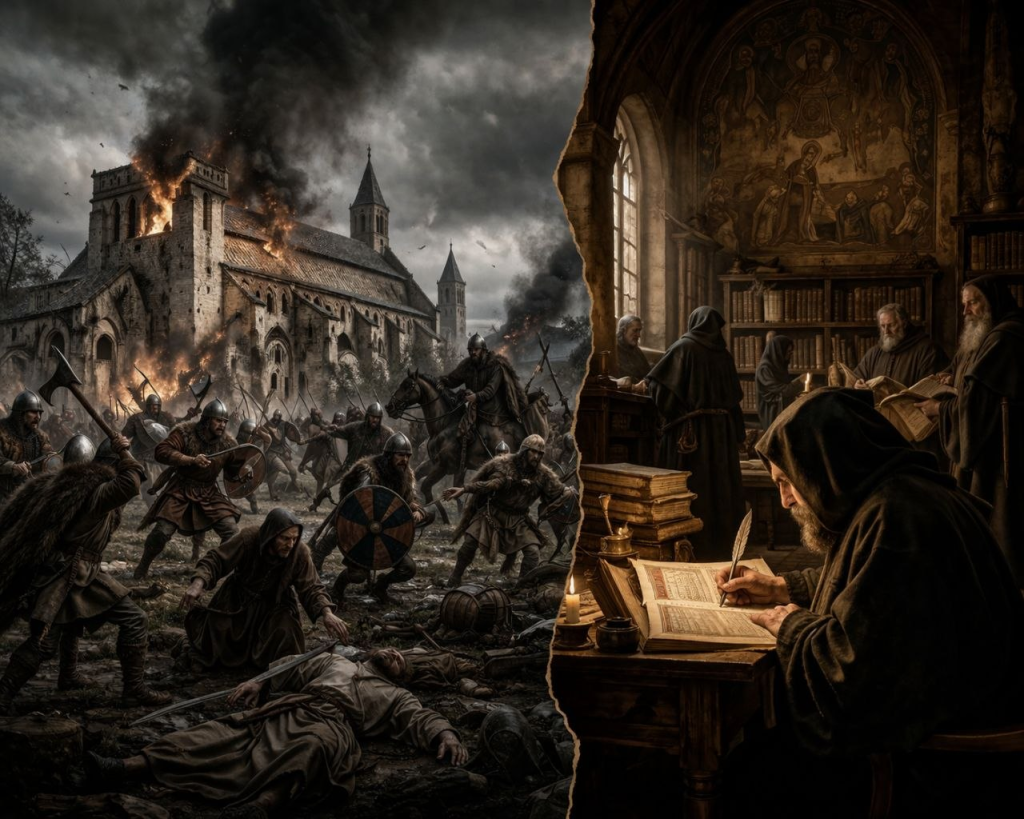
The convenient narrative goes like this: From the outside came the “barbarians,” the “heathens,” the enemies—and invaded Christian Europe. But this story is, above all, a perspective of those who wrote it down.
The uncomfortable reality looks different. While chroniclers lamented external aggressors, Christian princes had long been waging their own wars. They raided each other, plundered their own lands, and didn’t even spare churches and monasteries. The violence wasn’t an alien element—it was inherent to the system.
And who wrote about it? Precisely those monasteries that were affected. Their texts are not neutral reports, but interpretations. Raids were dramatized, atrocities embellished, events imbued with religious significance. Complex power struggles were reduced to a simple story: here the “Christian victim,” there the “heathen perpetrator.”
The result? A distorted view of history that continues to have an impact today. External enemies were stylized as symbols of evil, while internal violence was downplayed or pushed out of focus. Not because it didn’t exist—but because it was harder to fit into a morally clear narrative.
This doesn’t mean that attacks were fabricated from the outside. But their portrayal was selective, exaggerated, and ideologically biased. Anyone who truly wants to understand this period cannot be satisfied with the ready-made stories—but must ask: Who is telling what story here, and why?
Because the greatest deception in history is often not the lie itself, but the convenient oversimplification.Take a moment and consider what is here written. Then, ask yourself, can this be applied to the state of geopolitical actions by the United States since, say, the end of the American Revolution? About the War Between the States? About the World Wars? About the wars in Asia and the Middle East? And perhaps especially, at the current moment? Think about it …
-
Flynn Effect and Gen Z

Menu
CADD Graphics

Carolina Readiness Supply

Social Media and Websites
NC Renegade on TwitterNC Renegade on Gab
NC Renegade on Truth Social
Wes Rhinier on Gab
12 Round Blog
Barnhardt
Cold Fury
The Feral Irishman
Hammer’s Thor
Knuckledraggin My Life Away
Liberty’s Torch
90 Miles From Tyranny
Publius-Huldah’s Blog
Smoky Mountain Myco
Straight Line Logic
The Tactical Hermit
Western Rifle Shooters Association
Recent Comments
I hated mushrooms most of my life. And then my son starting doing research on mushrooms growing at the community…
We agree on planning and patience. I have near zero interest in fighting evil aka Equalizer. You and I have…
Steve, three words. Military Industrial Complex Also add in MIC kickbacks to all the neocon’s. Why has the pentagon never…
I’m not so sure the round up will work as some think. I believe there were some statistics put out…


Check out “MethylSulfonylMethane” as an inexpensive, bulk-sold supplement* with minimal risk; great for pain, especially the chronic types. *PureBulk.com [Apologies…